On a site development job, a wheel loader operator writes “hydraulic hose rubbing on frame” on the paper daily inspection. The sheet goes into a folder in the pickup. The same note appears for the next three days. On day five, the hose bursts while loading trucks. The example is a composite.
The operator did the inspection. The process still failed. A form can capture a condition without assigning someone to review it. A repair can happen without a record of what changed. Then nobody knows if the unit is ready, who owns the next step, or when it is due. A pre and post equipment inspection splits the work around each shift.
Paper can work when someone reviews it each day. A daily inspection checklist for heavy equipment gives operators a place to record what they see. The next step is to connect each failed item to an owner and an action. That connection is what equipment inspection software is for. This guide covers the four inspection types, a system checklist, the OSHA rules, and what to do when an item fails.

What is a Heavy Equipment Inspection?
A heavy equipment inspection is a planned check of a unit's condition and safety before, during, or after use. It finds visible damage, wear, leaks, and controls that are not working as expected, and it records what the inspector saw.
Inspections support safe operation, uptime, compliance, and an accurate condition record for the asset. The record is what lasts after the shift ends.
Inspection vs Preventive Maintenance
An inspection is not the same as preventive maintenance. Inspections identify conditions that require a decision or corrective action. Preventive maintenance follows a set schedule, by engine hours or by date.
The 4 Types of Heavy Equipment Inspections
Four common inspection types cover the cycle. A pre-use inspection happens before the first use of a shift. A post-shift inspection happens when the operator parks the machine. A periodic inspection happens weekly, monthly, or at a PM service. An annual or third-party inspection happens once a year, or when a client, insurer, or rule calls for one. The table below shows who does each one and what record to keep.
| Type | When | Who Does It | What It Covers | Record to Keep |
|---|---|---|---|---|
| Pre-Use (Daily) Inspection | Before first use or at the start of a shift | Operator | Visible condition, safety items, controls, attachments | Dated checklist with defects and actions |
| Post-Shift Inspection | At the end of a shift | Operator | New damage, leaks, wear, and issues from the shift | End-of-shift report with follow-up owner |
| Periodic Inspection | Weekly, monthly, or at PM service | Mechanic, equipment manager, or designated inspector | Condition, wear, and service-related checks | Checklist with findings and next steps |
| Annual or Third-Party Inspection | Annually, or as a client or insurer requires | Qualified person or third-party inspector | Required items for the equipment type and job | Inspection report with corrective actions |

A pre-use check asks whether the unit is ready for this shift. A post-shift check captures changes while the operator can still describe them. For road vehicles the same walkaround is usually run as a pre-trip inspection checklist.
Periodic reviews look for wear or service needs that may not stand out during a quick check. Annual or third-party inspections apply where a rule, client, or insurer calls for them.
Keep each inspection report with the unit's service history in your equipment maintenance software.
What Does OSHA Require for Heavy Equipment Inspections?

OSHA has no single rule that says inspect all heavy equipment every day. The duty for construction equipment is split across four places in 29 CFR 1926. 29 CFR 1926.20(b)(2) requires frequent and regular inspections by competent persons. 1926.601(b)(14) requires a beginning-of-shift check on jobsite motor vehicles, and 1926.601(a) excludes the earthmoving machines covered by 1926.602. 1926.602(a) sets equipment requirements for those machines and sets no inspection schedule. 1926.1412 sets shift, monthly, and annual inspections for cranes.
29 CFR 1926.20(b)(2) says an accident prevention program must provide for frequent and regular inspections of the job sites, materials, and equipment, made by competent persons designated by the employer. 1926.20(b)(3) says equipment that does not comply must be tagged or have its controls locked to make it inoperable, or be physically removed from its place of operation.
Motor vehicles that run inside an off-highway jobsite not open to public traffic fall under 29 CFR 1926.601. Paragraph (b)(14) calls for a check at the beginning of each shift. The named items are service brakes including trailer brake connections, the parking system, the emergency stopping system, tires, horn, steering mechanism, coupling devices, seat belts, operating controls, and safety devices. Lights, reflectors, wipers, defrosters, and fire extinguishers are included where that equipment is necessary. All defects must be corrected before the vehicle goes into service. Paragraph (a) states that this section does not apply to equipment covered by 1926.602, so loaders, dozers, graders, scrapers, and off-highway trucks sit outside it. For those machines the federal duty is the frequent and regular inspection in 1926.20(b)(2), plus what the OEM manual, the client, or a state plan adds.
For earthmoving equipment, 29 CFR 1926.602(a) sets requirements for seat belts, brakes, and audible alarms, and points to subpart W for rollover protective structures. The fender requirement in 1926.602(a)(5) is suspended under 1926.602(a)(8)(ii). A bidirectional machine needs a working horn. Earthmoving or compacting equipment with an obstructed view to the rear may not be used in reverse unless a reverse signal alarm is in operation or an employee signals that it is safe.
Forklifts and other powered industrial trucks follow their own rule. 29 CFR 1910.178(q)(7) requires an examination before the truck is placed in service, and at least daily after that. A truck that runs round the clock gets an examination after each shift. On a construction site, 29 CFR 1926.602(c)(1)(vi) points industrial trucks to ANSI B56.1. Our forklift inspection checklist covers the per-item detail.
A truck that runs on public roads as a commercial motor vehicle also falls under FMCSA rules. Before driving, the driver must be satisfied that the vehicle is in safe operating condition under 49 CFR 396.13. The driver files a driver vehicle inspection report, known as a DVIR, at the completion of each day's work when a defect is found, under 49 CFR 396.11. Every commercial motor vehicle gets a periodic inspection at least once every 12 months, under 49 CFR 396.17. The jobsite shift check does not replace any of them.
For cranes and derricks, 29 CFR 1926.1412 sets three cycles. A competent person must begin a visual inspection before each shift the crane is used, and finish it before or during that shift. Each month the crane is in service it gets the same inspection, documented with the items checked, the result, the inspector's name and signature, and the date. That monthly record must be kept for at least three months. At least every 12 months a qualified person inspects the crane.
OSHA defines the two roles in 29 CFR 1926.32, and the crane rules use the matching definitions in 1926.1401. A competent person can identify existing and predictable hazards and has authority to take prompt corrective measures. A qualified person has a recognized degree, certificate, or professional standing, or extensive knowledge, training, and experience, and has shown the ability to resolve problems relating to the work.
Quarry and aggregate sites, including sand and gravel operations, fall under MSHA, not OSHA. 30 CFR 56.14100 requires the equipment operator to inspect self-propelled mobile equipment before it is placed in operation on that shift. Defects that make operation hazardous require the machine to be taken out of service or tagged until they are corrected. Defects that affect safety and are not fixed at once must be reported to and recorded by the mine operator. A contractor working on a mining or logging site follows the mine rules.
This is a summary, not legal advice. State plans, owners, clients, and OEM manuals may add more.
Heavy Equipment Inspection Checklist
A heavy equipment inspection checklist covers nine systems: walkaround and structure; fluids and leaks; engine, cooling and exhaust; hydraulics; tracks, tires and undercarriage; attachments and ground-engaging tools; cab, controls and seat belt; lights, horn, alarms and mirrors; and ROPS, FOPS, guards and required safety equipment. A pre-use inspection is also called a pre-start or pre-operational check. How long the walkaround takes depends on the machine and the form. Time one on your own fleet before you set an expectation. Each item needs three things recorded: what was checked, what was found, and what happens next.
Use this system-by-system checklist as a starting point for loaders, dozers, excavators, graders, haul trucks, and attachments. Your OEM operator manual sets the check points and intervals. Adapt the form for each machine type.
Cold Checks and Running Checks
Some items are visible with the machine off. Others appear once it is running.
Before start-up: fluid levels, fresh drips on the ground, belt and hose condition, tire and track condition, structure and guards, the fire extinguisher, and the seat belt.
After start-up: gauges and warning lights, horn and backup alarm, lights, steering and brakes at low speed in a clear area, hydraulic functions through their range, and any new noise or smoke.
A leak under pressure shows itself on the running check. Keep hands and body clear while you look.
1. Walkaround and Structure
What to check: Walk around the unit. Look at the frame, steps, handholds, guards, pins, welds, and access points.
Failure signs: Look for cracks, bent parts, loose fasteners, missing guards, or fresh impact marks.
If it fails: Record the location and add a photo when possible. Ask a supervisor or mechanic whether the unit can run safely.
2. Fluids and Leaks
What to check: Check fluid levels and visible fluid condition at the points named in the operator manual. Look under the unit for fresh drips.
Failure signs: Note a low level, a new puddle, a strong fuel smell, or fluid on a hose, fitting, or surface.
If it fails: Record the fluid and location. A leak that affects safe operation needs a tag-out. Send other leaks for same-day review.
3. Engine, Cooling and Exhaust
What to check: Look at belts, hoses, radiator areas, intake parts, and exhaust supports. Check gauges and warning lights during startup. On a Tier 4 machine, check the DEF level and whether a regeneration is pending.
Failure signs: Note a damaged belt, loose hose, heavy smoke, unusual noise, rising temperature, or warning that stays on.
If it fails: Stop if a warning or condition makes continued use unsafe. Record the code or symptom for the shop.
4. Hydraulics
What to check: Inspect hoses, fittings, cylinders, exposed lines, and guards. Test the required functions at low speed in a clear area.
Failure signs: Look for rubbing, cuts, bulges, wet fittings, bent rods, or a control that responds unevenly.
If it fails: Keep people clear of a suspected pressurized leak. Report the exact location. Tag out the unit if the failure affects safe operation.
5. Tracks, Tires and Undercarriage
What to check: Check tires for condition and visible damage. Look at tracks, rollers, sprockets, wheels, and visible undercarriage parts.
Failure signs: Note cuts, bulges, loose or damaged track parts, missing hardware, or wear that changes how the unit sits.
If it fails: Record the side and location. Measure before you judge a tire. Use the limits in this tire inspection guide for construction equipment. Have a mechanic decide whether the unit can move.
6. Attachments and Ground-Engaging Tools
What to check: Check couplers, pins, locks, hoses, teeth, cutting edges, buckets, forks, and other installed tools.
Failure signs: Look for a missing lock, loose pin, cracked weld, damaged hose, or tool that moves when it should stay fixed.
If it fails: Use an attachment only when it is locked in place. Record the attachment and defect. Send the unit for review before work resumes.
7. Cab, Controls and Seat Belt
What to check: Check the seat belt, seat, steps, doors, windows, pedals, levers, and controls. Test key functions from the operator position.
Failure signs: Note a belt that will not latch, a blocked view, damaged control, or a pedal that sticks or does not return.
If it fails: Tag out the unit when the operator cannot control it safely. Record what failed and tell the supervisor before another operator starts work.
8. Lights, Horn, Alarms and Mirrors
What to check: Test lights, horn, backup alarm, mirrors, cameras, and other visibility aids fitted to the unit. These are the controls against struck-by and backover incidents.
Failure signs: Note a failed light, weak horn, alarm that does not sound, loose mirror, or view blocked by damage.
If it fails: A bidirectional machine needs a working horn under 29 CFR 1926.602(a)(9)(i). Earthmoving or compacting equipment with an obstructed view to the rear may not run in reverse unless the reverse alarm works or an employee signals that it is safe, under 1926.602(a)(9)(ii). Record the failed item and follow the rule that applies.
9. ROPS, FOPS, Guards and Required Safety Equipment
What to check: Check the rollover protective structure (ROPS), the falling object protective structure (FOPS), handrails, wheel chocks, the fire extinguisher, and the operator manual in the cab.
Failure signs: Note a cracked or modified ROPS, a missing guard or pin, a discharged or out-of-date extinguisher, missing chocks, or a bent handrail.
If it fails: Do not weld, drill, or modify a ROPS. Record the item and send the unit for review. Replace a discharged extinguisher before the next shift.
What Every Inspection Record Must Carry
Nine systems tell the operator what to look at. These fields tell the shop what they are looking at.
- Asset ID or unit number, plus the attachment fitted to it.
- Date, time, and the project or site.
- Hour meter reading, or odometer for a road truck.
- Inspector name and signature.
- Each item marked pass, fail, or not applicable.
- A note and a photo on every failed item.
- The outcome: repaired, deferred with a date, or tagged out.
- The name of the person who made that call.
What Changes by Machine Type
The nine systems hold for every machine. These items change with the machine.
- Excavator: track tension, swing bearing and its bolts, counterweight tail-swing clearance, boom and stick pins, quick coupler lock.
- Wheel loader: articulation joint and its lock pin, bucket pins and cutting edge, tire pressure, ride control.
- Dozer: blade pins and cutting edge, push arms, track sag, ripper shanks.
- Motor grader: circle and drawbar wear, moldboard end bits, tandem drive, blade lift cylinders.
- Haul truck: body hoist and safety prop, tailgate latch, body-up alarm, brakes and air system, load-bearing welds.
- Mobile crane: wire rope, hooks and latches, outriggers and pads, load chart in the cab, anti-two-block device.
How Often to Run Each Check
OEM manuals typically schedule service at engine-hour intervals such as 50, 250, 500, 1,000, and 2,000 hours. The hours below are common starting points, not a standard. Your OEM operator manual sets the real interval for each machine, and hard duty cycles shorten it.
| Check | Common trigger | Who runs it |
|---|---|---|
| Pre-use | Start of every shift | Operator |
| Post-shift | End of every shift | Operator |
| Weekly service check | 50 engine hours or one week | Operator or mechanic |
| Monthly service check | 250 engine hours or one month | Mechanic |
| Quarterly service check | 500 engine hours | Mechanic |
| Annual inspection | 2,000 engine hours or 12 months | Qualified person |

Heavy Equipment Inspection Best Practices

Eight habits separate an inspection program that catches problems from one that files them. The first four shape the form. The last four decide what happens after a failure is reported.
1. Use One Checklist per Asset Type
A haul truck and an excavator do not have the same parts or risks. Give operators a form that matches the unit and its installed tools. The right form lists the items that matter on that machine.
2. Make the Critical Items Required
Do not let the form accept a skipped safety check. Brake function, seat belt, steering, alarms, and attachment locks deserve clear prompts where they apply. Required fields make a blank answer visible during review.
3. Ask for a Photo on Every Failure
A photo can show the part, its location, and the condition at the time of the check. Ask operators to photograph the defect from a safe spot. A photo helps the shop decide what to inspect and what parts to bring.
4. Triage Every Failure the Same Day
Give every failed item an owner before the end of the day. The owner decides whether to repair it, defer it with a date, or tag out the unit. Clear handoffs matter the same way for operators, foremen, and shop staff.
5. Tag Out Equipment That Is Not Safe to Run
A tag-out should tell the next operator that the unit is not ready for use. Follow your site's lockout/tagout process for locking controls or moving the unit out of service. Mark the unit out of service where the next operator will see it. A tag that everyone reads the same way is a cheap control for construction safety management.
6. Defer Minor Items to the Next PM With a Date
Some defects can wait for planned work if a qualified person says the unit is safe to run. Record who made the decision, what work is due, and the date it must happen. A deferred inspection issue process keeps these items visible until the dated work comes due in preventive maintenance software.
7. Have a Supervisor Review and Sign Off
A supervisor should check that each reported issue has a status and owner. Sign-off confirms that someone reviewed the list. It also gives the next shift a record of what remains open.
8. Track Missed Inspections, Not Just Failed Ones
A blank inspection leaves the unit's condition unknown. Review which machines or crews missed a check in your equipment reports and analytics, then find out why. A due date and named owner make follow-up clear.
Worked Example: One Failed Item, Two Outcomes
All inputs and costs below are illustrative. The setting is a wheel loader on a site development job. The operator finds a hydraulic hose rubbing on the frame.
Path A: The note stays on paper. The operator records the hose on four daily sheets. Nobody assigns the repair. On day five, the hose bursts. The loader is down for two days. The crew cleans up fluid, requests emergency repair, rents a replacement, and waits for trucks.
Illustrative cost steps:
- Illustrative replacement rental: $1,200 per day × 2 days = $2,400.
- Illustrative repair parts: $480. Illustrative repair labor: 3 hours × $90 = $270.
- Illustrative cleanup: $600.
- Illustrative idle trucks: 3 trucks × 2 hours × $125 per hour = $750.
- Illustrative Path A total: $2,400 + $480 + $270 + $600 + $750 = $4,500.
Path B: The failure reaches the shop. The operator adds a photo. The shop gets the reported item the same day. The crew replaces a clamp and hose during a planned two-hour window at shift end.
- Illustrative repair parts: $480.
- Illustrative planned labor: 2 hours × $90 = $180.
- Illustrative Path B total: $480 + $180 = $660.
- Illustrative difference: $4,500 minus $660 = $3,840.
This leaves out costs that are hard to estimate, such as schedule effects beyond those truck hours. Not every rubbing hose bursts. Pick the rate you believe for your own fleet and multiply. The planned repair stays cheaper at any rate above roughly one in seven.
What to Do When an Item Fails
Every failed item gets one of four outcomes: stop now, fix today, defer to the next PM, or monitor. The outcome decides who acts and by when. Write the outcome on the inspection record, not in a hallway conversation. The table below shows the four levels, an example of each, and who makes the call.
| Severity | Example | Action | Who Decides | When |
|---|---|---|---|---|
| Stop Now (tag out) | Brakes do not hold | Stop use and tag out | Supervisor with qualified shop staff | Before operation continues |
| Fix Today | Steady hydraulic leak | Route to repair and confirm status | Shop lead or mechanic | Same shift |
| Defer to Next PM | Cracked mirror with another safe view available | Record repair task and due date | Supervisor or equipment manager | At next PM, by the dated plan |
| Monitor | Light seep with fluid level holding | Name an owner and a recheck date, then agree what makes it a repair | Supervisor or mechanic | At the stated check time |
Paper vs Digital Heavy Equipment Inspections

Paper is familiar. It works when someone checks each form daily. Digital inspections in an iOS and Android app can make it easier to attach a photo, route a defect, and see which checks are missing. The right choice depends on how the crew reviews and acts on each record.
- Legibility: Paper needs clear handwriting. Digital entries stay readable.
- Photos: Paper needs a separate photo or note. A digital record can keep the image with the failed item.
- Time and location: Paper needs the operator to write the date, time, asset, and project. Check that a digital record keeps the fields your review process needs.
- Shop follow-up: Paper needs a person to carry the failure to the shop. A shared queue can show reported items for same-day review.
- Missed checks and audit trail: A paper stack needs a daily review. Digital records can make missing forms and prior actions easier to find.
The format does not close the loop by itself. Assign a reviewer. Name who decides. Keep the repair or deferral record with the inspection in your work order software. If software is on your shortlist, our guide to the best construction equipment inspection software compares the leading platforms for 2026.
Common Gaps in Heavy Equipment Inspection Programs
Five gaps turn up again and again in inspection programs. Each one is a process gap, not an operator gap. Each one has a fix that takes a day to put in place.
- Pencil whipping: Pencil whipping is signing off a check nobody ran. A checked box does not show what the operator saw. Ask for a note when an item needs attention. A required photo on every failure makes an empty form easy to spot.
- One generic form for every machine: A single form can miss equipment-specific items. Match checks to the unit and its attachments.
- Failed items with no owner: A note without an owner can wait between shifts. Name the person who decides and acts.
- No record of the repair: A verbal update does not show what changed. Record the repair and who completed it.
- Skipping attachments and rental units: A crew can inspect the machine and skip its attachment or its rental unit. Include both in the site's check process, and keep rented machines on the same schedule in your equipment rental management software.
How Clue Supports Heavy Equipment Inspections
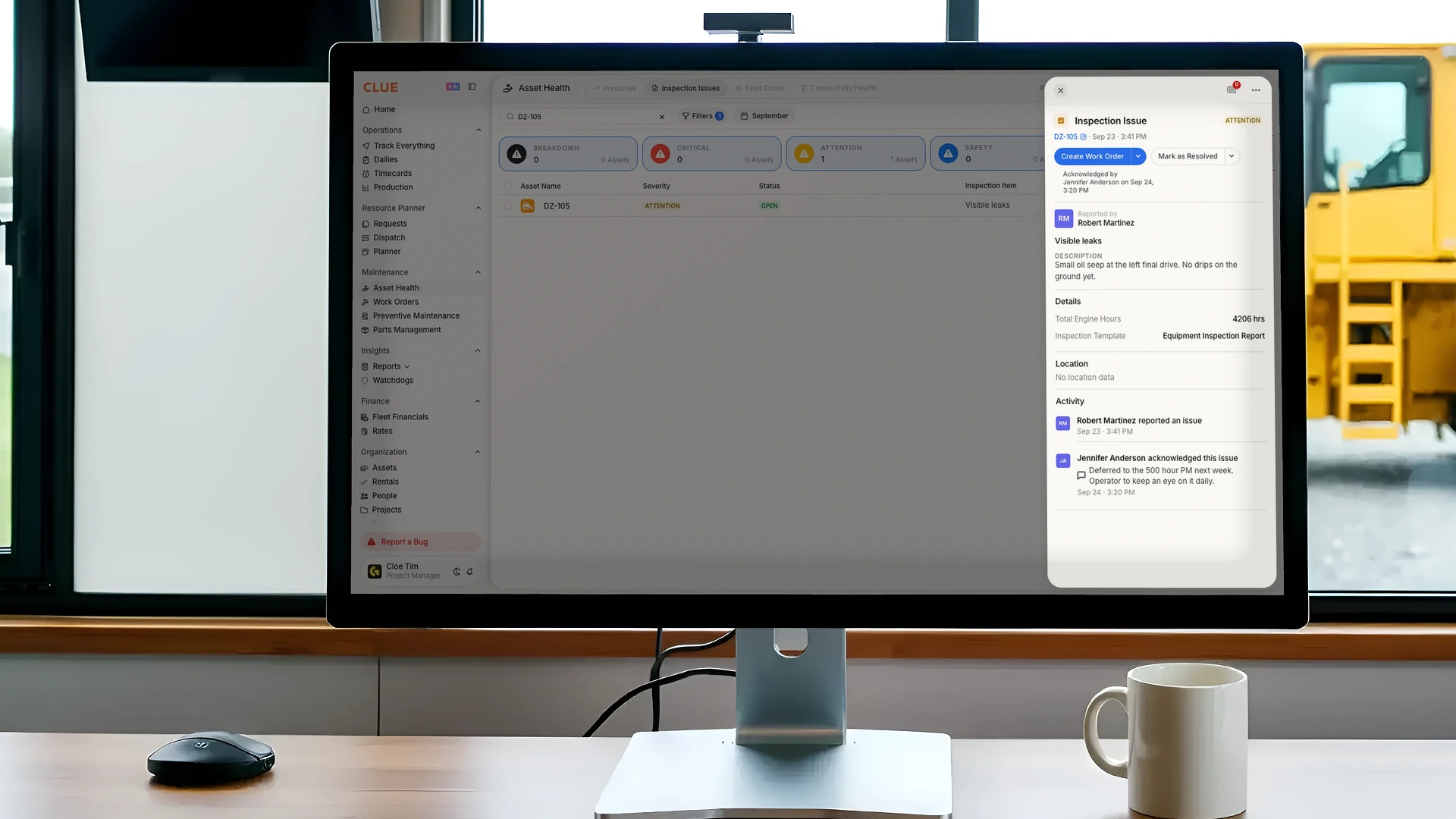
In Clue's equipment inspection software, you can create a QR code for any asset that opens its inspection form. Operators, lube truck drivers, and mechanics can start an inspection with a scan. Templates can mark items as required and prompt the operator when one is skipped. Camera items take live photos only. A defect needs a photo or file before it is submitted.
Inspections can require supervisor sign-off with Single Approval or Two-Step Approval. Reminders and a calendar show which inspections are due and which are done. The Inspection Summary Report shows Passed, Reported Issues, and Missing Inspections with a completion rate. You can filter it by project, crew, asset type, and template.
Reported defects stay in an inspection issues queue until resolved. You can fix an issue with a work order or defer it to the next PM. Failed checklist items become tasks on the work order they belong to. Inspection issues and telematics fault codes feed the same work order list. Crews can fill out and submit an inspection in the mobile app while offline. Completed reports from the last 24 hours stay readable on the device.
Final Thoughts
A hydraulic hose rubbing on a frame is a cheap fix. It gets expensive when nobody owns the next step. This week, choose one crew and review its last set of inspection sheets. For every failed item, record the owner, the decision, and the due date.
That review gives operators and shop staff a shared view of what is ready and what needs attention. One Clue customer, Palmetto Corp, caught a failing engine from an oil leak before it needed a $20,000 replacement. That was part of over $1 million saved in their first year (Clue case study, 2024). The catch is ordinary. The routing is what made it count.
Bring last week's inspection sheets to any demo you book.
Frequently Asked Questions
Does OSHA Require a Daily Heavy Equipment Inspection?
OSHA has no single rule that says inspect all heavy equipment every day. Jobsite motor vehicles must be checked at the beginning of each shift under 29 CFR 1926.601(b)(14). That rule does not reach the earthmoving machines covered by 1926.602, such as loaders, dozers, graders, and off-highway trucks. Cranes need a shift inspection by a competent person under 1926.1412(d). For the rest, 29 CFR 1926.20(b)(2) requires frequent and regular inspections of job sites, materials, and equipment by competent persons designated by the employer. This is a summary, not legal advice.
What Are the OSHA Heavy Equipment Inspection Requirements?
OSHA requirements depend on the equipment and the job. Jobsite motor vehicles need a beginning-of-shift check under 29 CFR 1926.601(b)(14), which does not apply to the earthmoving machines covered by 1926.602. Earthmoving equipment has seat belt, brake, and audible alarm requirements under 1926.602(a), with rollover protective structures covered by subpart W. The fender requirement is suspended under 1926.602(a)(8)(ii), and 1926.602 sets no inspection frequency. Cranes have shift, monthly, and annual inspection rules under 1926.1412. State plans, owners, clients, and OEM manuals may add more. This is a summary, not legal advice.
Does OSHA or MSHA Cover Equipment Inspections at a Quarry?
MSHA covers most quarry, sand, gravel, and aggregate sites. OSHA covers most construction sites. Under 30 CFR 56.14100(a), the equipment operator must inspect self-propelled mobile equipment before it is placed in operation on that shift. Defects that make continued operation hazardous require the machine to be taken out of service or tagged until they are corrected, under 56.14100(c). Defects that affect safety and are not corrected at once must be reported to and recorded by the mine operator, under 56.14100(d). A contractor working on a mine site follows the mine rules.
Do Haul Trucks Need a DOT Inspection on Top of the Jobsite Check?
Yes, when the truck runs on public roads as a commercial motor vehicle. The driver files a driver vehicle inspection report, known as a DVIR, at the completion of each day's work when a defect is found, under 49 CFR 396.11. The carrier keeps that report, the repair certification, and the driver review for three months. Every commercial motor vehicle also gets a periodic inspection at least once every 12 months, under 49 CFR 396.17. The beginning-of-shift check under 29 CFR 1926.601(b)(14) covers the jobsite, not the road.
What Does a Heavy Equipment Daily Inspection Checklist Include?
A daily checklist covers the unit's visible condition, fluids, engine area, hydraulics, tires or tracks, attachments, cab, controls, and safety devices. Use the OEM operator manual for equipment-specific points. Include space to record each defect, the person reviewing it, and the next action.
What Are the Four Types of Equipment Inspections?
The four common types are pre-use, post-shift, periodic, and annual or third-party inspections. Operators usually do pre-use and post-shift checks. Mechanics, equipment managers, competent persons, or qualified inspectors handle periodic and annual checks as required by the equipment and job.
What Is an Equipment Inspection Checklist?
An equipment inspection checklist is the list of items someone checks on a unit. It guides the review and captures the condition found. A useful checklist also records failures, photos when available, the person responsible, and whether the item was fixed, deferred with a date, or tagged out.
How Often Should Heavy Equipment Be Inspected?
Inspect heavy equipment before each use or at the start of each shift, unless a rule or the OEM manual sets a different interval. Add a post-shift check when your process calls for one. Set periodic intervals from the OEM operator manual, usually by engine hours or by a calendar date. Set annual intervals from the applicable rule and from client or insurer requirements.
Who Should Perform Heavy Equipment Inspections?
Operators commonly perform pre-use and post-shift checks because they use the unit during the shift. A mechanic or equipment manager can perform periodic checks. OSHA rules may call for a competent person or a qualified person for certain inspections. Follow the applicable rule and site process.
Who Inspects Rented Heavy Equipment?
Both sides have a part. The rental yard checks and documents the machine before it leaves the yard. The contractor inspects it on arrival, records its condition with photos, and runs the same shift checks as an owned machine for as long as it is on hire. Read the rental agreement, since it sets who pays for what. A dated arrival inspection also protects you in a return-condition dispute.
What Is the Difference Between a Competent Person and a Qualified Person?
OSHA defines both terms in 29 CFR 1926.32. A competent person can identify existing and predictable hazards and has authority to take prompt corrective measures to eliminate them. A qualified person has a recognized degree, certificate, or professional standing, or extensive knowledge, training, and experience, and has shown the ability to resolve problems relating to the work. Crane shift and monthly inspections call for a competent person. The annual crane inspection calls for a qualified person.
Does a Heavy Equipment Inspector Need a Certification?
OSHA does not name a certificate for a competent person. The test is whether the person can spot existing and predictable hazards and has authority to take prompt corrective measures, under 29 CFR 1926.32(f). A qualified person needs a recognized degree, certificate, or professional standing, or extensive knowledge, training, and experience, under 1926.32(m). Third-party programs offer inspector certificates for cranes and other machines. A client, an insurer, or a state program may require one even when the federal rule does not. Check what applies to your machine and your site before you assign the inspection.
How Long Should You Keep Equipment Inspection Records?
OSHA sets a period for some inspections. A monthly crane inspection record must be documented and kept for at least three months under 29 CFR 1926.1412(e)(3). The annual crane inspection record must be kept for at least 12 months under 1926.1412(f)(7). A truck that runs on public roads follows FMCSA rules, where the driver vehicle inspection report is kept for three months and the periodic inspection report is kept for 14 months. For other equipment, follow your company policy and any client, insurer, or state rule. Many fleets keep inspection records for the life of the asset as a condition record. That is common practice, not a general OSHA rule.
What Is Pencil Whipping on an Inspection?
Pencil whipping is marking an inspection complete without doing the check. It shows up as a sheet of all-pass boxes filled in one hand in under a minute. It hides real defects, and it makes the record worthless in an audit. Crews pencil whip when the form is too long for the time they have, when the machine is needed now, or when reporting a defect gets the operator blamed. Required items, a timestamp, and a photo on every failure make the practice visible.
What Are the Most Common Heavy Equipment Inspection Failures?
Five failures turn up again and again on construction fleets: hydraulic hose and fitting leaks, brake and parking brake problems, missing or dead safety devices such as a backup alarm or horn, worn tires and undercarriage parts, and cracks in a boom, frame, or weld. Most of them are visible from the ground. That is the case for running the walkaround before anyone climbs into the cab.
What Happens if OSHA Finds You Skipped an Equipment Inspection?
A missed check becomes a citation against whichever standard it breaks, such as 29 CFR 1926.20(b)(2) for the inspection program or 1926.601(b)(14) for the shift check. OSHA sets a maximum penalty for each class of violation and adjusts the figures each January, so check the current penalty table rather than an old number. A citation also puts the inspection record itself in evidence. That is why a dated record with a named owner matters more than the checklist.
Can an Operator Refuse to Run a Machine That Failed Inspection?
Yes, when the defect makes operation unsafe. 29 CFR 1926.20(b)(3) says equipment that does not comply must be tagged, have its controls locked, or be removed from service. Running it is the violation, not the refusal. OSHA protects a worker who reports a safety concern from retaliation under Section 11(c) of the OSH Act. The federal rule on walking off a task is narrow, so the better route is to report the defect, tag the machine, and get a supervisor decision on the record. Write the site rule down so the operator knows who to tell and what happens next.

Transform Your Equipment Management


