What is Construction Risk Management: Steps, Plan, and Template


Hi, I’m Maham Ali. I write about construction equipment management, helping teams use fleet data and maintenance intelligence to improve uptime, control costs, and run smoother jobsites.
Construction work combines moving parts that rarely sit still: labor availability, physical hazards, heavy assets, contract constraints, supply timing, design maturity, weather, and inspection pressure. Because those variables interact, one change can trigger a chain reaction that affects cost, time, quality, and safety at once. That reality is why risk management exists as an operational discipline rather than a theoretical checklist.
Construction hazard management helps teams prevent uncertainty from causing delays, losses, rework, disputes, or injuries. In mature organizations, it becomes a repeatable system with data, defined ownership, and execution tools. In newer organizations, it starts as a simple register and evolves over time.
This guide explains the process, components of a risk control plan, and how software supports it.
What is Construction Risk Management?
Risk management is a structured method to identify threats to objectives, evaluate their probability and consequence, decide responses, and monitor performance. The “objectives” are typically four outcomes: cost, schedule, quality, and safety, with compliance as a constant constraint.
A practical definition for field operations: It is the discipline of turning uncertainty into planned actions. That includes:
- Defining what could go wrong
- Understanding what it would cost if it happens
- Implementing controls that prevent or reduce damage
- Tracking whether controls are actually working
Why Risk Management is Critical in Construction
Risk is not only about catastrophic events. Many projects fail through accumulation: small misses that compound. A delayed delivery triggers resequencing. Resequencing creates congestion. Congestion increases safety exposure and slows productivity. Slower output creates overtime. Overtime drives fatigue. Fatigue increases error. Error creates rework. Rework creates dispute.
That’s why leadership matters. Senior oversight is needed to:
- Set tolerance thresholds (what level of exposure is acceptable)
- Ensure risk ownership is explicit (one person accountable per high-impact item)
- Fund controls that reduce downstream cost (training, inspections, planned maintenance, schedule buffers)
- Enforce consistent reporting without punishing transparency
Contractors who invest in safety training and advanced construction technologies achieve an approximately 59% reduction in injuries and accidents on job sites, demonstrating significant risk reduction potential when proactive risk controls are implemented.
When executives treat risk management in the construction industry as “paperwork,” field behavior mirrors that attitude. When leaders treat it as performance control, teams use it to make better decisions.
Common Risk Categories in Construction Projects
A category list matters because it prevents blind spots. Most teams naturally focus on immediate issues, rather than risks that are quietly accumulating.
1. Financial Exposure
This includes cash flow interruption, cost escalation, contingency erosion, and credit risk. A budget can look stable while payment timing creates liquidity stress. Monitoring should separate forecasted profitability from near-term cash availability.
2. Safety Exposure
This covers injury, fatality, and long-term health impacts, plus the operational consequences of incidents: stoppage, investigation, morale damage, and reputational loss.
3. Legal and Compliance Exposure
Code compliance, permit conditions, labor regulations, OSHA obligations, contractual disputes, and claims. The common failure mode here is poor documentation, not lack of good intentions.
4. Environmental Exposure
Weather events, contaminated soils, spill risk, dust/noise limits, erosion controls, and environmental permitting obligations.
5. Operational Exposure
Coordination failure, logistics constraints, productivity variability, staffing gaps, and process breakdowns.
6. Economic and Political Exposure
Funding shifts, inflation spikes, tariff changes, policy changes on public projects, geopolitical disruption of supply.
7. Unknown Conditions
Utilities, subsurface surprises, site access changes, third-party interference, unanticipated restrictions.
Equipment-related Risks in Construction Projects
Equipment is often where schedule, safety, and cost intersect. Treating it as a subtopic inside “operations” usually underestimates its impact.
Failure and Breakdown Exposure
A single critical asset outage can stall multiple crews. Risk here is not only mechanical. It includes parts availability, technician capacity, and repair authorization delays.
Availability and Utilization Exposure
Owning equipment does not guarantee readiness. An asset can be present but not usable due to inspection lapse, missing operator sign-off, unaddressed defects, or unresolved maintenance flags.
Improper Operation Exposure
Even well-maintained machinery becomes dangerous with wrong use: exceeding rated capacity, bypassing safety devices, using attachments incorrectly, or operating without proper ground conditions.
Deferred Maintenance Exposure
Postponed service is not neutral. It changes the probability distribution of failure, increases secondary damage when failure occurs, and raises the chance of unsafe operation.
Difference Between Hazard, Uncertainty, and Risk
These terms drive how teams respond.
- A hazard is a condition with potential to cause harm. Example: unprotected edges at height.
- Uncertainty is a lack of reliable information. Example: incomplete as-built drawings for buried utilities.
- Risk is the combination of likelihood and impact relative to objectives. Example: a high probability of weather delays during a planned exterior phase with no buffer and liquidated damages in the contract.
This matters because responses differ:
- Hazards usually require controls before work proceeds
- Uncertainty requires investigation, measurement, or contingency design
- Risk requires prioritization and resourcing based on exposure level
Identifying and Assessing Construction Risks
Risk identification must be systematic or it becomes a memory test.
Practical Identification Inputs
- Scope review broken down by work packages
- Site walkdowns during preconstruction and phase transitions
- Subcontractor means-and-methods reviews
- Equipment and access planning sessions
- Historical lessons from similar work types
- Review of contracts for scope gaps, exclusions, and notice requirements
Identification Techniques with Different Strengths
- Brainstorming workshops uncover what individuals miss alone
- Root cause analysis prevents repeating patterns like chronic rework
- “What-if” sequencing reviews find interdependency failures
- Supplier lead-time mapping surfaces schedule exposure early
Assessment Methods That Drive Prioritization
A risk matrix is the baseline: likelihood on one axis, impact on the other. For deeper control, add:
- Triggers (observable early warning signs)
- Leading indicators (signals before loss occurs)
- Response owner and deadline
- Residual exposure after controls are applied
A key improvement many teams miss: assess impact across multiple dimensions. One item may be low financial exposure but high safety exposure. Scoring should reflect that.
Inspection Integrity and Verification Risk
Many organizations have inspection processes. Fewer have inspection credibility.
Three common weak points:
- Completion without evidence (no photo, no timestamp, no signature)
- Checklists that allow skipping critical items
- Findings without closure (no linkage to corrective work)
The operational fix is to treat inspection as a control loop:
- Verification that the condition is checked
- Documentation that supports audits and incident review
- Closure tracking so defects do not persist across days or shifts
This is where risk management tools in construction add measurable value: mandatory fields, photo requirements, offline capture in poor-signal areas, and an audit trail that shows who checked what and when.
Primary Classifications of Construction Risks
Beyond broad risk categories, construction risks concentrate around three core classifications that directly affect project viability: financial, schedule, and design. These classifications reflect how risk ultimately materializes into loss, regardless of its original source.
- Financial risk relates to liquidity, margin erosion, and cash flow instability. It includes delayed payments, cost escalation, contingency depletion, and unplanned expenditures tied to change orders or rework. Financial exposure often emerges late, once corrective options are limited, making early identification critical. Poor financial risk control can halt progress even when field execution is sound.
- Schedule risk concerns the ability to meet contractual milestones and completion dates. It is driven by sequencing logic, labor availability, equipment readiness, permitting timelines, inspections, and interdependencies between trades. Schedule slippage rarely occurs in isolation; delays compound as downstream activities lose float and crews stack inefficiently.
- Design risk arises when construction proceeds with incomplete, uncoordinated, or unbuildable designs. This risk manifests through RFIs, rework, scope disputes, and productivity loss. Design risk increases sharply when construction overlaps with unfinished design, especially without clear change governance. These three classifications help leadership prioritize exposure based on business impact rather than surface symptoms.
Steps in the Construction Risk Management Process
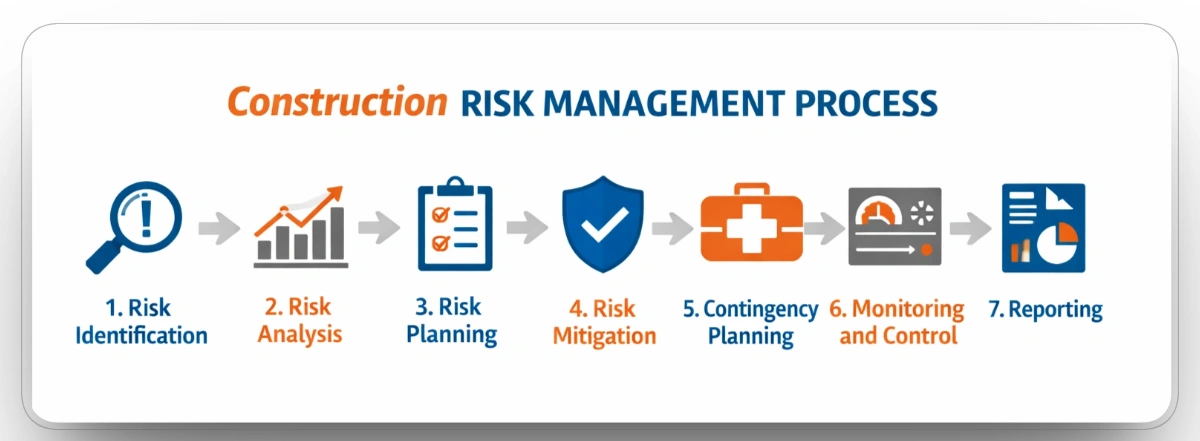
A structured construction risk management process ensures that uncertainty is handled consistently across projects, regardless of size or complexity. The process is cyclical, not linear, and must operate continuously throughout the project lifecycle.
- Risk identification establishes visibility by documenting threats tied to scope, site conditions, equipment, labor, logistics, and compliance. This step requires breaking work into executable components rather than relying on high-level assumptions.
- Risk analysis evaluates each identified risk based on probability, severity, detectability, and timing. This step determines which risks demand immediate controls versus monitoring.
- Risk planning defines response strategies, assigns ownership, and establishes thresholds for escalation. Planning also includes defining triggers that indicate when a risk is becoming active.
- Risk mitigation implements controls in the field, such as engineering changes, revised sequencing, safety barriers, inspection protocols, or maintenance schedules.
- Contingency planning prepares predefined responses for high-impact scenarios to reduce decision lag during live events.
- Monitoring and control tracks whether controls are functioning and whether exposure is increasing or decreasing.
- Reporting translates risk status into actionable information for decision-makers, ensuring timely intervention.
Risk Mitigation Strategies in Construction
Risk mitigation converts identified exposure into concrete action. Effective mitigation focuses on reducing probability, limiting impact, or both, depending on the nature of the risk.
- Contractual risk transfer allocates responsibility through scope clarity, indemnification clauses, insurance requirements, and flow-down provisions. While transfer reduces financial exposure, it does not prevent operational disruption, so it must be paired with execution controls.
- Insurance and bonding provide financial recovery mechanisms following loss events. Their effectiveness depends on policy alignment with project risks, proper endorsements, and strict adherence to notification and documentation requirements.
- Safety and compliance programs mitigate high-severity exposure by enforcing controls around hazardous activities, certifications, and regulatory requirements. Leading programs prioritize high-energy hazards and verification of compliance rather than policy volume.
- Robust project planning reduces uncertainty by aligning scope, sequence, labor loading, and procurement. Planning that accounts for constraints and variability prevents reactive decision-making.
- Quality control measures prevent defects that lead to rework and disputes. These include defined acceptance criteria, inspection hold points, and documentation standards.
- Continuous communication ensures all stakeholders understand evolving risks and mitigation actions, preventing misalignment across teams.
Preventive vs Reactive Maintenance Risk
Maintenance strategy is a critical but often underestimated risk control. Equipment reliability directly affects safety, productivity, and schedule predictability.
Preventive Maintenance
reduces failure probability by servicing assets based on usage, condition, and manufacturer guidance. Scheduled inspections, service intervals, and defect tracking distribute maintenance effort evenly and reduce catastrophic failures.
Reactive Maintenance
Concentrates failures during peak demand, increasing downtime, repair cost, and secondary damage. Breakdowns often occur mid-operation, introducing safety hazards and forcing schedule reshuffling.
Risk management in the construction industry increasingly treats deferred maintenance as an explicit exposure that must be documented, approved, and monitored. Linking inspections to maintenance workflows ensures asset readiness is continuously verified.
Managing Construction Risks in Practice
Risk response decisions must balance exposure, cost, and operational feasibility. Four response options exist, each with implications.
- Avoiding risk removes exposure entirely by changing scope, method, or sequence. This approach is effective for high-impact risks but may increase upfront cost or duration.
- Transferring risk reallocates financial responsibility through contracts or insurance. Transfer requires precise documentation and does not eliminate disruption.
- Minimizing risk reduces probability or severity through controls such as training, engineering solutions, inspections, or maintenance programs.
- Accepting risk acknowledges exposure and allocates contingency. Acceptance must be intentional, documented, and monitored to prevent unmanaged surprises.
Effective management requires selecting responses based on business tolerance, not convenience.
How Technology Strengthens Construction Risk Management Execution
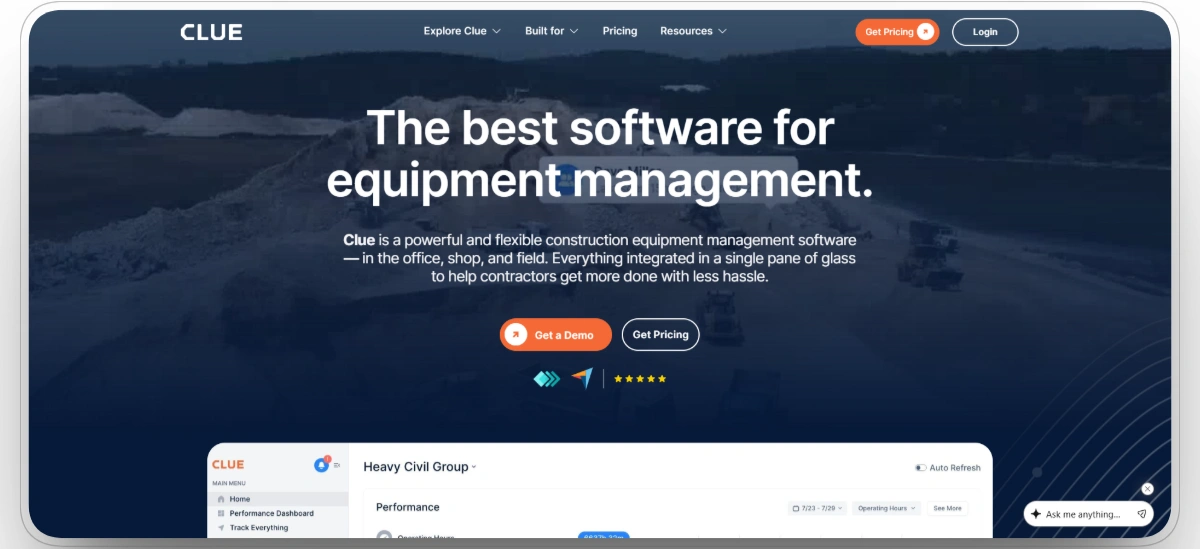
Identifying construction risks is not enough. The real challenge is enforcing controls consistently across jobsites, crews, and equipment. Construction risk management software helps translate plans into day-to-day execution.
Modern platforms like Clue support risk management in construction by closing execution gaps that commonly occur between planning and field operations.
1. Real-Time Safety and Risk Visibility
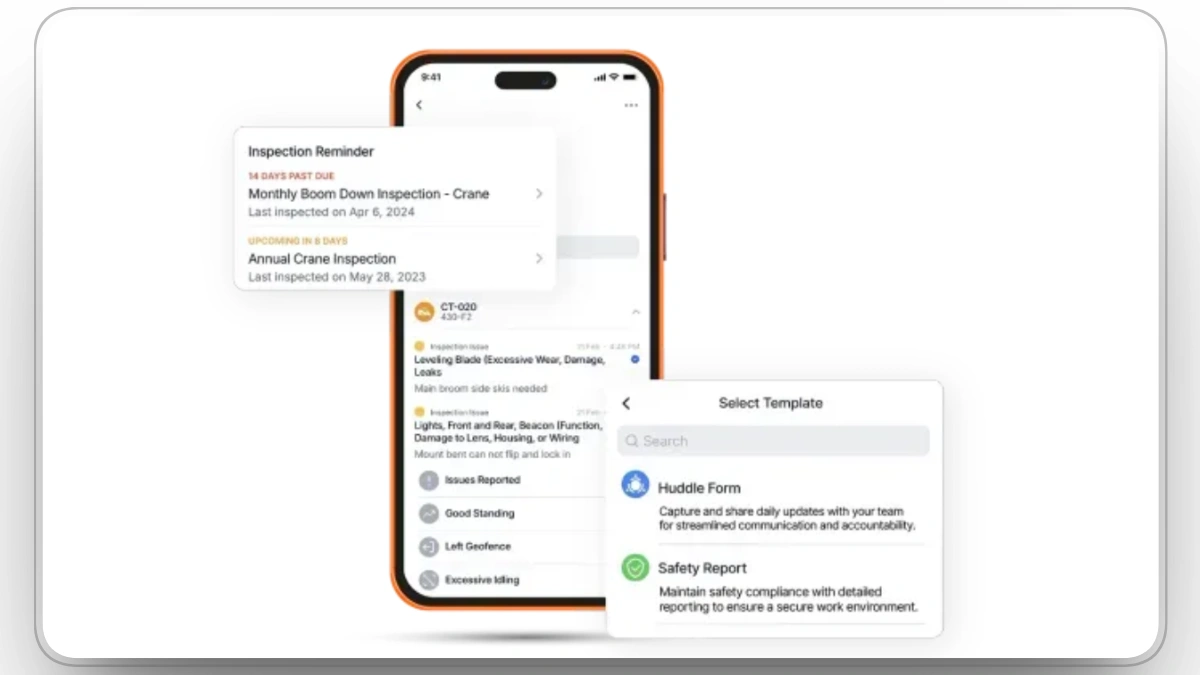
Delayed reporting weakens risk response. Field teams need to capture hazards and incidents as they occur. Clue enables real-time safety reporting and inspections from the field, improving early risk detection through its construction safety management software.
2. Verifiable Equipment Inspections
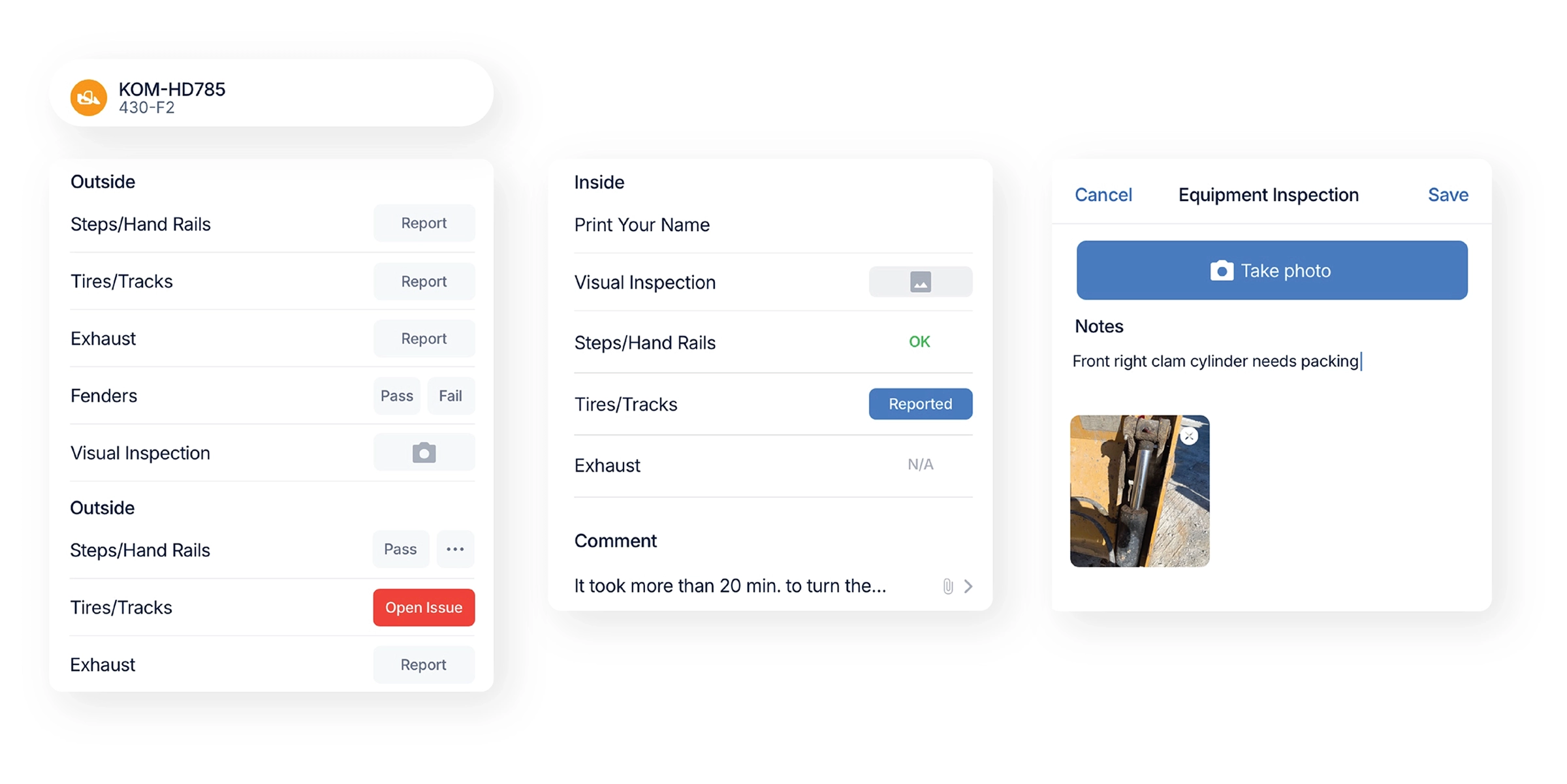
Paper inspections lack accountability. Missed or incomplete checks increase safety and compliance exposure. Clue enforces inspection completeness with required items and photo evidence, supporting stronger controls through digital equipment inspections.
3. Reduced Downtime Through Asset Visibility
Unexpected equipment failures disrupt schedules and budgets. Clue centralizes maintenance status and asset condition, helping teams plan preventive maintenance and reduce breakdown-related delays using construction equipment management software.
4. Stronger Compliance and Audit Readiness
Risk management requires defensible records. Clue consolidates inspections, incidents, maintenance logs, and corrective actions, supporting audit readiness through enterprise construction operations management.
5. Consistent Field Adoption
Risk controls only work if they are used. Clue’s mobile-first design allows operators and supervisors to complete inspections and reports quickly, improving participation through operator-focused construction software.

Benefits of Construction Risk Management
Strong risk management improves decision quality, reduces financial exposure, enhances safety outcomes, stabilizes schedules, and supports long-term business sustainability. Benefits compound over time as systems mature and lessons accumulate across projects.
- Improved Decision-Making: Provides leadership with timely, accurate risk data, enabling informed decisions on sequencing, resource allocation, and contingency use before issues escalate.
- Reduced Financial Exposure: Limits cost overruns, cash flow disruptions, and unplanned expenditures by identifying financial risks early and controlling them through proactive planning and governance.
- Enhanced Safety Performance: Lowers incident frequency and severity by identifying hazards, enforcing controls, and verifying compliance through inspections and corrective actions.
- Greater Schedule Reliability: Minimizes delays by anticipating constraints, managing interdependencies between trades, and responding quickly to emerging risks that threaten milestones.
- Stronger Operational Control: Improves visibility into equipment readiness, workforce capacity, and site conditions, allowing teams to maintain steady production and avoid reactive firefighting.
- Lower Dispute and Claim Risk: Strengthens documentation, traceability, and contractual compliance, reducing the likelihood and impact of claims, litigation, and project disputes.
- Improved Organizational Resilience: Builds repeatable processes that allow teams to respond effectively to change, recover faster from disruptions, and maintain performance under pressure.
Construction Risk Management Plan Template
A risk management plan in construction only works if it is structured clearly enough to be used, updated, and enforced throughout the project lifecycle. The following template represents a practical, field-tested structure that aligns with how construction risks are actually managed on active jobsites:
1. Project Information
- Project name and location
- Project type and scope description
- Contract type and delivery method
- Planned start and completion dates
- Owner, general contractor, and key stakeholders
2. Risk Management Objectives
- Define acceptable risk tolerance for cost, schedule, safety, and quality
- Identify risks that could materially impact project delivery
- Establish consistent methods for managing uncertainty
- Ensure regulatory and contractual compliance
3. Risk Register
Document all identified risks using a standardized register.
Required fields:
- Risk ID
- Risk description
- Risk category (financial, schedule, safety, design, equipment, compliance)
- Likelihood rating
- Impact rating
- Overall risk score
- Assigned risk owner
- Current status
4. Risk Assessment Matrix
- Define probability levels (rare to frequent)
- Define impact levels (minor to critical)
- Establish risk scoring thresholds for escalation
- Classify risks as low, medium, or high priority
5. Risk Mitigation Strategies
For each risk, document planned controls.
Mitigation types may include:
- Engineering or design changes
- Work sequencing adjustments
- Equipment inspections or maintenance actions
- Training or certification requirements
- Contractual or insurance measures
6. Contingency Planning
- Define trigger conditions for high-impact risks
- Document predefined response actions
- Identify decision authority for activation
- Allocate contingency time and budget
7. Inspection and Maintenance Controls
- Equipment inspection schedules
- Safety inspection requirements
- Defect reporting procedures
- Maintenance response timelines
- Verification and sign-off requirements
8. Monitoring and Review Process
- Risk review frequency
- Performance indicators used for monitoring
- Methods for tracking residual risk
- Escalation thresholds and response timing
9. Reporting and Communication
- Risk reporting format and cadence
- Stakeholders receiving risk updates
- Methods for communicating urgent risks
- Documentation standards for records
10. Compliance and Documentation
- Regulatory requirements addressed
- Audit and inspection records
- Change log for risk updates
- Approval and sign-off records
11. Continuous Improvement
- Lessons learned documentation
- Post-incident review process
- Updates to future risk plans
- Integration of historical data into new projects
12. Plan Approval
- Prepared by
- Reviewed by
- Approved by
- Approval date
13. Plan Review Schedule
- Planned review intervals
- Triggers for interim updates
- Responsibility for plan maintenance
Challenges in Construction Risk Management

While risk management is essential, implementing it effectively presents several practical challenges. These obstacles often stem from the complexity of construction environments, fragmented teams, and inconsistent execution rather than a lack of awareness.
- Constantly Changing Site Conditions: Construction sites evolve daily as work phases progress, crews rotate, and equipment moves. Risks identified during planning can quickly become outdated if the risk management process is not continuously updated to reflect real-time conditions.
- Fragmented Stakeholder Coordination: Multiple subcontractors, suppliers, inspectors, and owners operate with different priorities and communication styles. Without a unified risk management approach, responsibilities become unclear, leading to gaps in mitigation and delayed responses.
- Inconsistent Risk Identification and Reporting: Risks are often identified informally or inconsistently across teams. When reporting methods vary, critical information may not reach decision-makers in time to prevent escalation.
- Limited Field-Level Adoption: Risk management processes may be well-defined at the management level but poorly executed in the field. Complex documentation, time pressure, and lack of practical tools discourage consistent participation by crews and supervisors.
- Reactive Decision-Making Under Schedule Pressure: Tight timelines often force teams to prioritize short-term progress over long-term risk control. This can result in deferred maintenance, skipped inspections, or unapproved scope changes that increase exposure.
- Data Silos and Poor Visibility: Risk-related information is frequently spread across spreadsheets, emails, and disconnected systems. This fragmentation limits real-time visibility into risk status and reduces the effectiveness of monitoring and control efforts.
- Maintaining Up-to-Date Documentation: Keeping risk registers, inspection records, and mitigation plans current requires discipline and ownership. Outdated documentation creates false confidence and weakens compliance and audit readiness.
- Balancing Cost with Risk Reduction: Investing in preventive controls, training, and technology can be challenging when budgets are tight. Demonstrating the long-term value of risk reduction versus short-term cost savings remains a common hurdle.
Conclusion
Construction risk management is not a one-time planning exercise or a compliance requirement; it is an operational discipline that determines whether projects stay controlled or spiral into delay, loss, and dispute. Because construction environments are dynamic, risk must be managed continuously, with clear ownership, verified controls, and timely decision-making.
Projects that succeed do not eliminate risk; they anticipate it, prioritize it, and respond to it systematically. By combining structured processes, disciplined execution, and the right construction risk control tools, teams can convert uncertainty into manageable variables. Over time, this approach improves predictability, strengthens safety performance, protects margins, and builds organizational resilience across projects and portfolios.
In an industry where change is constant, effective risk management is what allows construction teams to move forward with confidence rather than react under pressure.
Frequently Asked Questions (FAQs)
1. What is the primary goal of construction risk management?
The primary goal is to identify potential threats early, evaluate their impact on cost, schedule, safety, and quality, and implement controls that prevent disruption or reduce consequences before losses occur.
2. How is risk management in construction different from general project risk management?
Construction hazard management focuses heavily on physical hazards, equipment readiness, site conditions, regulatory compliance, and trade coordination, factors that are far less prominent in office-based or manufacturing projects.
3. When should construction risk management begin?
Risk management should begin during preconstruction and continue throughout the project lifecycle. Early identification allows teams to influence design decisions, sequencing, procurement, and contract strategy before constraints become fixed.
4. What is included in a construction hazard management plan?
A Construction Hazard Management plan typically includes a risk register, risk matrix, assigned owners, mitigation strategies, contingency governance, monitoring methods, reporting structure, and documentation standards for inspections and corrective actions.
5. How does equipment maintenance affect construction risk?
Equipment reliability directly impacts safety, productivity, and schedule performance. Deferred maintenance and incomplete inspections increase the likelihood of breakdowns, downtime, and secondary incidents, making maintenance a critical risk control.
6. Does using construction risk management software replace manual oversight?
No. Software supports consistency, visibility, and documentation, but it does not replace leadership judgment or field supervision. It strengthens execution by enforcing processes and providing real-time data for better decisions.
7. What are the most common reasons risk mitigation fails?
Common failures include inconsistent field adoption, outdated documentation, fragmented reporting, unclear ownership, and treating risk management as paperwork rather than an execution tool.
8. How do organizations improve risk control over time?
Improvement comes from monitoring outcomes, analyzing what went wrong or right, refining processes, closing corrective actions, and using data from past projects to inform future planning and controls.
Transform Your Equipment Management
%20What%20It%20Is%20and%20What%20to%20Include.webp)