Diesel engine maintenance is the scheduled work that keeps an engine’s oil, fuel, air, coolant, and exhaust aftertreatment clean and within spec. On heavy equipment it runs on engine hours, with daily operator checks, tiered services, and calendar and condition triggers layered on top.
An excavator on a busy site throws a high coolant temperature warning in the middle of the afternoon. The 500-hour service was due weeks ago. The engine hour reading in the office spreadsheet was a month old, so nobody knew. The crew now has a machine to check and a job to keep moving.
Most fleets know their engines need service. The schedule lives in manuals, sticky notes, and memory. Hours pass without anyone seeing them.
Fleets can track engine hours in Clue’s equipment maintenance software and can see service coming before a warning takes a machine out of work. This guide covers what each engine system needs, daily checks, hour-based service, calendar and condition triggers, fluids, emissions care, oil analysis, warning signs, seasonal care, and a five-step fleet plan.
What Maintenance Does a Diesel Engine Need?
A diesel engine needs clean oil, clean fuel, clean air, the right coolant, and a healthy exhaust aftertreatment system, each checked on a fixed routine. The table shows what each system protects and the core tasks that go with it.
| System | What It Protects | Core Tasks |
|---|---|---|
| Lubrication | Bearings, liners, pistons, turbocharger | Check the level daily; change oil and filter on the hour interval; take an oil sample at each change |
| Fuel | Injectors and the high-pressure pump | Drain the water separator; replace primary and secondary fuel filters; keep storage tanks clean and dry |
| Air intake | Cylinders, piston rings, turbocharger | Service the filter by its restriction indicator; inspect intake piping and clamps |
| Cooling | Cylinder head, liners, EGR cooler, water pump | Check level and concentration; keep cooler fins clear; change coolant by hours or by test |
| Aftertreatment | Diesel particulate filter (DPF), selective catalytic reduction (SCR) catalyst, exhaust gas recirculation (EGR) valve and cooler | Let regens finish; use clean ISO 22241 DEF; clean or replace the DPF when ash builds up |
| Starting and charging | Batteries, starter, alternator, glow plugs or intake heater | Clean terminals and ground straps; test batteries before winter; inspect the alternator belt |
| Mechanical | Valve train, belts, engine mounts | Adjust valve lash; inspect belts, tensioners, hoses, and mounts |
Do Diesel Engines Need More Maintenance Than Gas Engines?
Diesel engines need different maintenance, and each service usually costs more. A diesel ignites fuel by compression, so it has no spark plugs or ignition system to service. It injects fuel at very high pressure, which makes clean fuel critical, and it makes more soot, which loads the oil and the exhaust filter. Most current heavy equipment diesels also carry a DPF, DEF, or both. In return, the engine is built to work under load for a long service life.
Why Heavy Equipment Diesel Engines Need Their Own Schedule

Heavy equipment service follows engine hours because off-road machines do not track work by miles. An hour at idle still counts on the meter, even when the machine moves no material. The meter gives you a record of engine run time, not the amount of useful work completed.
Dust, heat, heavy loads, and short work cycles put stress on oil, filters, and cooling systems. Machines may also run for long periods at low speed or shift between hard work and idle time. Those conditions can change what the engine needs compared with a machine used in steady conditions.
Modern diesel engines also have emissions systems that need care. A diesel particulate filter, selective catalytic reduction system with diesel exhaust fluid, and exhaust gas recirculation system each add inspection or service needs. The right tasks depend on the engine and its manual.
One fleet can have engines of different sizes and ages, each with its own service schedule. A single fleet-wide calendar rule for oil changes will not fit every machine. Start with the schedule in each engine manual. Use it to set the service baseline for that engine.
Hours or Miles: Which Meter Fits Each Asset?
A construction fleet rarely runs on one meter. Off-road machines count hours and on-road trucks count miles. Vocational trucks that idle on site or run a PTO need an hour limit as well, because that work adds wear without adding miles.
| Asset | Primary Trigger | Add a Second Limit For |
|---|---|---|
| Excavators, dozers, loaders, graders | Engine hours | Calendar time on seasonal machines |
| Generators, light towers, pumps, compressors | Engine hours | Calendar time, since standby units can sit for months |
| Dump trucks, water trucks, lowboys | Odometer miles | Engine hours, to cover idling and PTO work |
| Pickups and service trucks | Odometer miles or the oil-life monitor | Calendar time on low-mileage trucks |
Towing, short trips, and long idle time put an on-road truck on the severe-duty schedule in its manual.
Daily and Weekly Diesel Engine Checks
The daily checks are engine oil level, coolant level, DEF level, the fuel water separator, the air filter restriction indicator, belts and hoses, and leaks or warning lights. Radiator and cooler fins get a weekly look, or a daily one in dusty work.
Operators can do the daily checks at the start of a shift. Oilers or lube techs can repeat key fluid checks while fueling. A short, written routine helps the team spot a change and report it to the shop.
| Check | When | What to Look For |
|---|---|---|
| Engine oil level | Daily | Level between the marks, no milky or fuel-thinned oil |
| Coolant level | Daily, engine cold | Level in range, no oil film, no leaks at hoses |
| DEF level | Daily | Tank filled from a clean, sealed container |
| Fuel water separator | Daily or per manual | Drain water and sediment |
| Air filter restriction indicator | Daily | Change or service the filter when the indicator says so, not on a guess |
| Belts and hoses | Daily walkaround | Cracks, fraying, soft or swollen hoses |
| Leaks and warning lights | Daily | Fresh drips under the machine, any active warning or fault on the display |
| Radiator and cooler fins | Weekly, daily in dusty work | Packed dirt or debris blocking air flow |
A failed check should become a written issue with a photo that reaches the shop, not a verbal note. Use inspections to give operators a clear way to report what they find. Teams that still work on paper can start from a printable daily inspection template.
How Often to Service a Diesel Engine: The 250, 500, 1,000 and 2,000-Hour Ladder
Many heavy equipment diesel engines are serviced every 250 hours, with larger services at 500, 1,000, and 2,000 hours. Each larger service includes the smaller service tasks that come due at the same time. These are common examples. The engine manual and the oil and fuel you use set the real intervals.
| Interval | Typical Engine Tasks |
|---|---|
| Every 250 hours | Change engine oil and oil filter on many engines, with some running 250 to 500 hours; take an oil sample; check coolant concentration; drain the water separator; grease points per manual |
| Every 500 hours | Everything at 250, plus replace fuel filters, inspect the air intake system, test coolant condition, check the crankcase breather, and clean battery terminals and ground straps |
| Every 1,000 hours | Everything at 500, plus inspect belts and tensioners, inspect hoses and clamps including charge air piping, check engine mounts, and check DEF system filters where the manual calls for it |
| Every 2,000 hours | Everything at 1,000, plus check and adjust valve lash where the manual calls for it, inspect the turbocharger, inspect the aftertreatment system, and change coolant if it is due by hours or by test |
Dusty sites, high heat, long idle time, heavy loads, and poor fuel can call for shorter intervals. The manual usually lists a separate severe-duty schedule. New and rebuilt engines often have an early first service as well, so add it as a one-time task. A preventive maintenance plan can help the shop assign the right tasks to each machine.
Calendar and Condition Triggers That Hours Miss

Hours are the main service trigger. They miss two kinds of changes: time passing while a machine sits, and signs that its condition has shifted. Use both types of triggers alongside the hour-based schedule.
Calendar Triggers for Machines That Sit
Oil, coolant, fuel, and DEF can age even when an engine does not run. Seasonal machines and backup units need a time limit as well as an hour limit. A common example is “every 250 hours or every 6 months, whichever comes first.” The engine manual sets the interval for each machine.
Batteries and stored fuel also change over time. Add a calendar task for the parts of the machine that still need attention while it sits. Record the last check so the team can see when the next one is due.
Condition Triggers That Move a Service Up
An oil analysis result, a filter restriction indicator, a rising number of DPF regenerations, repeated fault codes, or a failed fluid check can signal that work should happen now. These signs can point to a change the hour meter will not show.
Set a clear next step for each signal. The shop may need to inspect the machine, take another sample, or open a work order. Condition-based maintenance helps you use those signs to adjust the timing of planned service.
Oil, Fuel, Air and Coolant: What Each System Needs
Four systems carry most of the routine work on a diesel engine. Each has a spec to match and a kind of damage it prevents.
Engine Oil: Which Oil Does a Diesel Engine Use?
Use the oil category and viscosity grade listed in the engine manual. For most current heavy equipment that is an API CK-4 oil. API describes CK-4 oils for engines that meet Tier 4 non-road emission standards, and they also cover engines that call for the older CJ-4, CI-4, and CH-4 categories. SAE 15W-40 is the common grade, with 10W-30 or 5W-40 for colder weather where the manual allows.
API FA-4 oils are a separate, thinner category that is not interchangeable or backward compatible with CK-4, so use one only where the manual lists it. The oil spec also affects the DPF: ash from burned oil additives collects in the filter and does not burn off in a regen.
Fuel System: Keep Water and Dirt Out
Common-rail injection systems run above 29,000 psi (2,000 bar) with very tight clearances, so small amounts of water or dirt can wear injectors and pumps. Most fuel care happens before the fuel reaches the engine.
- Drain the water separator daily or per the manual.
- Replace the primary and secondary fuel filters together at the interval in the manual, often every 500 hours.
- Prime the system with the hand or electric primer after a filter change. Do not pre-fill a new filter with unfiltered fuel unless the manual allows it.
- Fill machines at the end of the shift so less moist air sits in the tank overnight.
- Check site tanks and fuel trucks for water, which lets microbes grow and plug filters.
Filters that plug before their interval point to the fuel supply. Check the tank the machine was filled from.
Air Intake: Service by Restriction and Protect the Seal
Dust that gets past the air filter wears piston rings and liners quickly. Service the filter when the restriction indicator calls for it, since opening the housing early risks dropping dirt into the clean side. Replace a dirty element unless the manual allows cleaning, and do not clean the inner safety element.
At each service, inspect the piping and clamps between the filter and the turbocharger, where a loose clamp lets unfiltered air bypass the filter. Check the charge air piping after the turbocharger as well. A boost leak costs power and sends more soot to the DPF.
Cooling System: Match the Coolant and Test It
Cummins estimates that over 40% of all major engine repair costs originated because of improper cooling system maintenance. Coolant inhibitors protect against corrosion, scale, and the liner pitting that wet-sleeve diesel engines are prone to.
- Use the coolant type the manual names and do not mix types.
- Keep an ethylene glycol mix near 50% coolant and 50% water unless the manual says otherwise. That ratio protects to about -34°F.
- Test freeze point and inhibitor level with a refractometer or test strips at each service.
- Change coolant by hours or by test. Extended life coolants last much longer than conventional ones, so follow the interval for the coolant that is in the machine.
- Clean radiator and cooler fins against the direction of normal air flow.
Emissions System Care: DPF, DEF and EGR
Newer diesel engines depend on healthy aftertreatment systems to run as designed. Most of the care is daily habit in the field, not shop work, so operators and oilers need to know the basics.
DPF
Let a DPF regeneration finish when the machine starts one. Long idling and short work cycles can build soot faster. The filter also collects ash, which does not burn off during a regen. The manual sets when the filter needs cleaning or replacement.
A rising number of regens can signal a change in how the engine is running. Use the DPF regen guide to understand what a regen does and what to watch for.
DEF
Diesel exhaust fluid (DEF) is a solution of 32.5% urea in deionized water. Buy only DEF certified to ISO 22241. Keep it sealed and out of direct sun, with storage roughly between 12°F and 86°F. Rotate stock so the oldest gets used first. Heat shortens DEF’s shelf life, as API’s storage guidance shows:
| Constant Storage Temperature | DEF Shelf Life |
|---|---|
| 50°F or below | 36 months |
| Up to 77°F | 18 months |
| Up to 86°F | 12 months |
| Up to 95°F | 6 months |
| Above 95°F | Test before use |
Use dedicated, clean funnels and nozzles. Never put anything else in the DEF tank. Low or bad DEF can make the engine lose power, so include the tank and fluid in your daily check.
EGR
Soot and carbon can build up in the EGR valve and cooler. A coolant leak inside the cooler may show up as unexplained coolant loss. Follow the manual’s inspection interval and record any coolant loss for the shop.
These systems exist in part because of federal nonroad engine emission rules. Keep the required care tasks with the engine’s service plan so operators and the shop can follow the same instructions.
Oil Analysis: Let the Engine Tell You When
An oil sample gives you a low-cost look inside the engine. A lab report can show changes that a walkaround will not reveal, and each reading points to a different part of the engine.
| What the Report Shows | What It Can Point To | Typical Next Step |
|---|---|---|
| Iron, chromium, aluminum | Wear in liners, piston rings, or pistons | Compare with the engine’s trend; resample sooner if the numbers are climbing |
| Copper, lead, tin | Bearing wear | Inspect before the next service if the trend keeps rising |
| Silicon | Dirt getting past the air filter | Inspect the filter seal, intake piping, and clamps |
| Sodium, potassium, or glycol | Coolant in the oil | Pressure test the cooling system; check the EGR cooler and head gasket |
| Fuel dilution | A leaking injector or heavy idling | Check injectors and idle time; change the oil |
| Soot | Poor combustion, air restriction, or long idle time | Check the air filter, charge air piping, and injectors |
| Viscosity and base number | Whether the oil is still fit for use | Hold, shorten, or extend the drain interval |
Take each sample the same way. Use a warm engine, take the sample from the same point, and collect it before topping off the oil. A steady process makes reports easier to compare.
Read the trend for that engine across several samples, not from one result alone. If a report raises a concern, act on it with a work order. Add the report and the engine hours so the shop has both the finding and the service history.
Operating Habits That Extend Diesel Engine Life

Three operator habits protect a diesel engine between services: a short warm-up, less idling, and a cool-down before shutdown.
- Warm Up Before Loading: Start at low idle, then work at light load until the coolant gauge reaches its normal range. Cold oil flows slowly, and full load on a cold engine adds wear.
- Cut Idle Time: Idling adds engine hours, soot, and fuel in the oil without moving material. Set a shutdown rule for long waits. Idle time also shows up in the fuel bill, so it belongs in any plan to reduce construction fleet fuel costs.
- Cool Down After Hard Work: Let the engine idle before shutdown, commonly three to five minutes after full-load work, so the turbocharger cools while oil still flows. The operator manual gives the time for each machine.
Warning Signs of Diesel Engine Trouble and What to Do
Smoke color, power loss, hard starting, new noises, and fluid loss are the early warning signs of diesel engine trouble. Each one narrows the cause to a few systems, so the operator’s report tells the shop where to look first.
| Warning Sign | Common Causes | First Step |
|---|---|---|
| Black smoke under load | Restricted air filter, boost leak, worn or leaking injector | Check the restriction indicator and charge air piping, then the injectors |
| White smoke that stays after warm-up | Coolant entering the cylinders, or unburned fuel from a faulty injector or low compression | Check the coolant level; stop work if the engine is losing coolant |
| Blue smoke | Engine burning oil from worn rings, valve guides, or turbocharger seals | Track oil consumption; inspect the turbocharger |
| Loss of power | Plugged fuel filter, air restriction, boost leak, loaded DPF, or a derate from a fault code | Read the fault codes; check the fuel and air filters |
| Hard starting | Weak batteries, a glow plug or intake heater fault, air in the fuel system, or gelled fuel in cold weather | Test the batteries and the starting aid; check the fuel filters |
| Knocking or a new engine noise | Injector fault, air in the fuel, low oil pressure, or bearing wear | Stop and check the oil level and pressure before working the machine again |
| High coolant temperature | Low coolant, plugged cooler fins, slipping fan belt, stuck thermostat, or failing water pump | Reduce load and follow the display warning; let the engine cool before opening the cap |
| Low oil pressure warning | Low oil level, diluted oil, plugged filter, or a worn pump or bearings | Stop safely and shut down; check the oil level before restarting |
| Rising oil level or fuel smell in the oil | Fuel dilution from a leaking injector or heavy idling | Do not run the engine; sample and change the oil |
| Coolant loss with no visible leak | A leak inside the EGR cooler, head gasket, or liner seal | Pressure test the cooling system |
| More frequent DPF regens | Long idle time, injector wear, boost leak, or an EGR fault | Review idle time and fault codes; inspect the systems upstream of the filter |
| Fumes or oil mist from the crankcase breather | Excess blow-by from ring or liner wear, or a plugged breather | Check the breather; plan a blow-by or compression test |
Record a warning sign as an issue during the same shift, with the engine hours and a photo where it helps. Early reports are one of the simplest ways to reduce equipment downtime.
Cold Weather, Heat and Dust: Seasonal Diesel Engine Care

Cold changes how fuel, batteries, and DEF behave. Heat and dust are harder on coolers, air filters, and stored DEF. Add a short seasonal task list to the plan twice a year.
Cold Weather
- Fuel: Diesel can cloud and gel as temperatures drop. Switch to winter-blend fuel or add an anti-gel treatment before the cold arrives, since anti-gel only works before the fuel gels.
- Water: Drain water separators more often. Water freezes in filters and lines and blocks fuel flow.
- Starting: Test batteries before winter, check the glow plugs or intake heater, and use the block heater. Use starting fluid only if the manual allows it.
- Coolant: Test the freeze point before the first hard freeze.
- DEF: Leave room in storage containers, since DEF expands when it freezes at about 12°F, and keep spare DEF indoors.
Heat and Dust
In heat and dust, clean radiator and cooler fins daily, expect shorter air filter life, and store DEF in the shade.
How to Build a Diesel Engine Maintenance Schedule in 5 Steps
A fleet schedule starts with the details for each engine. These steps turn the manual’s service tasks into a plan the team can use.
1. List Every Engine and Its Manual: Start With a Complete Record
Make a list of every diesel engine in the fleet. Include generators, light towers, and pumps. Record each engine’s serial number, current hours, and the manual’s service schedule.
2. Get Accurate Hours: Give the Schedule a Reliable Starting Point
Pull engine hours from telematics where the machine reports them. Set a routine for meter readings on the rest. A schedule is only as good as its hour readings.
Use telematics integrations to bring machine data into your fleet records. For machines without a reported reading, assign someone to record the meter on a set routine.
3. Build One Tiered Plan per Machine Type: Group the Work
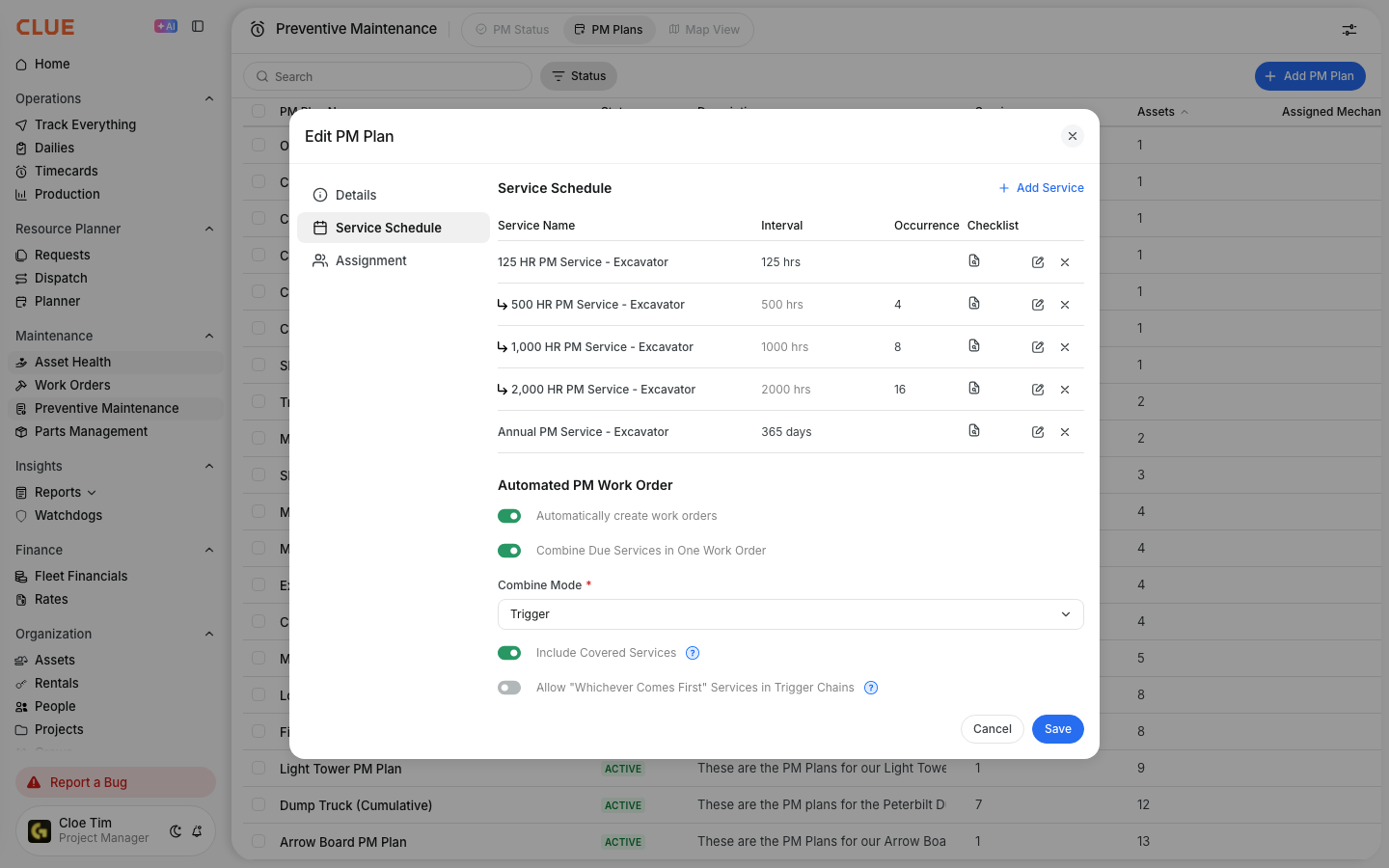
Set up the 250, 500, 1,000, and 2,000-hour services for each asset type or model, or the tiers its manual uses, such as a 125-hour first service. Add calendar limits from the manual. When services come due together, combine them into one work order so the shop can do the work in one visit.
4. Assign the Daily Checks: Give Each Person a Clear Role
Give operators and oilers the daily checklist. Make sure they have a way to report a failed check from the machine. The shop can use that report to decide what needs attention.
5. Review and Adjust Every Quarter: Keep the Plan Current
Look at overdue services, oil analysis trends, fault codes, and repeat repairs. Shorten intervals for machines in severe duty when the manual or condition signals call for it. Use work orders to track the work that follows.
One Excavator’s First 2,000 Hours
Here is how the ladder plays out on one machine. The numbers below are illustrative for one excavator using the service ladder above. The engine manual governs the real intervals and tasks.
| Service | Due Every | Times Due in 2,000 Hours |
|---|---|---|
| 250-hour service | 250 hours | 8 |
| 500-hour service | 500 hours | 4 |
| 1,000-hour service | 1,000 hours | 2 |
| 2,000-hour service | 2,000 hours | 1 |
Scheduled one by one, that is 15 separate service jobs. When a larger service comes due, it includes the smaller services due at the same time. The excavator comes in 8 times, once every 250 hours, with one work order for the task list at each visit.
The excavator works on a dusty site, so the team checks the air filter indicator daily and services the filter based on its condition. In month five, an oil sample shows rising silicon, which points to dirt getting in. The team inspects the intake hoses and clamps before the next service instead of waiting.
The schedule set the baseline; condition signals moved the work forward.
Common Diesel Engine Maintenance Mistakes

Most engine trouble in a fleet does not start with one big mistake. It starts with small habits that slide when the season gets busy and the shop falls behind. Watch for these six.
- Ignoring Idle Time: Idle hours add wear and soot without moving dirt, so watch the service intervals closely on machines that idle for much of the shift.
- Mixing Coolant Types: Mixing types can reduce protection. Label coolant and oil by machine so the shop uses the right fluid.
- Leaving Service Unlogged: Work that is done but not recorded leaves the next service set against an old record. The task may appear due too early or look missed.
- Skipping Oil Samples in Busy Weeks: The sample you skip may be the one that would show a new wear pattern early. Keep sampling in the routine during peak work.
- Treating Every Fault Code the Same: A code can call for a stop, a planned repair, or a check for a bad signal. Follow how to address fault codes and record the decision for the shop.
- Storing Fuel in Dirty Tanks: Water and dirt in a site tank or fuel truck can clog filters and damage injectors. Drain and check tanks as part of fuel management, not only the machines.
How Clue Keeps Diesel Engine Maintenance on Schedule

Clue keeps hours, schedules, and condition signals in one place so services happen on time. With equipment maintenance software, you can set PM plans by calendar days, engine hours, or odometer miles. Assign plans to asset types, make and model groups, or individual assets.
Tiered services can combine when a larger service is due. The lesser due services go on the same work order, and PM work orders can be created automatically. “Whichever comes first” services, such as hours or miles, can work in PM trigger chains. The PM Status view shows each asset’s services as overdue, upcoming, or in good standing across the fleet.
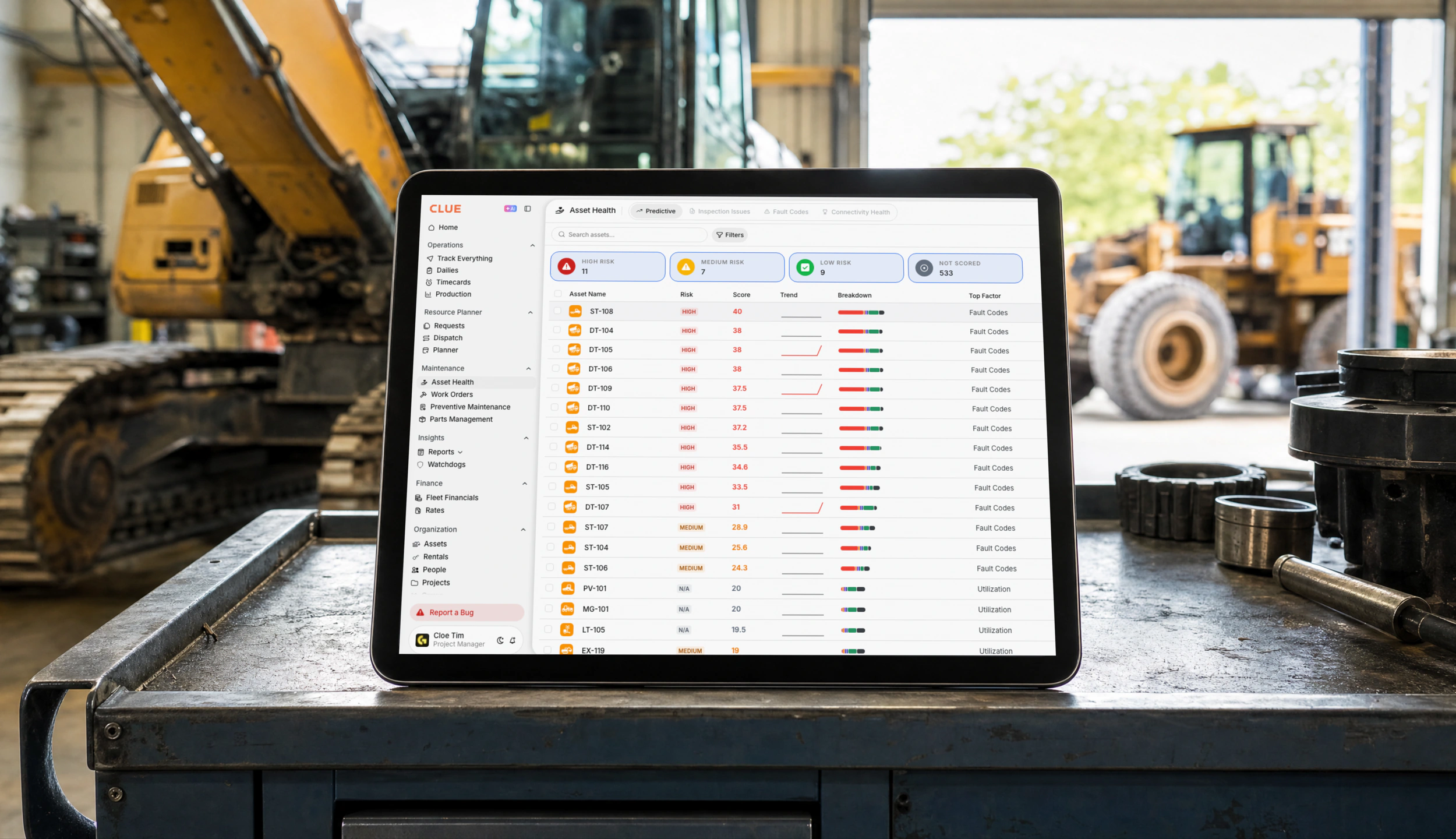
Engine hours and fault codes can come in from telematics integrations. The Oiler Report lets the person fueling a machine record gallons and mark DEF, engine oil, transmission oil, hydraulic oil, and coolant as pass or fail. Each entry can include a description, severity, and photos. Failed items become issues the shop can turn into work orders.
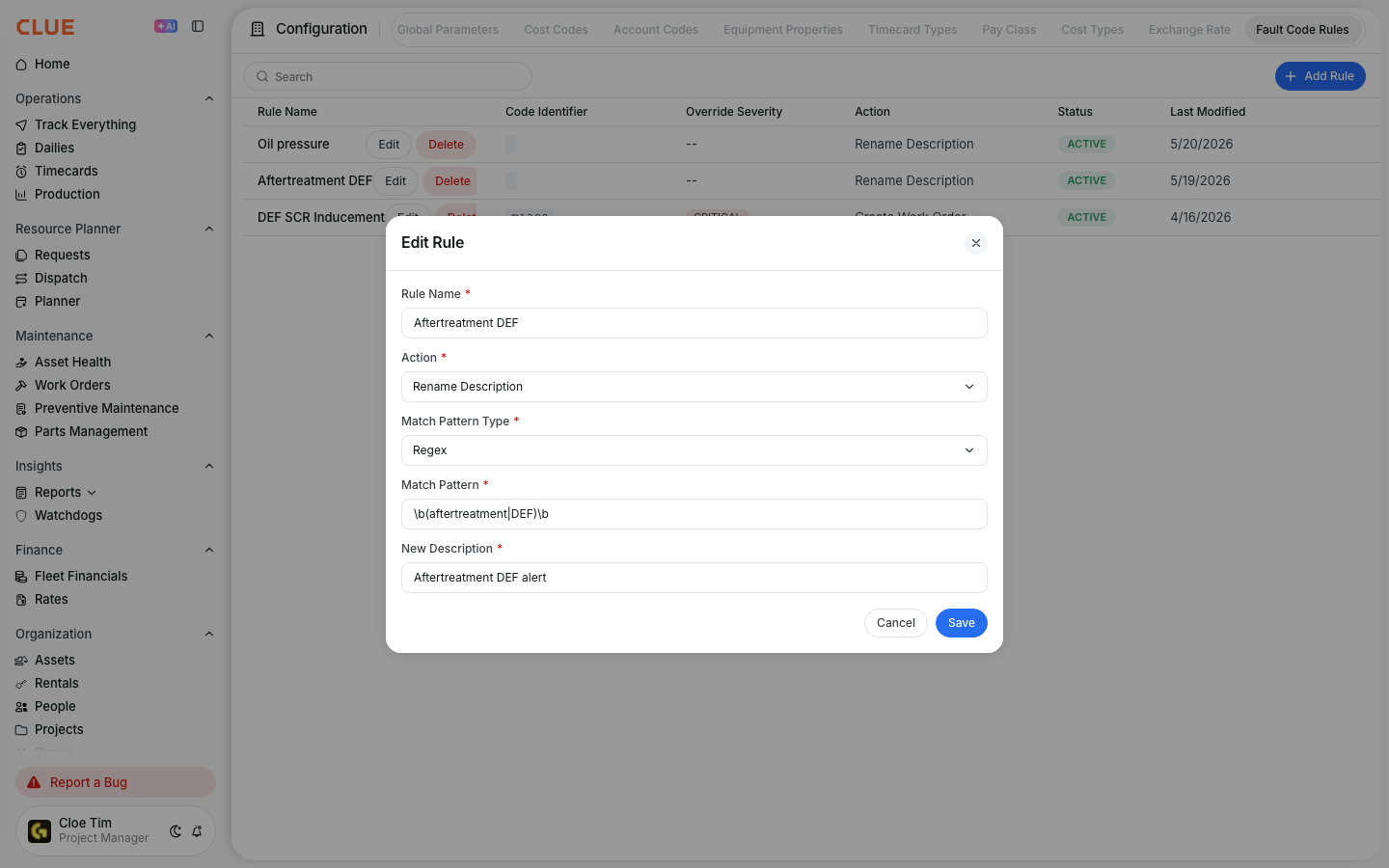
Fault codes are grouped by severity: critical in red, monitor or warning in yellow, and minor or informational in blue. The Fault Code Rules Engine lets you set a rule once per code to create a work order, dismiss a nuisance code, or rename a confusing description in plain English.
Final Thoughts
The excavator in the opening needed a current hour reading and a clear service record. A schedule gives the team a shared view of what is due for each diesel engine.
This week, pull current hours for every diesel engine in the fleet, compare them with the last logged service, and list every machine that is past due.
If Clue is on your shortlist, book a demo and bring your service ladder for one machine type.
FAQs
These answers cover common schedule questions for heavy equipment diesel engines. Use the engine manual to confirm the service needs for each machine.
How Often Should You Change the Oil in a Heavy Equipment Diesel Engine?
Most heavy equipment diesel engines need an oil and filter change every 250 to 500 hours. The engine manual sets the exact interval, and oil choice, duty level, and oil analysis results can shorten or extend it. Keep the filter change and sample timing aligned with the same service record.
How Often Should Diesel Fuel Filters Be Changed?
Many heavy equipment engines call for new fuel filters about every 500 hours, with the water separator drained daily. Replace the primary and secondary filters together. Filters that plug before the interval point to water or dirt in the fuel supply, so check the site tank as well as the machine.
Should Diesel Engine Service Be Based on Hours or Calendar Time?
Use engine hours as the main trigger, then add calendar limits where the manual calls for them. A parked backup machine still has aging fluids and storage needs. Condition evidence can move planned service forward when the engine shows a change.
Does Idle Time Count Toward Engine Hours?
Yes, engine hours usually continue to rise while the engine runs at idle. Check the machine’s meter or telematics record after a shift so the schedule reflects running time, even when the machine has moved little material.
How Often Should You Take an Oil Sample?
Take a sample at each oil change as a common routine. The manual or lab may suggest more frequent samples for critical machines. Keep the sampling point, engine temperature, and timing relative to an oil top-off consistent so results compare across reports.
How Long Does DEF Last in Storage?
DEF lasts about 12 months when stored at up to 86°F and about 18 months at up to 77°F, according to API storage guidance. At up to 95°F, shelf life drops to about 6 months. Keep the container sealed, out of direct sun, and use the oldest stock first.
Does DEF Freeze?
Yes. DEF freezes at about 12°F and can expand by up to 7% when frozen. Freezing does not harm it, and it can be used once it thaws. Machines with SCR systems heat the tank and lines, so leave expansion room in storage containers and keep spare DEF indoors in winter.
What Counts as Severe Duty for a Diesel Engine?
Severe duty includes heavy dust, high heat, long idle periods, heavy loads, or poor fuel. Check whether the engine manual lists a separate schedule for those conditions. Record the machine’s site and task so the shop can compare service needs across similar work.
Which Engine Fault Codes Mean You Should Stop the Machine?
Stop safely for critical codes such as high coolant temperature or low oil pressure. Follow the machine manual and the warning on the display before restarting. Other codes can signal a planned repair, so use severity and current symptoms to decide what the machine should do next.
How Many Hours Does a Heavy Equipment Diesel Engine Last?
There is no single number. Hours to overhaul vary widely with engine size, duty cycle, dust, idle time, and service history, and many heavy equipment engines are built to be rebuilt more than once. Crankcase blow-by, oil consumption, and oil analysis trends say more about remaining life than the hour meter does.
What Is Blow-By on a Diesel Engine?
Blow-by is combustion gas that slips past the piston rings into the crankcase. Every engine has some. Heavy fumes or oil mist from the breather, oil pushed out of seals, or rising oil consumption point to ring or liner wear, or to a plugged breather. A shop can measure it with a blow-by or compression test.
Do Diesel Engines Need Fuel Additives?
Not as a routine. Engine makers design for fuel that meets the diesel standard, and most do not require aftermarket additives. Two cases are common exceptions: an anti-gel treatment before cold weather, and a biocide when a storage tank tests positive for microbial growth. Follow the engine manual and your fuel supplier.

Transform Your Equipment Management