What Is DPF Regen?
DPF regen heats a diesel particulate filter until trapped soot burns off. This guide covers the three regen types, how regen differs from DPF cleaning and from SCR and DEF, the warning signs, and what a skipped cycle costs.


DPF regen heats a diesel particulate filter until trapped soot burns off. This guide covers the three regen types, how regen differs from DPF cleaning and from SCR and DEF, the warning signs, and what a skipped cycle costs.
DPF regen (diesel particulate filter regeneration) is the process of heating a diesel particulate filter until the soot trapped inside it burns away, so exhaust keeps flowing and the engine holds full power.
Every Tier 4 Final diesel machine carries a diesel particulate filter (DPF). Clue pulls DPF fault codes from mixed fleets into one list, so a loading filter becomes a work order instead of a derate on site.
Key Takeaways
DPF regen and DPF cleaning both clear a loaded filter, but they remove different material in different places. Regen is heat doing the work while the machine runs. Cleaning is a technician doing the work with the filter off the machine. Mixing the two up is the most common reason a shop books the wrong job.
| Dimension | DPF Regen | DPF Cleaning |
|---|---|---|
| What it removes | Soot trapped in the filter | Ash left behind after regen |
| How it happens | Heat burns soot into ash | A technician removes ash from the element |
| Where it happens | On the machine, during work | Off the machine, in a service bay |
| Who starts it | The ECU, the operator, or a technician | A technician, at a set interval |
| How often | Routine, during normal operation | Every 6 to 12 months, per EPA |
EPA is direct about the limit of regen:
In addition to regeneration, the filter must be periodically cleaned to remove noncombustible materials and ash. — U.S. Environmental Protection Agency, Technical Bulletin: Diesel Particulate Filter General Information (EPA-420-F-10-029)
A DPF regen cycle works by raising exhaust temperature until trapped soot oxidizes, and the engine control unit (ECU) decides when that needs to happen.
Pressure sensors sit on either side of the filter and measure the difference between them. The ECU reads that difference, adds engine data such as load and run time, and estimates the soot load. When the estimate crosses the trigger point, the ECU raises exhaust heat. Soot burns to ash. The ash stays. A dash message tells the operator which cycle is running and whether it needs anything from them.
Regen frequency is not fixed. EPA states it is determined by the engine's duty cycle, particulate matter emission rate, filter technology and other factors. A machine idling between loads regens on a different rhythm than the same model pushing material all day.
The three types of DPF regen are passive, active and parked. They differ by what supplies the heat and whether the machine keeps working through the cycle. Most machines use all three over a season, and the mix tells you something about how the machine is being worked.
| Type | What supplies the heat | Machine keeps working? | Operator action |
|---|---|---|---|
| Passive | The work the machine is already doing | Yes | None |
| Active | The ECU adds fuel or heat on purpose | Usually | Watch the dash message |
| Parked (forced) | A cycle started with the machine stopped | No | Park it, start it, let it finish |
EPA defines passive regen as combustion that happens without added fuel, heat or driver action, and active regen as a cycle that may require driver action and other sources of fuel or heat. Parked regen is the fallback when normal operation never got the filter hot enough.
DPF regen handles soot, while DEF and SCR handle NOx. They are separate systems sharing the same exhaust, so a fault in one does not mean a fault in the other. Operators often report a machine as needing a regen when the real fault sits in the DEF tank or the SCR catalyst.
| System | What it targets | What it uses | Regen involved? |
|---|---|---|---|
| DPF | Particulate matter, or soot | A ceramic or metallic filter | Yes |
| SCR | Oxides of nitrogen, or NOx | A catalyst in the exhaust | No |
| DEF | Feeds the SCR catalyst | Urea solution in its own tank | No |
EPA states plainly that DPFs generally do not reduce oxides of nitrogen emissions. If a machine throws a DEF quality or SCR fault, a regen will not clear it. Fuel matters here too, because EPA verifies DPFs for ultra low sulfur diesel, which holds up to 15 parts per million sulfur. See EPA diesel fuel standards and the nonroad engine rules in 40 CFR Part 1039.
For example, take an excavator loading trucks in short bursts with long idle gaps between them. Exhaust never stays hot enough for a passive cycle, so the ECU runs active regens more often. The operator shuts two of them down early to finish a load. Soot keeps building, and the machine asks for a parked regen mid-shift, which costs the crew the time a completed active cycle would have cost in the background. The fix is not a bigger filter. It is less idling, and letting the active cycles finish.
A completed regen protects engine power, fuel burn, and the filter itself. Each interrupted cycle leaves soot behind and moves the next, more disruptive cycle closer.
Signs a machine needs a regen show up on the dash first, and the machine's behavior confirms them. Train operators to report the lamp when it appears rather than at the end of the shift, because the gap between the first warning and a derate is where the cheap fix lives.
| Sign | What it usually means | What to do |
|---|---|---|
| DPF or regen lamp on the dash | Soot load has reached the trigger point | Let the cycle run, or park it if the dash asks |
| A DPF-related fault code is logged | The system logged a specific filter or sensor fault | Send the code to the shop before the next shift |
| Power drops, or the machine derates | Back pressure is already high | Stop and request a parked regen |
| Long idling or short runs | Exhaust never got hot enough for a passive cycle | Change the duty cycle, cut idle time |
| Cleaning intervals shorten | Excess soot, or an engine fault upstream | Run diagnostics rather than booking another cleaning |
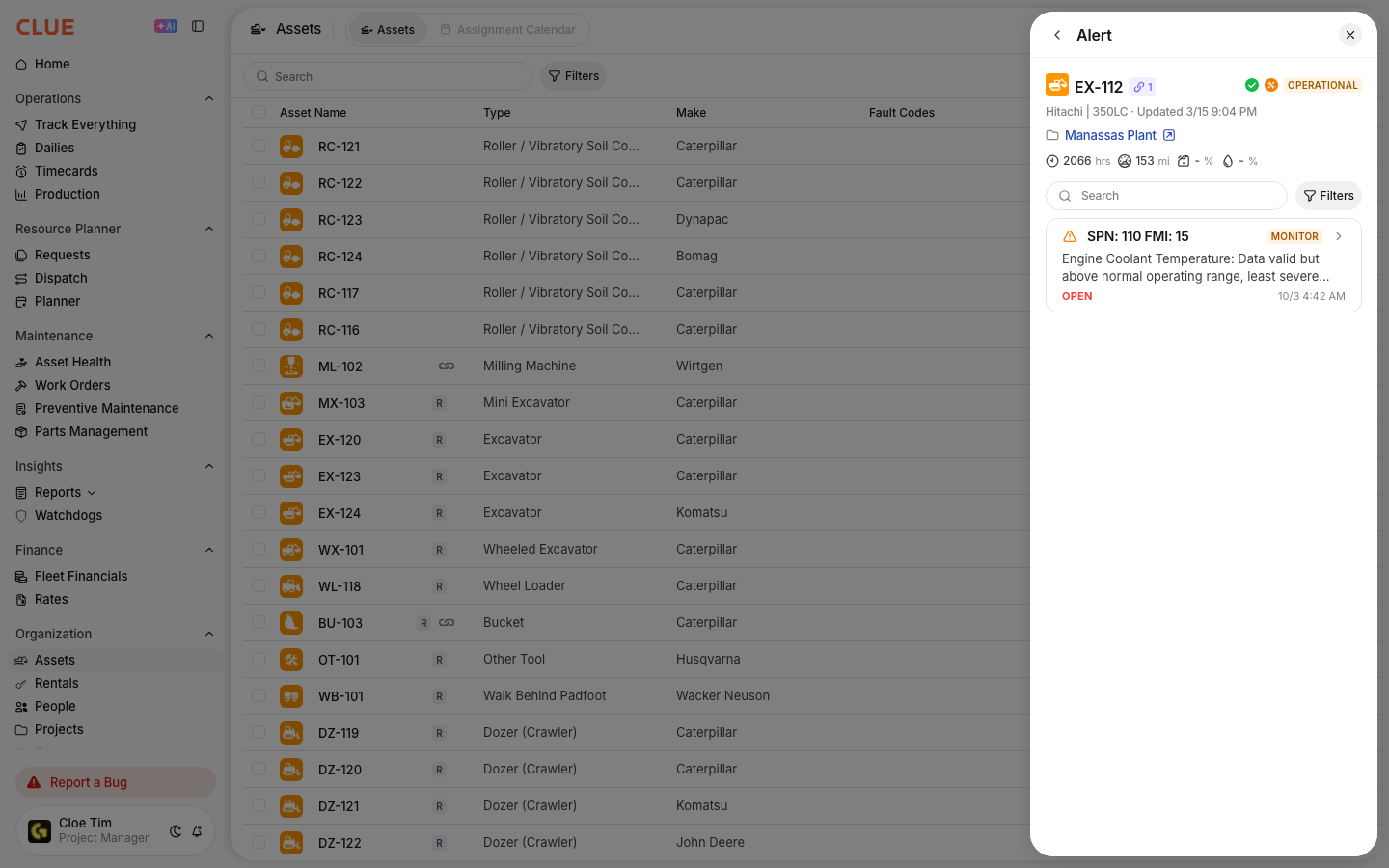
A diagnostic trouble code is the machine naming the fault itself, and our guide to reading and triaging fault codes walks through what to check first. Clue reads those codes from mixed-fleet telematics in English and Spanish. A DPF code then reaches the shop through Clue's equipment maintenance software, which opens the repair as scheduled work before the operator feels the derate.
These are the DPF regen questions that come up most often between operators and the shop. Each answer stands on its own, so you can paste one into a toolbox talk or an operator handout without rewriting it. Where a number comes from EPA, the source is named in the answer so a technician can check it.
DPF stands for diesel particulate filter. It sits in the exhaust and traps soot before exhaust leaves the machine. EPA reports that verified filters cut particulate matter by 85 to 90 percent or more. The filter does not reduce NOx, which is the job of the SCR system and DEF.
Stopping a DPF regen once it has started is possible, but avoid it unless there is a safety reason. Cutting the cycle short leaves soot in the filter, so the system asks for another regen sooner, and that next one is often a parked cycle. Check your machine's manual for the stop procedure.
A DPF should be cleaned every 6 to 12 months according to EPA guidance for verified filters. Engine makers on Tier 4 Final machines usually set the interval in engine hours instead, so use the hour figure in your manual. Treat a shrinking interval as a reason to run diagnostics.
Frequent DPF regens usually come from long idling, light loads and short run times, which keep exhaust too cool to burn soot passively. The ECU answers by running active cycles more often. Frequent regens can also point to a sensor, injector or turbo fault, so run diagnostics before simply cleaning more often.
A DPF regen burns extra fuel during active and parked cycles, because the system adds fuel on purpose to raise exhaust temperature. Passive regen adds none, since the machine's own workload supplies the heat. Steadier work and less idling keep a larger share of your regens passive and cheaper.
A machine keeps working during passive and active regen, so those cycles run in the background while the crew works. A parked regen is different, because the machine stays stopped until the cycle completes. Plan parked regens around the shift so they do not interrupt production at the wrong moment.