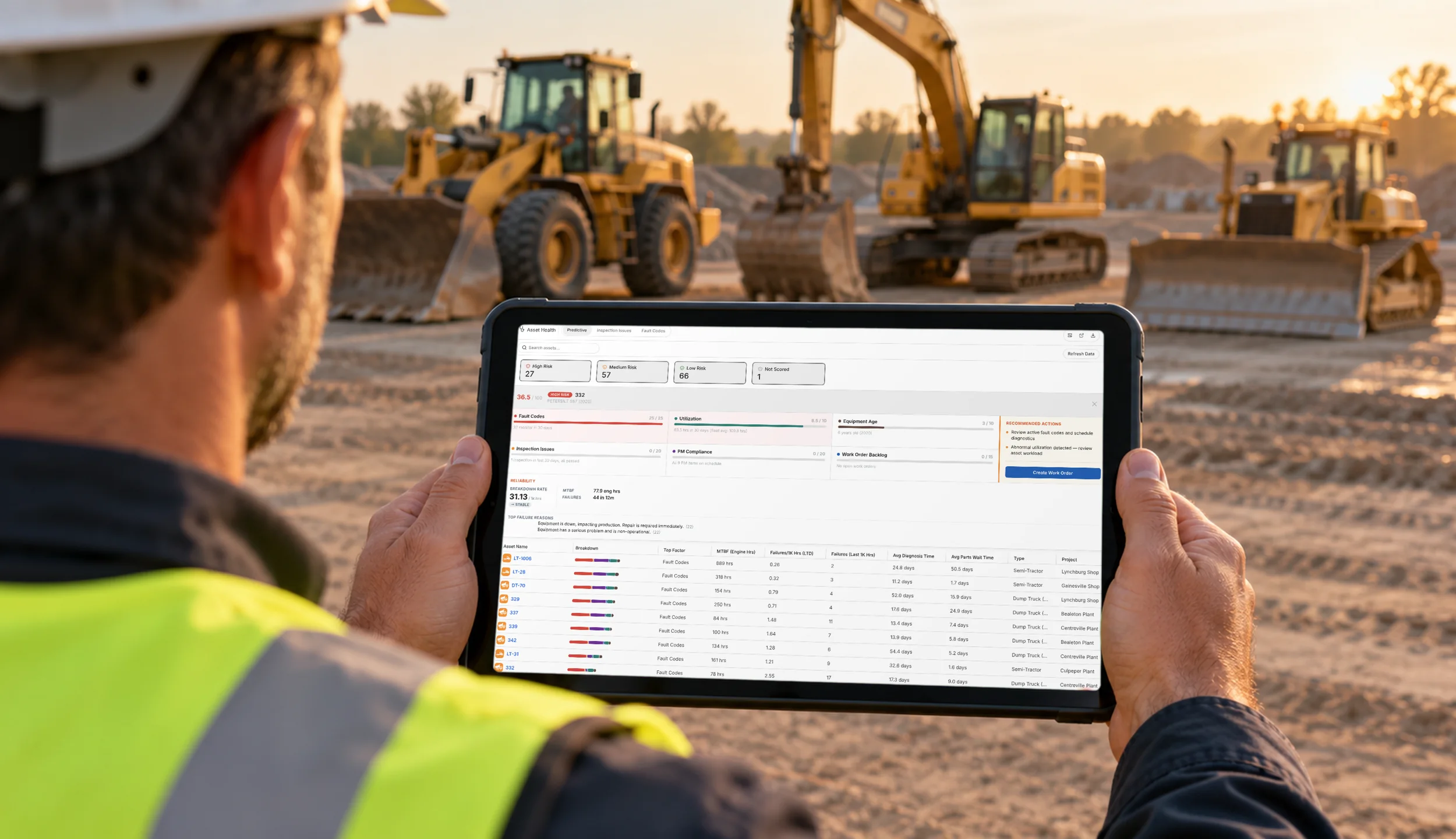
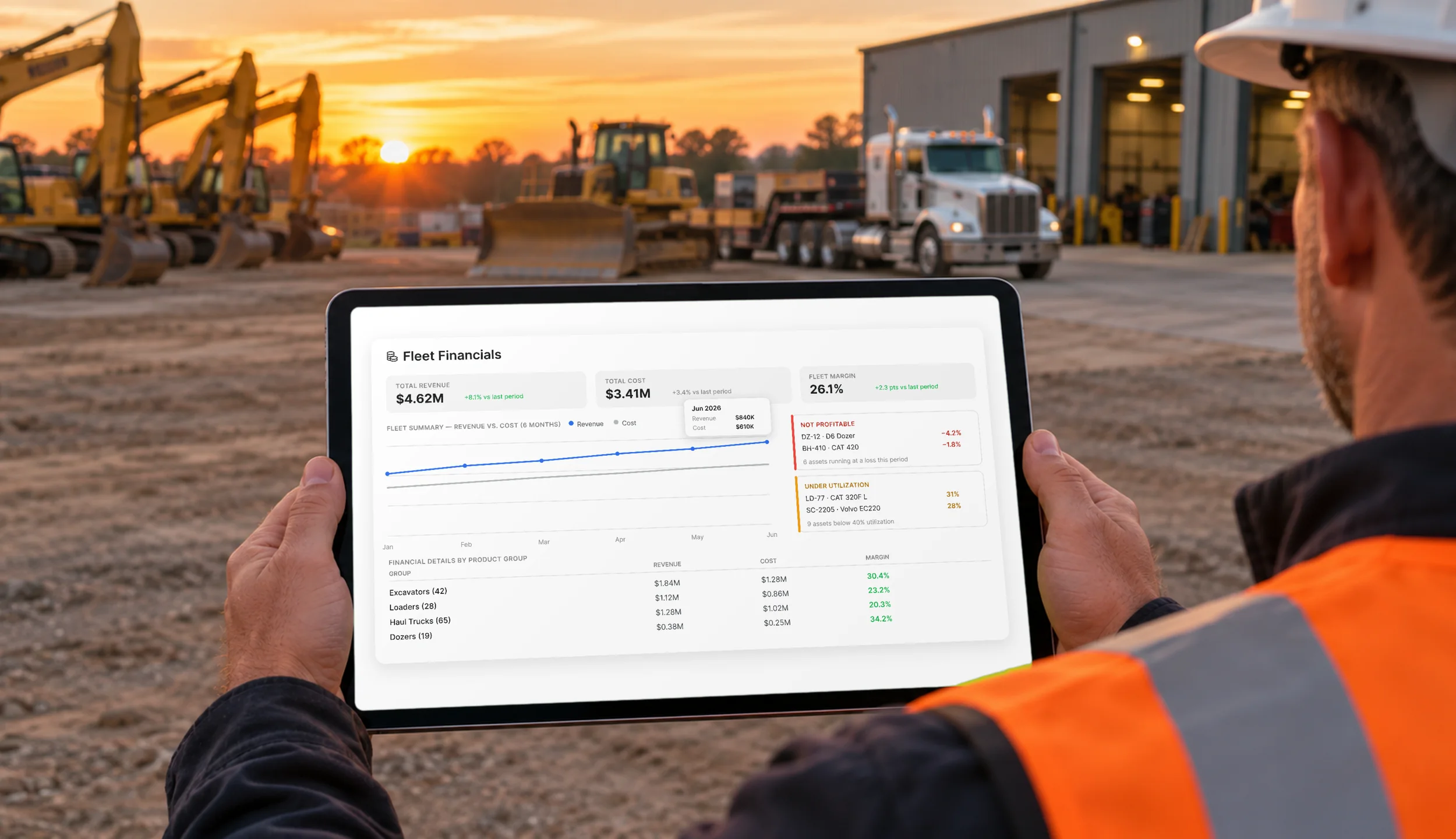
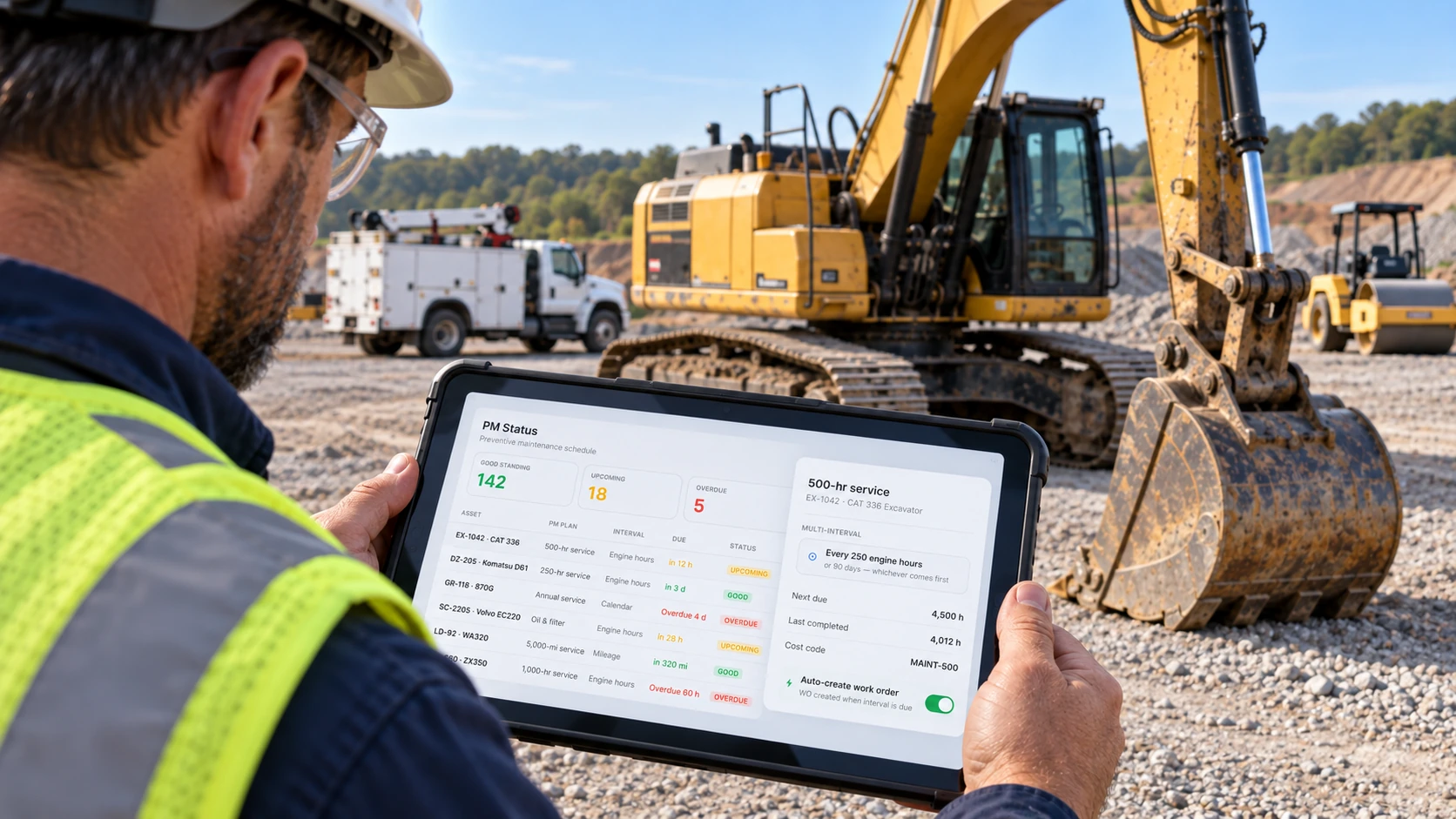
On a construction jobsite, every hour a dozer, excavator, or crane sits idle costs money. Lost production. Idle crews. Missed deadlines. Construction equipment downtime is the single biggest hidden cost most fleet managers struggle to control, and it rarely shows up as a single line item on a budget. It spreads across rental replacements, overtime, schedule slips, and lost bids on the next job.
The good news: a large share of this is preventable. Not through better mechanics, but through better systems. Fleets that consistently keep machines moving have something in common. They detect issues earlier, move repairs faster, and stop the same failures from happening twice. A purpose-built construction equipment maintenance software platform is what lets them do this at fleet scale.
This guide walks through 9 proven downtime reduction strategies for construction fleets, how construction technology impacts equipment downtime, and the metrics that prove the work is paying off.
What Counts as Construction Equipment Downtime

Construction equipment downtime is any period when a machine that should be working is not. It includes mechanical failure, but it covers far more than just breakdowns.
A working definition for construction fleets includes four types:
- Unplanned downtime. Breakdowns, fault codes, hydraulic leaks, electrical issues, or operator-reported problems that stop production on the jobsite.
- Planned downtime. Scheduled maintenance, inspections, transport between sites, or fueling delays that extend longer than expected.
- Idle downtime. Machines that are available but not assigned to active work, often missed entirely in standard reporting.
- Wait for downtime. Time lost waiting on parts, approvals, vendor response, or operator availability.
If you only track the first category, your real downtime is two to four times higher than your reports show. Closing this gap is what most construction equipment downtime solutions are actually built to do.
The Real Cost of Downtime on Construction Sites
Most teams underestimate downtime because they only count the repair bill. The actual cost is much wider, and the numbers from authoritative industry research show how much.
McKinsey & Company research found that large construction projects typically take 20 percent longer to finish than scheduled and run up to 80 percent over budget, with unplanned equipment downtime among the leading drivers. Aberdeen Research puts the cost of unplanned downtime at an average of $260,000 per hour across heavy industry, while a single unavailable machine on a construction site can cost between $2,000 and $10,000 per day in idle labor and missed milestones. Industry experts surveyed by For Construction Pros found that unplanned downtime rates of 20 to 30 percent are common, while disciplined operators using purpose-built software hold their rate to around 5 percent.
Unplanned equipment downtime can cost industrial operations ~$260,000 per hour, and reactive repairs can run 3–9× higher than planned maintenance.
For a single critical asset like an excavator on the critical path of a project, an hour of downtime can include:
| Cost Category | Typical Impact per Hour |
|---|---|
| Direct repair labor and parts | $200 to $1,000+ |
| Idle crew labor (3 to 6 workers) | $250 to $600 |
| Rental replacement (if available) | $80 to $400 |
| Schedule delay penalty (per day) | $500 to $5,000 |
| Expedited parts or vendor fees | $150 to $1,000 |
| Lost equipment utilization rate | 8 to 25% drop over a quarter |
A single failure on a paving crew or grading sequence can cost ten times more than the repair invoice. In road and highway construction, where every active hour matters, the multiplier is even higher.
The goal of any serious downtime management program is therefore not just faster repairs. It is shrinking every part of the delay cycle so a small issue never gets the chance to become a big one.
9 Proven Strategies to Reduce Construction Equipment Downtime
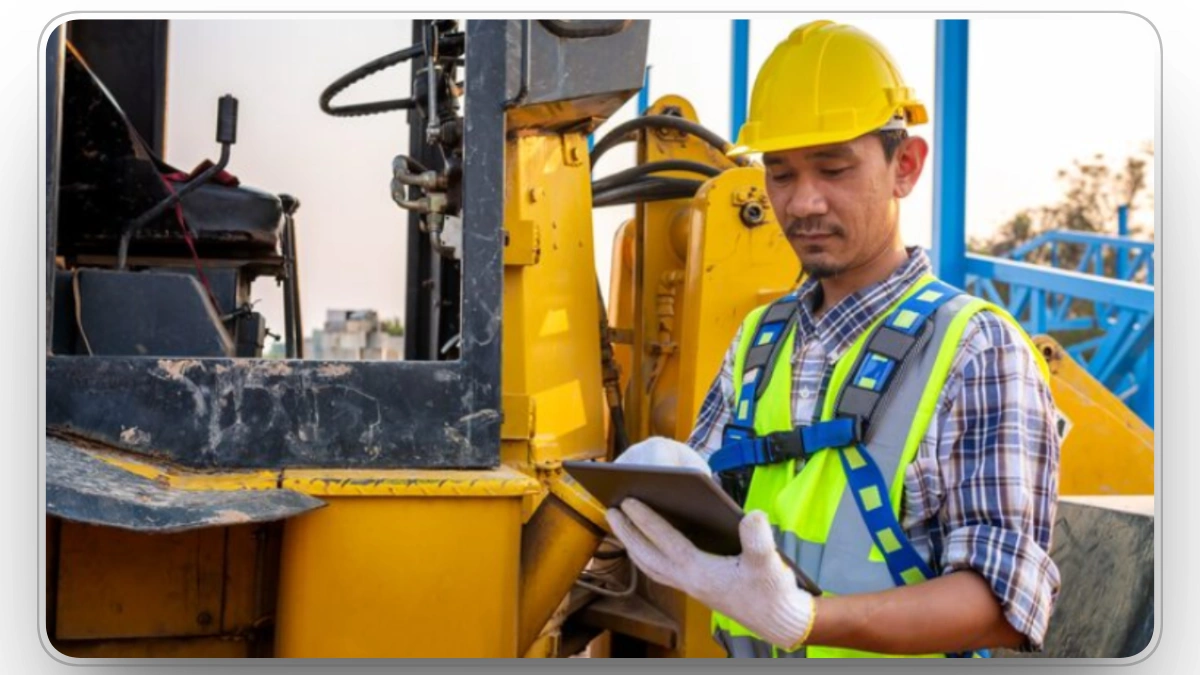
These are the strategies that actually move the needle. Not theory. The same downtime reduction strategies high-performing construction fleets use to minimize equipment downtime on construction sites every quarter.
1. Standardize Daily Inspections Across Every Jobsite
The most reliable way to reduce equipment downtime on construction sites is to catch issues before they become breakdowns. That starts with inspections, and inspection quality depends entirely on standardization.
Most construction fleets have inspections in some form, but the formats vary by foreman, site, or shift. One crew checks engine oil and fluids. Another checks hydraulic hoses and undercarriage. Another fills the form out without leaving the cab. When formats vary, data cannot be compared and small issues fall through.
What to do:
- Use the same inspection categories, severity ratings, and required fields on every jobsite.
- Make inspections mobile-first. Field crews should not fight paper forms or desktop logins.
- Require photo evidence for any defect rated above minor.
- Tie inspection completion to operator clock-in so it cannot be skipped.
When inspections are standardized across a fleet, defect detection rates typically improve significantly in the first quarter. That is downtime prevented, not just reported.
2. Turn Failed Inspections into Work Orders Instantly
Detection without action is the most common downtime trap in construction. A defect gets flagged on a Monday inspection, sits in someone's inbox until Wednesday, gets discussed Thursday, and turns into a $4,000 hydraulic failure on Friday afternoon.
The fix is to remove the human delay. Every failed inspection item should automatically convert into a work order with an owner, priority level, and target completion date. Telematics fault codes should do the same.
What to do:
- Connect inspections directly to your work order system. No manual handoff.
- Assign default priority levels by defect type: critical, scheduled, monitor.
- Notify the shop manager and the assigned mechanic at the same time.
- Track the lag time between fault detection and work order creation as its own metric.
Reducing this lag from 48 hours to under 4 hours is one of the fastest ways to decrease downtime on a construction fleet.
3. Schedule Maintenance Based on Real Engine Hours, Not the Calendar
Calendar-based maintenance creates two problems. You service equipment that does not need it yet, and you miss equipment that needs it sooner. Both increase downtime.
IBM research summarized by industry analysts found that around 30 percent of preventive maintenance tasks are unnecessary when scheduled by calendar alone. That is wasted labor, wasted parts, and wasted machine availability. At the same time, calendar-driven schedules miss machines that are running hard and need attention sooner.
Construction equipment usage varies wildly. A wheel loader on a busy aggregate site may rack up 200 engine hours in a month. The same machine at a slower jobsite might only see 60 hours. Treating them identically wastes money on one and risks breakdown on the other.
What to do:
- Pull engine hours from telematics or operator logs, not the calendar.
- Set service intervals by hours, fuel burn, or load cycles rather than by month.
- Factor in jobsite conditions. A dozer in red clay needs different intervals than the same dozer on a paved haul road.
- Combine inspection findings with usage data to flag assets that need attention sooner.
Done well, this is the foundation of true preventive maintenance, and it consistently reduces both unnecessary service and surprise breakdowns at the same time.

4. Pre-Stage Parts and Vendor Paths for Repeat Failures
A large portion of construction equipment downtime is not repair time. It is wait time. Waiting on parts. Waiting on a vendor. Waiting on approval. Waiting on someone to track down the right specification.
Industry data shows emergency reactive repairs cost 3x-9x more than the same work performed as scheduled maintenance, largely because expedited parts, overtime labor, and emergency vendor calls all carry premium pricing. If the same components fail repeatedly across your fleet, the parts for them should already be on hand or already approved for fast order. The vendor relationship should already be defined. The approval workflow should already be cleared.
What to do:
- Identify your top 10 repeat-failure components across the fleet: filters, hoses, sensors, undercarriage parts, hydraulic seals, belts, and tires.
- Stock minimum levels on critical parts and set automatic reorder triggers.
- Pre-approve repair vendors by region and asset type.
- Build a fast-lane workflow for repairs under a set dollar threshold so mechanics do not wait on approval emails.
This single change shrinks the gap between fault and fix, which is where most downtime hours actually live.
5. Prioritize Repairs by Production Impact, Not Failure Severity
Not all downtime hurts equally. A mid-size excavator with a minor hydraulic leak might be inconvenient. The same excavator on the critical path of a grading sequence can shut down three crews and delay the entire project.
Treating every defect equally drags resources away from the failures that actually slow production. To minimize equipment downtime on construction sites, mechanics and shop managers need visibility into which machines control the schedule.
What to do:
- Tag every active machine with its current job role and production criticality.
- Build a simple priority matrix: critical path + active use = top priority.
- Make this visible in the work order queue, not just in the project manager's head.
- Review the criticality tags weekly as job phases change.
Smart prioritization meaningfully reduces production-impacting downtime without adding a single mechanic. Pairing this approach with strong equipment utilization data makes the decisions repeatable across jobsites.
6. Train Operators to Catch Early Warning Signs
Operators sit closer to the equipment than anyone else. They feel the vibration changes. They hear the hydraulic whine. They notice when a track starts pulling left. The earlier they report it, the cheaper and faster the fix.
But operators only report what they are trained and incentivized to report. In many fleets, the culture is to keep running until something stops working. That is a downtime culture, not an uptime one.
What to do:
- Train operators on the top 5 early warning signs for each asset class they run.
- Make defect reporting fast. One minute on a phone, not 15 minutes on paper.
- Recognize and reward early reporting that prevents a larger failure.
- Close the loop. Tell the operator what was found and what was fixed.
Operators who feel heard catch problems weeks earlier. That is direct downtime prevention, not just downtime tracking.
7. Use Construction Technology and Telematics for Predictive Insight
This is where construction technology directly impacts equipment downtime. Modern telematics, sensors, and fault code data give you signals long before a breakdown becomes visible to a human.
One construction fleet with 45 heavy equipment assets reported a 34 percent reduction in maintenance costs and 62 percent fewer unplanned breakdowns within 18 months of moving from preventive to predictive maintenance, with documented savings of $287,000 annually. Broader research summarized from McKinsey and other firms shows predictive maintenance approaches can deliver 30 to 50 percent downtime reduction and 20 to 40 percent longer equipment lifespan compared with reactive approaches.
A failing alternator, a clogged DPF, a hydraulic pressure drop, a coolant temperature creeping up over weeks. These show up in telematics data before they show up as a breakdown. The fleets that ignore this data run reactively. The fleets that act on it run predictively.
What to do:
- Connect your fleet to a single source of truth that ingests telematics from every OEM.
- Set fault code thresholds that trigger inspections or work orders automatically.
- Use the Fault Code Guide to translate manufacturer codes into actions your shop can take.
- Combine fault data with inspection history to spot machines drifting toward failure.
When telematics, inspections, and maintenance live in one system, predictive maintenance becomes practical rather than theoretical. This is the clearest example of construction technology impact on equipment downtime in a real fleet.
8. Run Weekly Repeat-Failure Reviews by Asset Class and Jobsite
If the same model of skid steer keeps failing on the same component, you do not have a series of unrelated breakdowns. You have a systemic issue. Maybe a maintenance gap. Maybe a training gap. Maybe a sourcing or parts quality issue.
Top-performing maintenance organizations achieve greater than 90 percent compliance with their preventive maintenance schedules, according to the Society for Maintenance and Reliability Professionals. Hitting that level is impossible without weekly visibility into where the system is leaking.
What to do:
- Group failures by asset class, model, jobsite, and operator.
- Look for the top 3 repeat failure modes each week.
- For each repeat, ask why the fix did not hold last time.
- Update PMs, training, or parts decisions based on what the data says.
This is the highest-leverage hour in any equipment manager's week, and it is the foundation of any serious effort to eliminate downtime across a construction fleet. For a deeper comparison of approaches, see our guide on preventive vs reactive maintenance.
9. Connect Inspections, Work Orders, Parts, and Telematics in One System
You can do all eight strategies above, but if the data lives in four different tools, the handoffs will leak. That is where most construction equipment downtime solutions actually fail. Not in the strategy, but in the system.
A unified platform pulls inspections, work orders, parts inventory, telematics, utilization, and cost data into one view. When a fault code fires on a paver in the field, the shop sees it, the parts inventory shows what is on hand, and a work order routes to the right mechanic, all in minutes.
What to do:
- Audit how many systems your maintenance workflow currently passes through.
- Identify where data has to be re-entered or reconciled. That is where downtime hides.
- Move toward a single platform that connects field, shop, and office.
A purpose-built construction equipment management software platform connects inspections, work orders, parts, telematics, utilization, and cost data across the full fleet lifecycle. When these workflows operate in one system, the small delays that compound into major downtime become easier to identify and eliminate.
How Construction Technology Impacts Equipment Downtime

Construction technology has changed how downtime is detected, prioritized, and resolved. Three shifts matter most for any team trying to reduce equipment downtime on construction sites today.
Telematics turns reactive fleets into predictive ones. Real-time fault data, engine hours, and idle patterns expose problems before they become breakdowns. Research from the U.S. Department of Energy shows that companies using preventive over reactive maintenance save 12 to 18 percent on total maintenance costs, and every dollar spent on preventive maintenance saves an average of five dollars in avoided downstream costs. Predictive maintenance approaches widen that gap further.
Mobile-first inspections eliminate paper delay. Defects flagged in the field move to the shop in seconds, not days. This single shift is one of the biggest sources of downtime reduction in modern construction fleets, especially in road and highway construction where machines move between active phases quickly.
AI-assisted scheduling is starting to optimize maintenance timing against jobsite demand. Instead of fixed PM intervals, smart systems are beginning to recommend when to pull a machine in based on usage, failure probability, and project priority.
Construction technology has become the connective layer for all of this. Without it, the data exists but does not move. With it, downtime becomes a problem you can measure, prioritize, and act on.
Equipment Rentals as a Downtime Reduction Strategy
For many fleets, rentals are seen as a fallback when something breaks. The smarter play is to use rentals strategically as part of your downtime plan, not just as a reaction to it.
Equipment rentals that reduce downtime on construction sites usually do one of three things:
- Cover predictable peak demand. Renting during peak load periods extends owned fleet life and reduces wear-driven failures across critical assets.
- Replace older, failure-prone assets during high-stakes project phases. When reliability has to match a tight schedule, swapping an aging dozer for a newer rental for two months can save more than it costs.
- Bridge gaps during major rebuilds or component replacements on owned equipment. This way the jobsite never loses momentum while a critical machine is in for a long repair.
A practical rental strategy includes pre-approved vendors, standing rate agreements, and clear decision rules for when to rent versus repair. Companies like EquipmentShare have built parts of their business around reducing construction equipment downtime through on-demand availability, and that model has reshaped how mid-size contractors think about ownership versus rental. Pairing this approach with proper rentals management software keeps the cost and availability picture clear across both owned and rented assets.
The point is not to rent more. It is to make rental a deliberate part of your downtime strategy, not a panic response.
Key Metrics to Track Downtime Reduction
If you cannot measure it, you cannot reduce it. These are the metrics that matter for construction equipment downtime management:
| Metric | Formula | What It Tells You |
|---|---|---|
| Downtime Rate | Downtime Hours / Scheduled Hours × 100 | How much productive time is being lost |
| MTTR | Total Repair Time / Number of Repairs | How fast you recover from failures |
| MTBF | Operating Time / Number of Failures | How reliable your assets are on average |
| Availability | Uptime / (Uptime + Downtime) | What share of time equipment is usable |
| PM Compliance | Completed PMs / Scheduled PMs × 100 | How disciplined your maintenance is |
| Repeat Failure Rate | Repeat Failures / Total Failures × 100 | Whether root causes are being fixed |
Track these monthly per asset class. Trend them over quarters. The number to watch most closely is the gap between MTTR and your full recovery time, because that gap is where most hidden downtime sits.
Common Mistakes That Keep Construction Downtime High

Even fleets with good systems get stuck. The same mistakes show up over and over across construction operations:
- Reactive culture. Waiting for breakdowns instead of acting on early signals from operators and telematics.
- Tracking without action. Data dashboards that no one reviews, no one owns, and no one ties to decisions.
- Ignoring operator input. The closest people to the equipment are often the last to be heard.
- Equal-priority repair queues. Treating critical path failures the same as minor defects on idle machines.
- Disconnected systems. Inspections in one tool, telematics in another, parts in a third, costs in a fourth.
- Calendar-only maintenance. Servicing by date instead of by real usage and condition.
- No repeat-failure review. Fixing the same component over and over without ever asking why.
Any one of these can keep downtime stuck at the industry-average 20 to 30 percent reported across construction, instead of the 5 to 6 percent that disciplined fleets consistently achieve.
Your Construction Downtime Reduction Plan (Quick Checklist)
If your team needs a place to start, this is the order that works best for most construction fleets:
- Week 1. Audit your current downtime rate per asset class. Get a real baseline.
- Week 2. Standardize inspections across every site. One format, one tool, one process.
- Week 3. Connect failed inspections to work orders automatically.
- Week 4. Pull telematics data into the same system. Tie fault codes to action.
- Week 5. Stock minimum levels on top 10 repeat-failure parts.
- Week 6. Tag every active machine with production criticality. Use it in repair priority.
- Week 7. Start weekly repeat-failure reviews. Pick three issues to fix at the root.
- Ongoing. Watch MTTR, PM compliance, and repeat failure rate every month.
Small changes done consistently outperform big projects done occasionally.
Conclusion
Reducing construction equipment downtime is not about eliminating every failure. It is about catching issues earlier, moving repairs faster, and preventing the same failures from happening twice. Fleets that do this successfully rely on better systems, not just better mechanics.
The proof comes from real operations. Palmetto Corp documented $1 million in savings after centralizing equipment management, demonstrating what is possible when inspections, work orders, telematics, and maintenance history are connected in a single workflow. Clue enables fleets to consolidate this information, giving teams real-time visibility and control over their equipment.
With unplanned industrial downtime averaging $260,000 per hour and single-machine outages costing thousands per day, the importance of managing downtime has never been clearer. Using Clue, fleets can transform downtime from a hidden cost into a measurable, actionable metric, ensuring every asset contributes to on-time, efficient operations.
Related: our guide to the best construction equipment management software compares the leading platforms for 2026.
FAQs
1. What is the biggest cause of construction equipment downtime?
Slow response after a problem is detected. Most downtime is not the repair itself. It is the delay between fault detection, reporting, work order creation, parts arrival, and the start of work. Shrinking those gaps is the fastest way to reduce equipment downtime on construction sites.
2. How do you measure construction equipment downtime accurately?
Track downtime from fault detection to return to service, not from when the work order opens. Use a consistent classification schema across all jobsites so the data can be compared. Pair downtime rate with MTTR, MTBF, availability, and PM compliance for a full picture.
3. How does construction technology impact equipment downtime?
Telematics surface fault codes and usage patterns before breakdowns. Mobile inspections turn field findings into action in minutes. A unified construction equipment management platform ties it all together so issues do not get stuck in handoffs between teams. The combined effect is faster detection, faster repair, and fewer repeat failures.
4. Can equipment rentals reduce downtime?
Used strategically, yes. Pre-approved rentals can cover peak demand, replace failure-prone assets during critical project phases, and bridge gaps during major repairs. The key is to plan rentals into your downtime strategy, not react to a breakdown with whatever is available.
5. How often should you review your downtime data?
Operationally, weekly. Strategically, monthly and quarterly. Weekly reviews catch repeat failures and process gaps fast. Monthly and quarterly reviews show trends in MTTR, MTBF, and overall availability per asset class.
6. What is a healthy downtime rate for a construction fleet?
Disciplined fleets often run below 6 percent unplanned downtime, with PM compliance above 90 percent and reactive maintenance below 20 percent of total work. Numbers above these usually point to a system or scheduling issue rather than just a maintenance problem.
7. Can small contractors cut downtime?
Yes, to a point. Standardized inspections, disciplined PMs, clear operator reporting, and a basic parts plan will lower downtime significantly even on a small fleet. Construction technology amplifies these gains once the fundamentals are stable.
8. How quickly can a fleet expect to see downtime reduction?
Visible results often appear within the first quarter. Inspection-driven catches and parts staging show up first. Telematics-driven gains and repeat-failure elimination usually take two to three quarters to fully compound across a fleet.
9. How to reduce downtime on mixed fleets?
Standardize the workflow even when the equipment is not standard. Use a single platform that ingests telematics from every OEM, a single inspection format, and a single work order system. The brand mix matters less than the workflow consistency around it.

Transform Your Equipment Management