Many construction fleets do not struggle with maintenance alone. They face a challenge with how maintenance decisions are made.
Equipment is serviced, inspections are completed, and schedules are followed. Yet breakdowns still happen and costs remain unpredictable.
The issue is not simply performing maintenance, but making the right decisions about when and how it is done.
In construction environments where usage, load, and conditions vary across assets, a single approach to maintenance does not produce consistent outcomes.
This is where the difference between preventive and predictive maintenance becomes critical.
Preventive vs Predictive Maintenance Explained

Preventive maintenance follows fixed schedules based on time, usage, or manufacturer guidelines. It guarantees regular servicing but does not consider actual wear or real-time equipment condition.
Unlike preventive maintenance, which follows fixed schedules, predictive maintenance uses real-time data to respond to the actual condition of each asset. It detects early signs of failure and schedules maintenance only when there is measurable risk, improving timing and reducing unnecessary service.
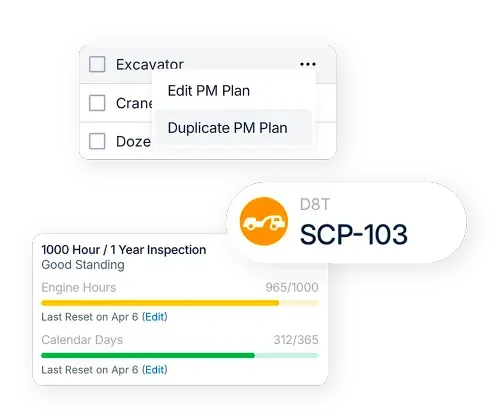
In practice, construction fleets rarely rely on one approach alone. Clue combines scheduled maintenance with real-time data, allowing teams to maintain structure while adjusting decisions based on operating conditions.
Why Fixed Maintenance Schedules Break in Construction?
The limitation of preventive maintenance is clear when examining how equipment wears in real-world conditions.
Several factors affect how quickly components wear:
- Load intensity impacts the stress placed on components
- Operating environment exposes equipment to dust, moisture, and temperature variations
- Operator behavior introduces uneven mechanical strain
- Utilization patterns vary between idle time and continuous operation.
This is where preventive maintenance loses accuracy, as fixed intervals fail to match actual wear. It assumes predictable wear, but real-world conditions are variable.
Predictive maintenance aligns activities with real-time operating conditions instead of relying on predetermined schedules.
Is Preventive Maintenance Based on Fixed Schedules?

Preventive maintenance operates on predefined intervals, ensuring consistency across the fleet.
Maintenance is triggered by engine hours, mileage, calendar schedules, or manufacturer guidelines. Depending on the asset and operation, there are several types of preventive maintenance each with its own scheduling logic and application.
This approach works well when usage is predictable. It guarantees regular servicing, minimizes failure risks, and ensures consistency across teams.
The limitation is timing. Wear varies across asset, but fixed intervals do not. As a result, some components are serviced too early, while others fail between intervals. The system remains structured, but not precise.
For example, an excavator may be serviced every 250 engine hours regardless of condition, resulting in unnecessary work while real issues between intervals go unnoticed.
Is Predictive Maintenance Based on Equipment Condition?
Predictive maintenance uses data such as sensor inputs and analysis tools, telematics, usage patterns, and maintenance history to detect deviations from normal performance. Maintenance is triggered when risk indicators suggest a potential failure, rather than at fixed intervals.
This shifts execution. Timing adjusts based on actual equipment condition, enabling earlier intervention and reducing reliance on fixed schedules.
For example, a hydraulic issue may trigger maintenance based on pressure deviations before failure occurs.
When implemented correctly, predictive maintenance can reduce downtime by 30-50% and lower maintenance costs by 18-25%. These gains come from better prioritization, not increased maintenance activity.
These differences become clearer when compared side by side.
How Do Preventive and Predictive Maintenance Actually Differ?
The real difference is what triggers action and how risk is prioritized.
Where Preventive and Predictive Maintenance Actually Converge?
In real construction operations, preventive and predictive maintenance are not used in isolation.
Preventive maintenance provides the structure. It ensures that assets are serviced regularly and that no equipment is neglected.

Predictive maintenance improves timing. It identifies when intervention is actually required based on usage, condition, and performance signals.
The challenge is not choosing one over the other. It is ensuring that both operate within the same workflow.
Clue combines scheduled maintenance with real-time data inputs, allowing maintenance plans to adjust based on how equipment is actually used.
Inspections, utilization data, and fault code signals feed directly into work orders, ensuring that identified issues lead to action.
The result is a system where a detected fault code on an excavator does not sit in a report; it becomes a scheduled work order, assigned, tracked, and resolved within the same workflow.
Challenges in Implementing Maintenance Systems

The gap between design and execution is where most systems fail. These challenges directly affect how preventive and predictive strategies perform in practice:
1. Over-Expansion Too Early
Rolling out advanced monitoring across the entire fleet too quickly creates operational complexity. Without clear prioritization, teams are overwhelmed, and critical assets do not receive focused attention.
2. Lack of Workflow Integration
Inspection findings, telematics data, and fault codes exist in separate systems. Without a connected workflow, issues are identified but do not progress into structured maintenance tasks.
3. Skill Gaps
Field teams can identify visible problems, but translating condition data into priority actions is not always straightforward. For example, a reading for a bulldozer might show an early sign of a hydraulic issue, but without proper training on interpreting that data, the team may not act on it until it fails.
4. Resistance to Process Change
Maintenance is often managed through informal communication such as calls and messages. Moving to standardized workflows requires behavioral change, which is difficult to enforce across multiple job sites.
5. Delayed Decision Cycles
Even when issues are identified early, action is slowed by approval layers, parts availability, and unclear ownership. These delays compound over time, contributing directly to a growing maintenance backlog that becomes increasingly costly to clear.
Conclusion
Preventive and predictive maintenance are not competing strategies. They serve different roles.
Preventive maintenance provides baseline control by ensuring consistent servicing and reducing obvious failures. Predictive maintenance improves timing, allowing teams to act based on real-time equipment conditions instead of fixed schedules.
The difference shows up in execution. Fleets that rely only on schedules maintain activity. Fleets that align maintenance with real conditions control outcomes.
The most effective strategy combines both: preventive for consistency and predictive for precision.
Construction equipment maintenance software like Clue connects inspections, usage data, maintenance schedules, and work execution in one workflow, ensuring that maintenance decisions lead to timely action.
FAQs
1. When should a fleet adopt predictive maintenance?
Fleets should introduce predictive maintenance when equipment utilization becomes inconsistent, downtime costs increase, or fixed schedules no longer prevent failures effectively.
2. Can predictive maintenance replace preventive maintenance?
No. Predictive maintenance improves timing but does not replace the need for baseline servicing, inspections, and compliance-driven maintenance.
3. Which equipment benefits most from predictive maintenance?
High-value, high-utilization assets such as excavators, cranes, and haul trucks benefit the most, especially when their failure impacts multiple operations.
4. What data is needed for predictive maintenance?
Predictive maintenance relies on telematics data, fault codes, usage patterns, maintenance history, and in some cases sensor data like vibration or temperature.
5. Why does predictive maintenance fail for some fleets?
Most failures come from poor data quality, lack of workflow integration, and delays between issue detection and action, not from the technology itself.
6. How does predictive maintenance reduce costs?
It improves timing. Maintenance is performed only when needed, avoiding unnecessary servicing while preventing expensive failures.
7. Is predictive maintenance practical for small fleets?
Yes, but selectively. Small fleets can apply predictive methods to critical assets without implementing full-scale monitoring across all equipment.
8. How do these two approaches affect equipment lifespan?
Preventive maintenance extends lifespan through regular servicing, while predictive maintenance prevents premature wear and major failures by aligning interventions with actual condition.

Transform Your Equipment Management