Ask a project manager what a late excavator costs, and you will get the rental figure. Ask the CFO, and you will get the schedule penalty. Ask a fleet director after a bad quarter, and you will get the longer, messier answer. A domino of missed pours.
That is construction asset maintenance in its real form. Not a workshop activity. Not a clipboard task. A risk-control function sitting inside the P&L.
The International Organization for Standardization (ISO 55000) frames asset management as the practice of realizing value by balancing cost, risk, opportunity, and performance. That is the boardroom version. The lived-in version is blunter. If maintenance is weak, every other metric lies.
That gap between "looks busy" and "is profitable" is the focus of this article. It is also why the construction industry is moving past treating heavy equipment telematics as a tracking gadget and toward treating it as the data layer that holds the entire upkeep function together.
Why Does Small-Fleet Logic Break at Enterprise Scale?

Small-fleet logic breaks at enterprise scale because capital is committed long before any blade touches dirt, and that capital then bills the business every day. Fuel, fluids, tires, parts, labor, depreciation, downtime, and insurance all show up on the P&L whether the asset is working or not.
The Virginia Transportation Research Council put real numbers on this for a public-sector fleet. A replacement value of roughly USD 534 million, backed by more than 10,000 units of rolling stock across 83 maintenance facilities. Its life-cycle cost study makes a point most contractors learn painfully rather than proactively. Equipment cost per unit of service follows a U-shape. It drops in the early years, bottoms out, then climbs again as the machine ages.
Translated to project economics, keeping a worn-out dozer because the company already owns it is not frugality. It is a deferred invoice written in broken hoses and missed deadlines.
How do aging assets drive non-linear risk?
Aging assets drive non-linear risk because repair costs, downtime impact, and schedule consequences all compound as a machine moves into its late life. Research from the Texas Department of Transportation on equipment replacement decisions points to three uncomfortable truths.
Repair spend escalates non-linearly as construction equipment ages, with late-life years dominating lifetime cost. Downtime cost rises sharply once fleets are right-sized, because no spare unit is available to absorb a sudden failure. Each failure carries larger schedule consequences than it once did, because critical-path density has increased across modern projects.
A single-yard contractor with one idle skid-steer loses a day. A multi-division contractor with twelve concurrent jobs loses a day on the critical path of one project, and forces cascading changes across the other eleven. That cascade is why construction equipment maintenance has become a board-level concern, with construction equipment maintenance software helping teams connect fault data, work orders, service planning, and cost visibility.
Why is maintenance one of the biggest construction equipment costs?
Maintenance is one of the biggest construction equipment costs because it can account for 15 to 20% of the total cost of owning a machine, according to industry research. Layer extended parts-supply lead times on top of that, and reactive maintenance becomes financially indefensible.
A fleet manager is no longer just paying for a repair. The team is paying for a six-week parts wait while the asset sits behind a chain-link fence.
This is exactly where modern heavy equipment telematics software stops being optional. Not because dashboards are fashionable, but because the old "fix it when it breaks" mindset was built for a world where spare parts arrived the next day and spare machines sat in the yard. Neither assumption holds anymore.
Up to 30% of construction equipment sits idle at any given time due to breakdowns, maintenance delays, or inefficiencies, highlighting how proactive maintenance can dramatically boost productivity.
What Does Telematics Actually Change Inside a Maintenance Function?

Telematics changes a maintenance function in four specific ways once the noise about real-time dashboards and green dots on maps is set aside. None of these changes are about tracking.
1. Usage reality replaces the service calendar
A pickup truck lives or dies by its odometer. A crawler crane does not. It may move five meters in a shift while its engine, hydraulics, and slewing gear work for nine hours straight. Mileage-based service intervals for construction gear are the wrong tool for the job. Engine hours, idle time, load-cycle counts, and fuel burn correlate far better with wear. Crushers and screens have their own needs. See our guide to maintenance services for aggregate equipment.
Once a fleet flips from mileage-based to duty-based intervals, two things happen. Machines that did not need service stop being serviced, and machines that have been silently asking for attention stop being ignored.
2. The shift from breakdown repairs to data-driven maintenance
This progression is more than jargon. It changes what the maintenance team is allowed to know about its own fleet.
Reactive maintenance reacts to the bang. The team learns about failure from the operator, usually via a phone call from a job site. Preventive maintenance follows a fixed schedule. The team services every X hours whether the machine needs it or not. Predictive maintenance listens to the machine. Fault codes, hydraulic pressure drift, unusual fuel burn, vibration signatures, and temperature excursions feed a model that flags a component before it fails.
For a deeper comparison of these two approaches, see our breakdown of preventive vs predictive maintenance in construction.
An excavator working in rock strains its undercarriage differently than the same model digging clay or trenching sand. Predictive logic reads the actual stress signature and adjusts the service plan, which a blanket 500-hour interval cannot do.
3. Maintenance data becomes financial data
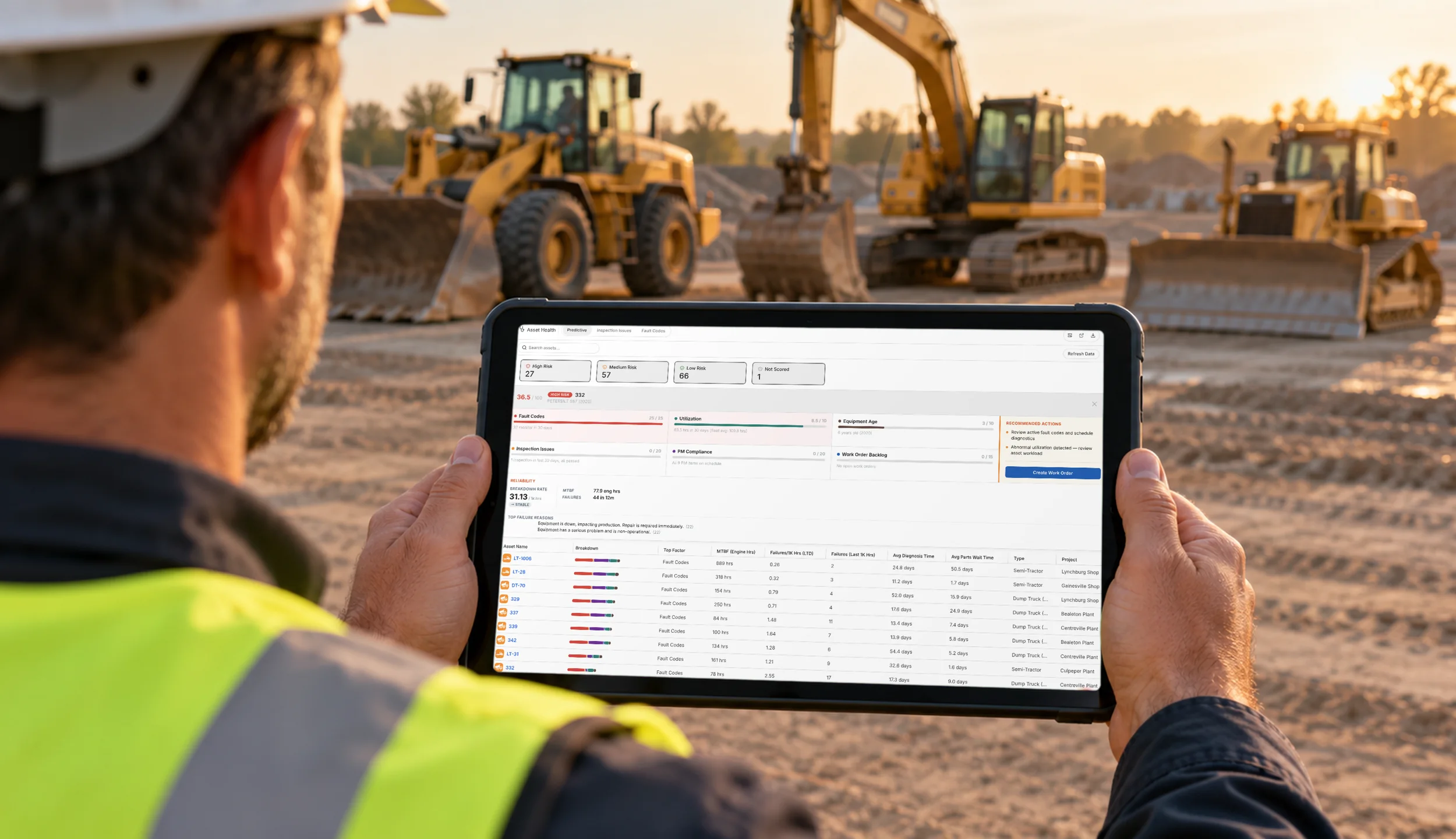
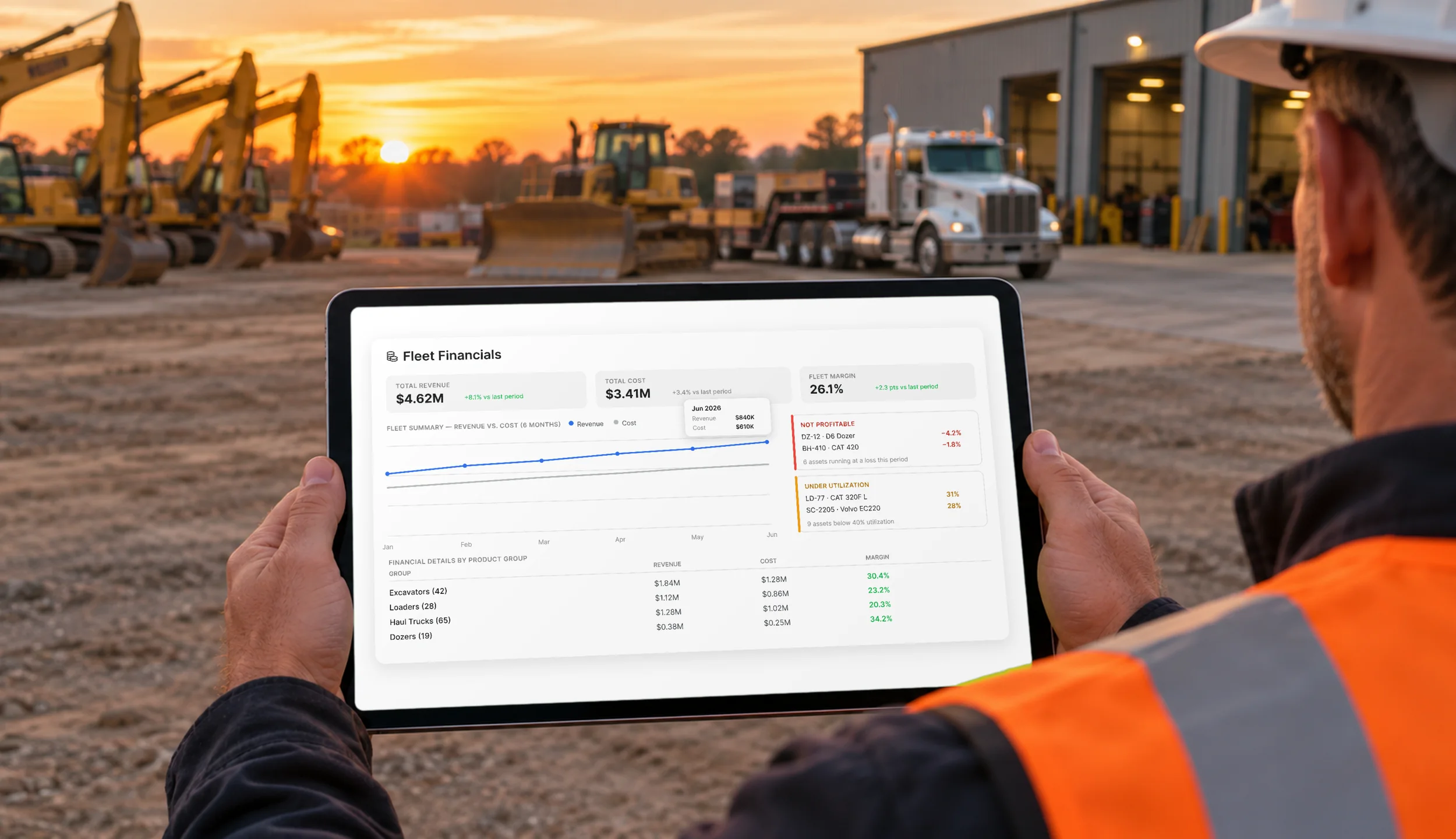
This is where enterprise telematics for heavy equipment earns its place. When utilization, repeat-failure rates, diagnostic trouble codes, and comparative repair costs flow into one view, maintenance leaders stop arguing with finance and start informing them.
The team can answer, machine by machine, which assets are worth continued servicing, which should be retired early before the U-curve punishes the fleet, which can be shifted between regions to balance utilization, and which to stop owning and start renting. That is capital allocation, not workshop administration.
4. The workflow finally closes
The classic failure mode is a fault that gets seen but never fixed properly. It shows up on a dashboard, a ticket gets opened somewhere, a technician checks the wrong asset, a part is ordered but does not arrive, and the warranty claim quietly disappears.
A connected upkeep system stitches the entire chain into one continuous flow. A live fault triggers an inspection, which generates a work order, links to parts availability, routes to the right vendor, records the invoice, captures warranty recovery, and updates the meter once resolved. Miss any of those links, and the fleet pays twice.
Where Do Most Telematics Solutions Fall Short in Construction?

Most telematics solutions fall short in construction because the marketing story assumes data is standardized, systems integrate smoothly, and visibility solves most problems. The real complexity sits underneath those assumptions, and that is where enterprise decisions break.
1. Interoperability has limits in mixed construction fleets
Standards such as ISO/TS 15143-3 have improved how machine data is shared between systems. They define a common structure for transmitting equipment data from OEM platforms to customer applications. The standard does not fully normalize the data itself.
Fault codes, for example, remain OEM-specific. Each manufacturer uses its own definitions, which means fault interpretation still requires OEM-specific mapping, diagnostic context is not standardized, and integration effort is reduced but not eliminated. The data pipeline is standardized. The meaning of the data is not.
2. Real-time data in construction is often delayed or incomplete
Telematics is often described as real-time, but in practice the description depends on how data is collected and transmitted. The ISO specification itself allows for update intervals of up to 15 minutes, with variability based on connectivity and device settings.
Field studies highlight additional constraints. Not all OEMs support the same protocols. Some data is encrypted or commercially restricted. Missing data intervals are common due to GNSS loss or device limitations. Cellular connectivity is inconsistent across job sites. The result is that "real-time visibility" is often delayed, partial, or inconsistent across assets, and operations designed around perfectly live data lead to incorrect assumptions.
3. Standard telematics data is not enough for advanced maintenance
Most mixed-fleet integrations provide baseline data. Location, engine hours, idle time, basic utilization. That is useful for tracking. It is not enough for deeper operational decisions.
For example, Volvo Construction Equipment separates its APIs into standard endpoints for basic data and extended APIs for diagnostics, energy usage, and battery performance. Caterpillar provides ISO-compliant data for general use and enriched data through platforms such as VisionLink. In both cases, advanced data may require paid access, fault-code context may sit in separate service systems, and integration is not handled by the OEM.
The implication is clear. Standardization reduces friction. It does not eliminate the need for OEM-specific data layers, additional subscriptions, or internal integration capability.
4. Connected equipment expands cybersecurity risk
Most telematics discussions stop at "secure cloud platforms." That is not enough at enterprise scale. According to guidance from the UK National Cyber Security Centre, connected devices increase the attack surface of an organization. A compromised device can become an entry point into broader systems.
Key requirements include secure update mechanisms, strong authentication, encryption of data in transit and at rest, centralized monitoring and logging, and recovery mechanisms after compromise. The National Institute of Standards and Technology frames this more directly. Connected devices are not just tools. They are system components that change the overall risk profile of the organization, which makes telematics adoption a security and governance decision as much as an operational one.
What Makes a Purpose-Built Platform Different for Construction Asset Maintenance?

A purpose-built platform is different because it does not just add another visibility layer. It connects inspections, telematics, maintenance workflows, and utilization into a single system. That is exactly where most fleets struggle today.
Most fleets do not struggle because they lack tools. They struggle because their systems do not connect. Faults are detected. Inspections are completed. Work orders are created. Each step lives in a different place, handled by different people, with no guarantee that one leads to the next.
Clue is built for mixed-fleet construction environments where data is fragmented across OEM portals and disconnected tools. Fault codes do not sit in dashboards. Inspection findings do not stay isolated. Work orders do not rely on manual follow-up. The full sequence moves in one continuous workflow, from detection to resolution.
Platforms in this category are often evaluated as part of the best heavy equipment telematics solutions, but the real difference is not tracking or alerts. It is whether the system can handle the messy part. Connecting fragmented data and turning it into action without delay.
What Does a Scalable Enterprise Operating Model Look Like?
A scalable enterprise operating model for construction asset maintenance rests on five connected layers. It is less a product checklist and more an architecture.
The mixed-fleet data layer is built on standard telematics exchange where possible, with OEM-specific enrichment where necessary. The maintenance execution layer connects faults, inspections, and meter readings directly to work orders, with no re-keying and no orphan tickets. The parts and inventory layer keeps upkeep from being delayed by stock-outs, and pre-positions critical spares based on predicted failure modes.
The workforce and skills layer addresses what every contractor now feels at scale. The diesel technician shortage is real. Maintenance maturity depends on knowing which technicians are certified for which OEMs, where they are stationed, and how scheduling matches technician availability to expected service load. Without that visibility, the layers above produce work orders that nobody can execute on time.
The commercial and governance layer ties cost per operating hour, warranty recovery, vendor performance, and device security into one accountable view. This is where finance, procurement, and IT meet maintenance. Strong ERP and CMMS integration is what makes this layer useful, instead of decorative.
Enterprises do not fail because they lack dashboards. They fail because data, work, parts, people, and accountability sit in separate kingdoms that do not share a common language.
Industry Illustration: When Uptime Becomes a Customer Metric

The principle applies clearly across the equipment rental segment. Sunbelt Rentals operates more than 14,000 product types across over 1,200 locations in North America and the United Kingdom. At that breadth, uptime stops being a maintenance KPI and becomes a customer-experience KPI.
The stated requirement at companies operating at this scale is a full-fleet solution that proactively improves uptime and prevents delays on customer projects. When the business model is renting productivity to other contractors, every unplanned breakdown is someone else's bid slipping. Construction equipment maintenance, in its proper form, is not just turning wrenches. It is preventing delays, bad handovers, and revenue leakage before any of those reach the client invoice.
Why Do Telematics Alerts and Asset Identification Matter?
Telematics alerts and heavy equipment identification matter because they prevent the unglamorous, expensive problems that erode margin between the big wins. The predictive-maintenance story gets the attention. The alert and identification layer does the everyday work.
What high-value alerts actually look like
- Geofence breach alerts flag unauthorized movement outside of working hours, which is the first line of defense against theft and after-hours misuse.
- Idle threshold alerts flag sustained idling beyond a configured limit, which directly attacks the largest driver of wasted fuel and unnecessary engine hours.
- Fault code severity alerts escalate only when a code crosses a defined severity threshold, which prevents alert fatigue while catching genuine risks.
- Operator misuse alerts trigger on unsafe RPM, harsh braking, or overload events.
- Service-due cascades do not just flag a single machine. They route the work order to the right technician, with the right parts pre-staged.
Why asset identification is harder than it sounds
In a mixed construction equipment fleet, knowing which machine is which is harder than it sounds. Identical serial-number formats across OEMs, inconsistent naming conventions across regions, attachments that shift between parent machines, and assets transferred between divisions without records all create a silent data-quality problem.
Telematics platforms that invest in strong identification, such as barcode, RFID, or QR-backed asset tracking tied to telematics serial numbers, produce cleaner utilization data, cleaner cost allocation, and cleaner warranty records. It is an unglamorous capability that pays off every single day in accurate decisions.

How Should Enterprise Fleets Evaluate Their Own Maintenance Maturity?
Enterprise fleets should evaluate maintenance maturity across four layers. These questions separate high-maturity fleet operations from dressed-up spreadsheets.
1. The data layer
Does the fleet have a single record per physical asset, or multiple conflicting ones? What percentage of the fleet reports engine hours, idle time, and fault codes reliably? Where are the OEM-data gaps, and what is the business cost of each one?
2. The execution layer
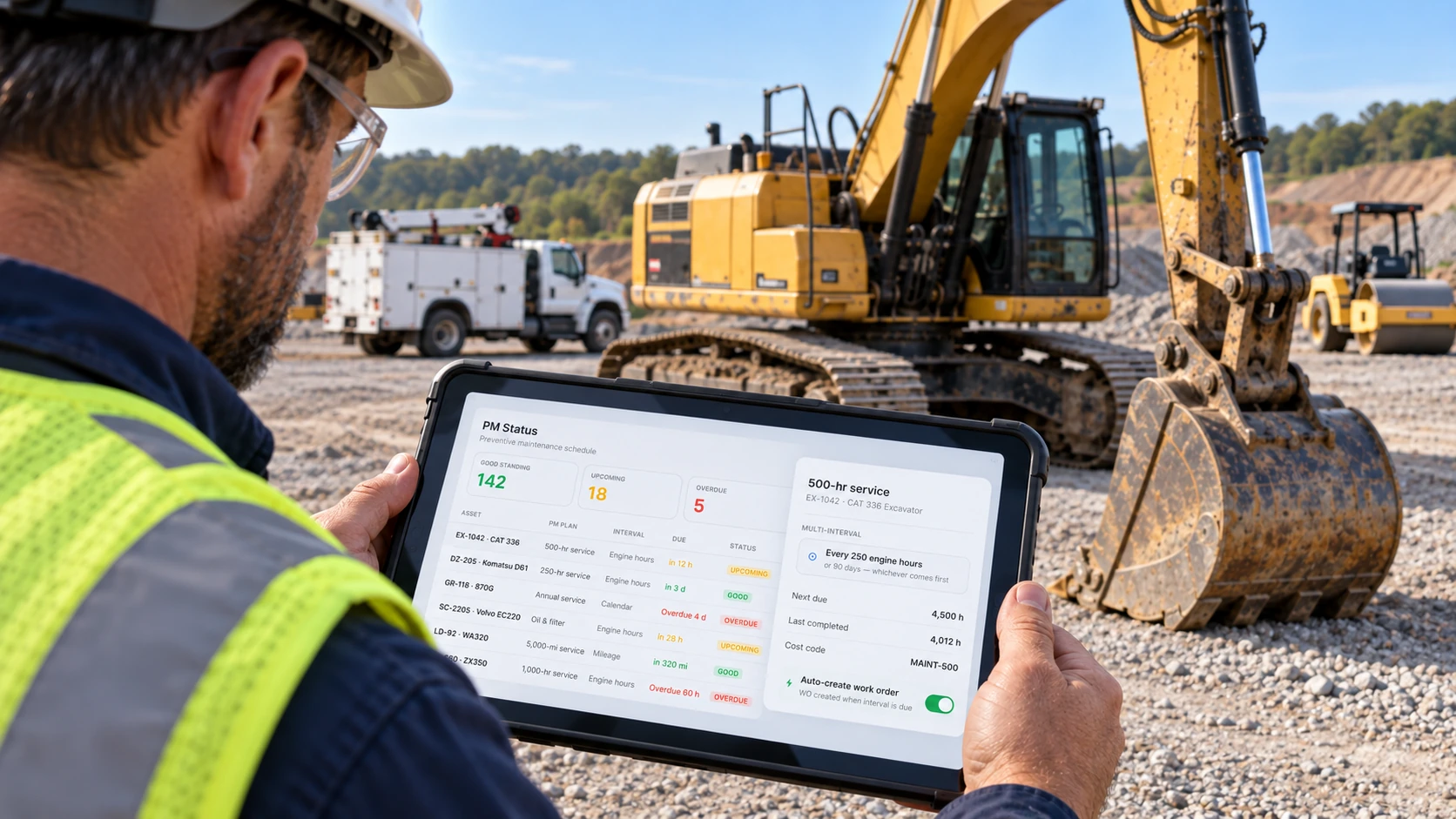
How long does it take from fault-code trigger to technician dispatch? What percentage of work orders need a second shop visit? How often does the right part arrive before the technician does? How does PM schedule compliance trend month over month, given that compliance below 85 to 90% typically signals rising failure rates in the next cycle?
3. The commercial layer
What percentage of in-warranty repairs are successfully recovered from OEMs? Can the team benchmark vendor turnaround time across regions? Does the fleet have a defensible view of cost per operating hour per asset class, and a working measure of mean time between failures for critical machines?
4. The governance layer
Who owns device life cycle, including provisioning, retirement, and credential rotation? How are telematics data flows documented for audit and security review? Is there a named accountability path when a connected asset is compromised?
How Should You Choose the Best Heavy Equipment Telematics Solutions?

The best heavy equipment telematics solutions are chosen by evaluating execution, not hardware specifications or tracking features. Telematics on its own does not solve maintenance or uptime problems. It provides visibility. The platforms that matter are systems that determine how data turns into action.
The evaluation should focus on how mixed OEM data is interpreted, how maintenance workflows connect to parts, work orders, and costs, how the system behaves when data is delayed or incomplete, how newer asset types such as electric equipment are handled operationally, how easily the platform integrates with existing systems, and how security and device governance are managed across the fleet. These factors determine whether a platform improves outcomes or simply increases visibility.
Clue is an operations system that connects telematics data with maintenance workflows. It brings together multi-OEM equipment data, preventive maintenance planning, digital work orders, and utilization and cost tracking into a single workflow. Instead of leaving telematics data in dashboards, the system links it directly to maintenance actions and operational decisions.
For teams evaluating heavy equipment telematics solutions across mixed fleets, the real question is not which platform tracks assets best. It is which platform ensures that detected issues actually lead to timely action.
What New Challenges Shape Construction Asset Maintenance Today?

Construction asset maintenance now extends beyond mechanical upkeep. As fleets evolve, four challenges introduce constraints that traditional maintenance processes were never designed to handle. We cover the broader set in our deeper guide to construction equipment maintenance challenges.
1. Battery performance and degradation management
Electric equipment introduces a different failure profile. Instead of visible wear, degradation happens gradually and often without clear surface indicators. Maintenance now needs to account for how batteries age over time, how repeated charge cycles affect performance, and how thermal conditions under load influence reliability. Without structured tracking of these factors, performance drops quietly until it starts affecting runtime and productivity.
2. Charging as an operational constraint
Charging is not just an energy requirement. It becomes a scheduling variable that directly affects equipment availability. Maintenance planning must align charging cycles with project timelines, site energy capacity, and equipment demand. A delay in charging, or a mismatch in scheduling, creates the same disruption as a mechanical failure even though nothing is technically broken.
3. Software updates and system stability
Over-the-air updates introduce a layer of software dependency that did not exist in traditional fleets. Equipment behavior can change based on software versions, which means maintenance must include controlled rollout, visibility into system states, and the ability to respond if an update causes issues. Without that structure, updates introduce inconsistency across assets and disrupt operations in ways that are harder to diagnose than mechanical faults.
4. Sensor reliability in assisted and autonomous equipment
Modern machines rely heavily on sensors for operation, safety, and performance optimization. Maintenance is no longer limited to physical components. It must also ensure that sensor data remains accurate and reliable. Calibration issues, signal degradation, or faulty inputs lead to performance problems that are not tied to traditional mechanical failure.
Where Construction Asset Maintenance Actually Decides Profit
Construction asset maintenance is not, and never was, a back-office discipline. At enterprise scale, it is the function that quietly decides whether bids hold, whether crews stay productive, whether capital is earning its keep, and whether clients stay loyal.
Maintenance is no longer just what happens after equipment fails. It is the operating discipline that decides whether assets protect margin or drain it.
With Clue, fleet teams track equipment life cycle, manage predictive maintenance, and reduce downtime from one connected platform. See how it works on a real fleet.
Frequently Asked Questions
1. Why do identical machines have different maintenance costs in the same fleet?
Because operating conditions affect asset wear more than specifications. Load intensity, terrain, operator behavior, and duty cycles create unique stress patterns. Without condition-based tracking, both machines follow the same maintenance schedule, resulting in uneven failures and inconsistent cost profiles.
2. How does poor asset identification affect maintenance decisions?
Inconsistent asset labeling or duplication across systems leads to unreliable data. This fragmentation impacts maintenance history, utilization tracking, and cost-per-hour calculations, causing incorrect repair decisions, missed warranty claims, and overall inefficiency. Clean identification is key for accurate decisions.
3. What is the biggest hidden delay in construction equipment maintenance?
The main delay is the gap between detecting a fault and taking action. Faults are often spotted early through inspections or telematics, but delays in assignment, parts availability, or ownership can extend downtime far beyond the actual repair work.
4. Why don’t preventive maintenance programs reduce downtime in large fleets?
These programs often assume uniform wear across all assets, but real-world conditions cause uneven degradation. Some machines get over-serviced while others fail between scheduled intervals, making downtime unpredictable despite a regular maintenance schedule.
5. How does maintenance impact project scheduling beyond equipment availability?
Maintenance decisions affect task sequencing. Delayed or unreliable assets can disrupt critical-path tasks, force rescheduling across crews, and cause downstream delays that extend beyond the original failure. Maintenance has a broader operational impact.
6. Why is telematics data underutilized in construction fleets?
Data from telematics systems is often collected but not operationalized. While these systems offer visibility into location, hours, and fault codes, the lack of workflow integration prevents turning this data into prioritized actions. Without execution, it remains simply informational.
7. When should a construction company replace equipment instead of repairing it?
When the cost of repairs, delays, and lost productivity outweighs the cost of replacement or rental alternatives. As assets age, repair costs increase exponentially, and downtime impact grows. Once the combined costs become economically inefficient, replacement is a better option.
8. How does maintenance maturity influence capital allocation decisions?
Mature maintenance systems provide valuable insights into asset performance, failure patterns, and cost trends. This clarity helps companies make informed decisions on whether to retain, retire, redeploy, or replace equipment. Without this insight, capital decisions tend to be reactive and misaligned with actual asset value.

Transform Your Equipment Management