What Is Mean Time to Repair (MTTR)? A Complete Overview


Hi, I’m Maham Ali. I write about construction equipment management, helping teams use fleet data and maintenance intelligence to improve uptime, control costs, and run smoother jobsites.
MTTR does not live in a dashboard. It shows up in delays, idle crews, and decisions that take too long.
A piece of equipment goes down. Work slows or stops. People start asking questions. Where is it? Who owns it? What is wrong? How long will it take? Every minute between those questions and a clear answer is part of your MTTR.
This is not a small problem. Deloitte research on predictive maintenance reports that unplanned downtime costs industrial manufacturers an estimated $50 billion every year, while poor maintenance strategies can reduce productive capacity by 5 to 20 percent. In construction, the issue shows up directly in fleet availability: For Construction Pros reports that unplanned downtime rates of 20 to 30 percent are not uncommon across heavy equipment fleets.
Most explanations reduce MTTR to a simple formula. That is technically correct, but it misses what matters in construction. MTTR is not just about repair speed. It is about how quickly your operation responds, aligns, and executes under pressure.
What is Mean Time to Repair (MTTR)?
.webp)
Mean Time to Repair (MTTR) is the average time required to fix a failed asset and return it to working condition. In construction, many teams track MTTR as a broader recovery window, from failure detection through repair, validation, and return to service. The key is to define the start and end points clearly before comparing the metric across assets, jobsites, or vendors. It is one of the most widely tracked maintenance KPIs and is used to evaluate how efficiently a team responds to and recovers from equipment downtime.
In construction, MTTR is more than a maintenance metric. It is a direct reflection of how well a fleet operation handles pressure when an asset fails on a job site.
What does MTTR include beyond repair time?
MTTR includes every minute between failure and full return to service, not only the time spent turning a wrench. In construction environments, the total MTTR usually breaks down into six distinct stages:
- Detection. The delay between failure and the moment the team becomes aware of it. Operators may continue using equipment despite early warning signs, or issues may go unnoticed until performance drops noticeably.
- Reporting. The time it takes to communicate the issue. In many fleets, this still happens informally through calls or messages, which adds delay and often produces incomplete information.
- Assignment. The lag in establishing ownership. Is the repair handled internally, by a vendor, or under warranty? Unclear ownership alone can add hours.
- Diagnosis. The time spent identifying what is wrong. Without access to historical data or fault insights, diagnosis becomes trial and error, especially in mixed fleets.
- Repair execution. The most visible stage. The actual physical work. It is rarely the longest part.
- Validation and return to service. The time to test, confirm operational status, and reassign the asset. Often overlooked, often slow.
Each of these stages adds friction. In most fleets, the majority of downtime comes from these coordination gaps, not from the repair itself. Improving MTTR is rarely about hiring faster mechanics. It is about removing the silent delays that sit between detection and action.
What does MTTR stand for? Repair, Recovery, Resolve, or Respond?
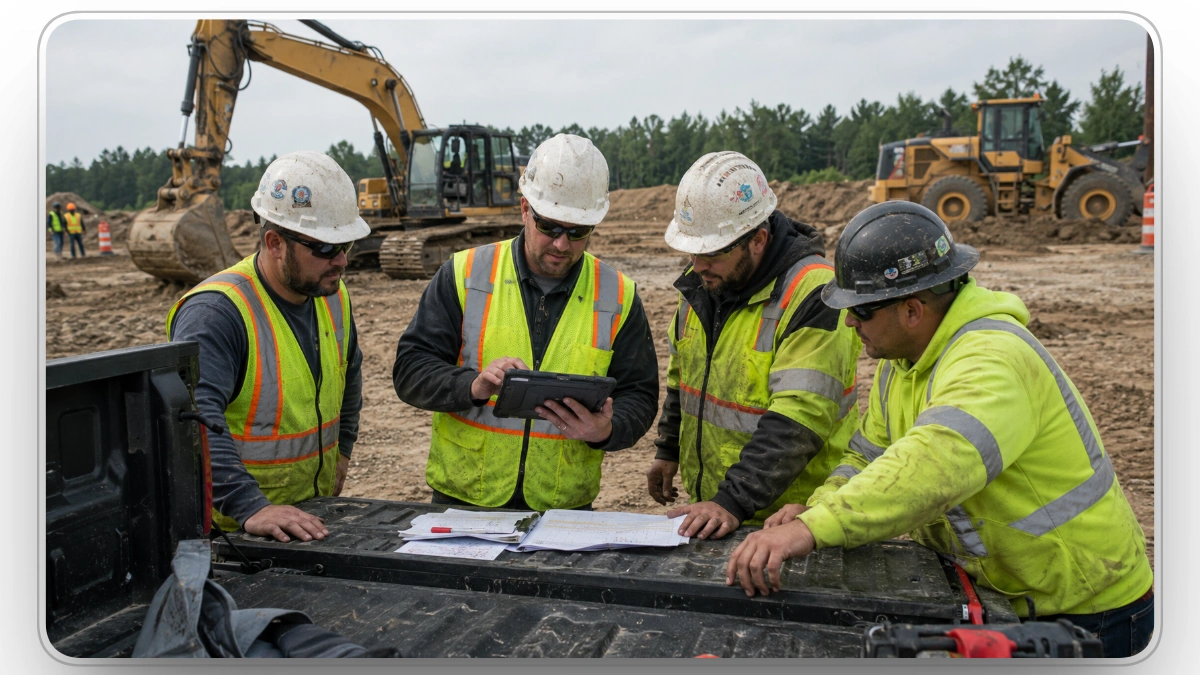
The same acronym is used for four different metrics, and confusion between them is one of the most common reasons MTTR data is misread.
- Mean Time to Repair measures the time spent actively fixing the asset, from when work begins to when the repair is complete.
- Mean Time to Recovery measures the time from failure until the asset is fully back in service. It includes detection, diagnosis, repair, and validation.
- Mean Time to Resolve is often used in IT and includes everything in recovery plus the work done after the incident to prevent it from happening again.
- Mean Time to Respond measures the time from when an alert is received to when someone begins working on it.
Most construction teams use Repair or Recovery, but they rarely define which one. Two fleets reporting the same MTTR can be measuring completely different things. Before tracking the metric, decide which version you are using and apply it consistently across every asset and every job site.
What is the MTTR formula? How is MTTR calculated?
The MTTR formula is straightforward:
MTTR = Total Repair Time ÷ Number of Repairs
On paper, the formula works in any environment. In practice, the inputs that feed into MTTR are rarely consistent across construction fleets, where assets move between sites, conditions change daily, and external vendors are often involved.
The biggest issue is not the formula itself. It is how "repair time" is defined. Some organizations start counting from the moment maintenance begins. Others start from the moment a failure is detected. Some include delays caused by logistics or approvals. Others exclude them entirely. These inconsistencies make MTTR highly sensitive to internal definitions, which is why two fleets reporting the same number can be operating at completely different levels of efficiency.
A worked example of MTTR in construction
A contractor runs a fleet of 12 excavators across three job sites. Over one month, the fleet experiences four unplanned breakdowns. The downtime for each repair, measured from failure to return to service, looks like this:
- Excavator A: hydraulic line failure, 4 hours
- Excavator B: electrical fault, 9 hours
- Excavator C: engine sensor issue, 3 hours
- Excavator D: track tensioner failure, 16 hours
Total downtime is 32 hours. The number of repairs is 4. MTTR for the fleet that month is 8 hours.
On its own, that number tells you very little. It does not explain why Excavator D took 16 hours, or whether the delay was in detection, parts sourcing, or vendor scheduling. It does not show that three of the four repairs were completed in under 9 hours, while one outlier dragged the average up. This is why MTTR is only useful when paired with the breakdown by stage, asset, and failure category. The single number is a starting point, not an answer.
Why is MTTR important in construction?

MTTR is important because it directly affects asset availability, project schedules, rental costs, and how much margin a contractor keeps on a job. The financial signal is hard to argue with: Deloitte research on smarter maintenance places the global cost of unplanned downtime at roughly $50 billion per year and notes that poor maintenance strategies can drag a plant's productive capacity down by 5 to 20 percent. In construction, where margins are tight and crews stand idle the moment a critical asset goes down, the local impact is even sharper.
For maintenance managers, MTTR helps answer three decisions that come up constantly.
1. Should an asset be repaired or replaced?
A consistently low MTTR means the asset can be quickly restored to peak performance with reasonable cost and effort. Assets with consistently low MTTR are often stronger repair candidates, especially when repair cost, utilization, age, and replacement value still support keeping them in service.
A consistently high MTTR is a different story. An asset that takes a long time to repair, repeatedly, drags entire schedules with it. In most cases, replacing the asset is more economical than absorbing the downtime cost.
2. When should preventive maintenance be performed?
MTTR can validate whether a preventive maintenance program is working. If MTTR trends down across a fleet over several quarters, the program is doing its job. If MTTR stays flat or climbs, something needs to change, whether that is intervals, scope, or quality of execution.
3. What is slowing down repair times?
MTTR can pinpoint bottlenecks once it is broken down by stage. A high portion of time spent in detection points to weak inspection or telematics coverage. A high portion in diagnosis points to a parts inventory or expertise gap. A high portion in execution points to scheduling and labor availability. The metric becomes diagnosable as soon as it stops being a single number.
What are the benefits of tracking MTTR?

Tracking MTTR offers concrete operational and financial benefits to construction fleets, especially when it is broken down by stage and asset.
1. Reduced unplanned downtime
MTTR data reveals where time is actually being lost. Once the bottleneck is visible, it is fixable. Reducing downtime keeps crews productive and projects on schedule, and it directly limits the cost-per-hour exposure that hits hardest when critical equipment fails.
2. Stronger asset reliability
MTTR identifies which equipment consistently takes longer to repair, which often points to deeper reliability issues. This insight supports better repair-versus-replace decisions and longer asset life across the fleet.
3. Lower repair costs
Repairs that drag out cost more in labor, rentals, and rework. A lower MTTR usually translates directly into lower total cost per failure. Over a full year, the difference between a controlled MTTR and a reactive one can run into the hundreds of thousands of dollars on a mid-sized fleet.
4. More accurate project planning
Predictable MTTR means project managers can plan around realistic recovery windows instead of worst-case assumptions. Schedule risk drops as soon as MTTR becomes consistent, and crew utilization improves because field teams stop being held hostage by unpredictable repair timelines.
5. Data-driven maintenance decisions
MTTR provides a measurable baseline for evaluating vendors, technicians, repair processes, and maintenance investments. Without it, every improvement decision is based on opinion. With it, every change in process can be tested against an objective number.
How does MTTR compare to MTBF, MTTF, MTTA, and MTTD?
MTTR is one of several reliability metrics that operations teams use to understand asset performance. Each one answers a different question, and they are most useful when read together.
In practice, most fleets track only MTTR, which gives a partial view. Tracking MTTD and MTTA alongside it reveals where the delays actually start, which is almost always before the wrench ever touches the equipment. For a wider view, see our guide on the best metrics to measure equipment reliability, where MTTR is treated as part of a metric set rather than a standalone number.
Why is the average MTTR misleading?
Average MTTR can be misleading because repair times are not evenly distributed. A few long-duration incidents can pull the average sharply upward, even when most repairs are completed quickly. This is why median and percentile views give a more accurate picture of typical performance.
If three repairs take 2 hours, 3 hours, and 20 hours, the average MTTR is 8.3 hours. But most repairs are actually completed within 3 hours. The median (3 hours) reflects reality far better than the average.
What more mature teams track
- Median MTTR
- 90th percentile MTTR (worst-case scenarios)
- MTTR by asset type
- MTTR by failure category
This level of detail reveals where delays are concentrated and where improvements will have the highest impact.
What are the common challenges in calculating MTTR in construction?

Calculating MTTR accurately in a construction environment is harder than it appears. Several specific challenges show up across most fleets.
1. Inconsistent recording of repair times
Without standardized procedures for capturing failure time, repair start time, and return-to-service time, the data quickly becomes unreliable. Different operators or technicians often record events differently, which means the same incident can produce different numbers depending on who logs it.
2. Variations in repair complexity
A simple hydraulic hose change and a full transmission rebuild both count as repairs, but they have nothing in common in terms of time. Without segmenting MTTR by failure type, the average loses meaning, and small recurring issues get lost behind a few big ones.
3. Limited data integration
Many fleets still rely on disconnected systems, spreadsheets, or paper records. When inspection data, work order data, and repair logs do not flow into the same place, MTTR has to be reconstructed manually, which introduces errors and delays. Bringing fleet data into a single platform is the structural fix for this.
4. External factors outside the team's control
Vendor scheduling, parts availability, warranty processes, and rental approval cycles all extend repair time. They are often invisible inside the MTTR number unless they are tracked separately, which makes it easy to blame internal teams for problems caused by external dependencies.
5. Unclear definition of "repair time"
Should the clock start at detection or at work start? Should it include validation and testing? Should it include time waiting for parts? Without an agreed definition, MTTR cannot be compared across periods, sites, or vendors.
6. Selective ticketing
When small failures go unticketed and only large ones are recorded, the dataset skews toward worst cases. The reported MTTR looks higher than the real picture, and small recurring issues stay invisible until they become big ones.
Addressing these challenges requires a combination of standardized procedures, clear definitions, and a single source of data that all teams use consistently. For more on this, see our guide on construction work order management.
What causes high MTTR in construction?
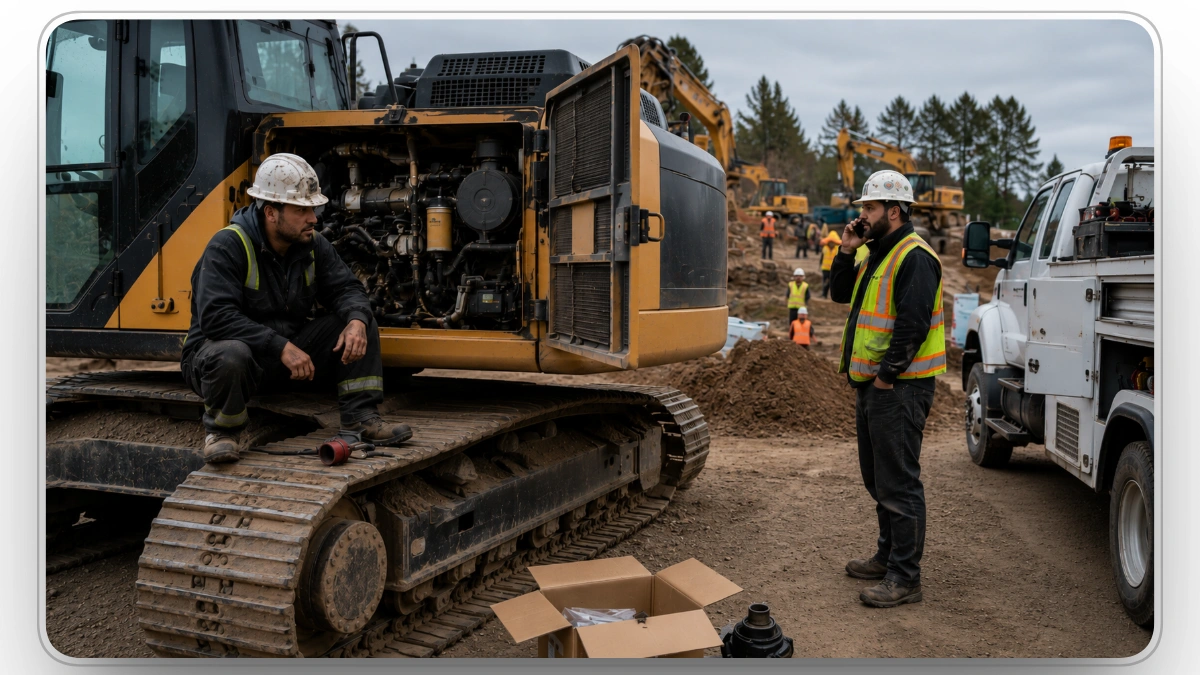
A high MTTR is rarely caused by slow mechanics. It is usually caused by systemic issues that delay every stage of the response.
1. Limited asset visibility
If teams cannot immediately identify where an asset is, who last used it, or what condition it is in, response time increases automatically. Hours can be lost just establishing the basic facts of the failure. Real-time construction asset tracking software closes this gap by giving every team member instant location, status, and usage history for every machine.
2. Weak inspection feedback loops
Inspections are frequently completed but not acted on. When issues are documented but not escalated, small faults turn into major failures, which then take far longer to repair than they would have if caught early.
3. Vendor and rental dependencies
External repair processes introduce delays that are often not tracked. Approval cycles, scheduling constraints, and limited visibility into vendor progress all contribute to longer MTTR, especially for warranty work and rental returns.
4. Parts and inventory constraints
A repair cannot proceed without the right parts. When inventory data is unclear or unavailable, teams lose time deciding what to do next, ordering parts that should already be on hand, or waiting for emergency shipments.
5. Fragmented communication
When information is spread across calls, texts, emails, and paper logs, coordination slows down. Updates are missed, duplicated, or delayed, and decision-making becomes reactive instead of structured.
For a closer look at the root causes behind extended downtime, explore our guide on how to reduce construction equipment downtime.
How to reduce MTTR in construction (step by step)
.webp)
Reducing MTTR is a process discipline, not a speed contest. The fleets with the best MTTR control the steps between failure and resolution. The following actions consistently move MTTR in the right direction.
1. Standardize how failures are reported
Replace calls and informal messages with a structured reporting process. Every failure should be logged with the asset ID, location, fault description, and time of detection. Structured work order management makes this consistent across every team and every job site, and removes the ambiguity that delays diagnosis.
2. Predefine ownership for every asset category
Decide in advance who handles each type of repair: internal team, vendor, or rental provider. When ownership is predefined, no time is lost arguing or escalating. Critical assets should have predefined response paths and priority thresholds.
3. Move from time-based to condition-based maintenance
Time-based maintenance assumes failures follow predictable intervals. They rarely do. Condition-based maintenance uses real-time inputs, like engine hours, vibration, and fault codes, to trigger work before a small issue becomes a major failure. The financial case for the shift is strong: Deloitte's analysis of predictive maintenance found that mature predictive programs can increase equipment uptime and availability by 10 to 20 percent and cut overall maintenance costs by 5 to 10 percent.
4. Connect inspections directly to work orders
When an operator finds an issue during a daily inspection, that issue should generate a work order automatically, with the asset, location, and fault category attached. This removes the most common delay in MTTR: the gap between detection and action.
5. Standardize repair playbooks
Common failure types should have predefined diagnostic steps and parts lists. Standardized playbooks reduce trial-and-error diagnosis and shorten repair execution. They also make repair times comparable across technicians and shifts.
6. Track repair time by stage, not just total
Break down MTTR into detection, reporting, assignment, diagnosis, execution, and validation. The stage with the most lost time is the one to fix first. Without this breakdown, "improving MTTR" is a guess.
7. Use a CMMS to centralize repair history
A construction CMMS keeps every inspection, work order, and repair tied to the asset. Historical context speeds up diagnosis on the next failure and supports better repair-versus-replace decisions over time.
8. Build a fault categorization standard
Standardized fault codes (hydraulic, electrical, engine, structural) make MTTR comparable across assets and across time. Without categorization, the data shows trends that are not real and hides trends that are.
How to measure MTTR accurately in the field
Accurate measurement depends on capturing the right data consistently. At a minimum, every incident should record:
- Failure time
- Detection time
- Repair start time
- Repair completion time
- Return-to-service time
Without this structure, MTTR becomes unreliable and difficult to act on. With it, MTTR becomes a tool that points directly at the next improvement.
What is a good MTTR benchmark for construction equipment?
There is no universal answer to what a good MTTR is, but practical guidance does exist. For critical heavy equipment such as excavators, loaders, and cranes, an MTTR of 4 to 8 hours is generally workable for repairs handled in-house. When vendor involvement, parts sourcing, or warranty processes are required, that range typically extends to 24 to 72 hours. For non-critical or support assets, longer MTTR is often acceptable because the operational impact is smaller. A light tower or a portable compressor with a 24-hour MTTR may not affect project timelines, while the same number on a primary excavator can stop work entirely.
These ranges are starting points, not targets. The right benchmark depends on equipment type, project criticality, and the real cost of downtime in your specific operation. Two fleets with identical 6-hour MTTR can be performing very differently if one has a 30-hour 90th percentile and the other has a 9-hour 90th percentile. The average looks the same. The actual exposure does not.
This is why effective benchmarking focuses on patterns rather than a single number:
- Assets with consistently high MTTR
- Failure types that drive delays
- Variability across job sites or projects
- Predictability of repair timelines
The more useful question is not "what is a good MTTR" but "is our MTTR predictable, and is it trending in the right direction." Predictability matters more than the absolute number, and patterns are far more actionable than a generic industry target.
How does MTTR relate to Service Level Agreements (SLAs)?
In construction, MTTR is not just an internal metric. It often appears in contracts. Equipment rental agreements frequently include uptime guarantees or maximum repair windows, where the rental provider commits to restoring service within a defined number of hours after a failure is reported. Maintenance contracts with OEMs and third-party vendors often work the same way, with response time and repair time written in as service level commitments. Tracking these contracts cleanly is exactly what rental equipment management is built to handle.
This matters for two reasons.
First, when MTTR is contractually defined, the way it is measured needs to match the contract. If the rental agreement starts the clock when the issue is reported, but your internal tracking starts when work begins, the two numbers will never agree. Disputes over downtime credits usually come from this mismatch.
Second, vendor MTTR should be tracked separately from internal MTTR. Mixing them hides where the real delays come from. A fleet with strong internal repair performance but slow vendor turnaround will see a high overall MTTR and waste time looking for the problem in the wrong place.
When MTTR feeds into a service level agreement, the metric stops being a maintenance KPI and becomes a financial and contractual control point. It needs to be measured with the same rigor as any other contract term.
What is the real impact of MTTR on construction performance?
MTTR is not just a maintenance metric. It directly affects operational and financial outcomes across a construction business.
- Higher MTTR reduces equipment utilization and asset availability.
- Delayed repairs cause rental cost leakage on extended rental periods.
- Unpredictable repair times disrupt project scheduling and crew planning.
- Delayed repairs escalate into more severe and more expensive failures.
- Without MTTR data, vendor and replacement decisions become guesswork.
Conclusion
MTTR becomes predictable the moment teams stop treating it as a single number and start treating it as a sequence of stages, each of which can be measured and improved. Detection, reporting, assignment, diagnosis, execution, and validation each contribute to the total. Fix the slowest stage and total MTTR drops without any one technician working faster.
Clue’s construction equipment maintenance software brings asset tracking, inspections, fault reporting, work orders, and maintenance history into one system. Every field issue is tied to a specific asset, assigned through a structured workflow, and tracked in real time, turning MTTR from a number teams observe into a process they can control.
FAQs
What does MTTR stand for?
MTTR stands for Mean Time to Repair. The same acronym is also used for Mean Time to Recovery, Mean Time to Resolve, and Mean Time to Respond. Teams should agree on which version they are using before tracking the metric, otherwise two reports showing the same number may be measuring completely different things.
What is a good MTTR for construction equipment?
For critical heavy equipment, an MTTR of 4 to 8 hours is workable for in-house repairs, while vendor-involved repairs often run 24 to 72 hours. There is no universal good number. The more useful goal is a predictable MTTR with a tight 90th percentile, because predictability is what allows project managers to plan around realistic recovery windows.
Why is median MTTR often more useful than average MTTR?
Repair times are usually skewed by a few long incidents, which means the average can misrepresent reality. Median MTTR reflects typical performance more accurately and is harder for outliers to distort, which makes it a better baseline for spotting genuine trends in the data.
How is MTTR calculated?
MTTR is calculated by dividing the total repair time over a period by the number of repairs in that period. The formula is MTTR = Total Repair Time ÷ Number of Repairs. The challenge in construction is not the formula itself but the consistency of the inputs that feed into it.
What is the difference between MTTR and MTBF?
MTTR measures how long it takes to recover from a failure. MTBF (Mean Time Between Failures) measures how long an asset runs between failures. MTTR tells you about recovery. MTBF tells you about reliability. Both are needed for a full view of asset performance, because a low MTTR with frequent failures is still a problem.
How does vendor involvement affect MTTR?
Vendor involvement introduces external delays such as scheduling, approvals, and parts sourcing. Vendor MTTR should be tracked separately from internal MTTR, otherwise external bottlenecks get hidden inside an overall number that looks like an internal problem and pushes teams toward fixes that will not help.
Can reducing MTTR actually increase maintenance costs?
Yes, it can. Aggressively minimizing MTTR can raise costs if it prioritizes speed over efficiency, for example by overstocking parts or relying on premium emergency vendors. The goal is a controlled MTTR, not the lowest possible MTTR at any cost. A predictable MTTR with reasonable spend usually beats a low MTTR achieved through expensive workarounds.
How can a CMMS help reduce MTTR?
A CMMS centralizes inspections, work orders, parts, and repair history against each asset. That removes the coordination delays that drive most MTTR loss and gives teams the data needed to identify and fix bottlenecks over time. Used well, a CMMS turns MTTR from a metric you experience into a metric you manage.
Transform Your Equipment Management