Autonomous maintenance is a pillar of total productive maintenance (TPM) in which operators perform the basic daily care of the machines they run, including cleaning, inspecting, lubricating and tightening, and report problems early.
Clue records those operator findings against the machine. An operator stands closest to the machine every shift. They notice a new leak, sound, smell or loose guard before work starts, so an early report becomes shop work instead of a note nobody reads.
Key Takeaways
- Operators handle daily care. The shop keeps diagnosis, skilled repair and safety-critical work.
- The Occupational Safety and Health Administration (OSHA) already requires a pre-shift check, in the Code of Federal Regulations (CFR).
- Autonomous maintenance is one pillar of total productive maintenance, not a replacement for planned service.
- The U.S. Department of Energy (DOE) reports more than 55 percent of maintenance at the average facility is still reactive.
- Start with one crew or one machine type. Fleet-wide launches fail on unclear checklists.
Autonomous Maintenance vs. Planned Maintenance
Autonomous maintenance and planned maintenance split the same machine between two groups. Operators take the short daily tasks that need no special tools. The shop takes work that needs diagnosis, lockout or a torque spec. Confusing the two is how a guard gets tightened by someone not trained to touch it.
| Dimension | Autonomous Maintenance | Planned Maintenance |
|---|
| Who does it | The operator running the machine | A technician in the shop |
| When | Every shift, before and during work | On an hour or calendar schedule |
| Typical tasks | Clean, inspect, lubricate, tighten, report | Diagnose, service, repair, replace |
| Tools needed | Basic, supplied with the machine | Shop tools, lockout, diagnostics |
| Trigger | The shift starting | A due date, meter reading or defect report |
| Output | A completed checklist and early defect reports | A completed work order |
A preventive maintenance plan sets the shop's service by machine hours or calendar date, which makes it clear which jobs fit the daily checklist and which need scheduled bay time.
What OSHA Requires Before Each Shift
OSHA already requires the core of autonomous maintenance for vehicles on a construction site, which means the daily check is a legal floor rather than an improvement project. The agency behind it, the Occupational Safety and Health Administration, sets the wording below.
All vehicles in use shall be checked at the beginning of each shift to assure that the following parts, equipment, and accessories are in safe operating condition and free of apparent damage that could cause failure while in use: service brakes, including trailer brake connections; parking system (hand brake); emergency stopping system (brakes); tires; horn; steering mechanism; coupling devices; seat belts; operating controls; and safety devices. — U.S. Occupational Safety and Health Administration, Construction standard 29 CFR 1926.601(b)(14)
The same rule adds that all defects shall be corrected before the vehicle is placed in service. Ten named items, checked every shift, with defects fixed first. Build the operator checklist on top of that list rather than beside it.
What Operators Own vs. What the Shop Owns
Operators own daily care. The shop owns anything needing tools, diagnosis or a safety decision. Writing the split down prevents two failure modes. Operators attempt repairs they were not trained for. Or they report nothing, assuming the shop already knows.
| Task | Owner | What it covers |
|---|
| Pre-shift checks | Operator | Walk the machine, then complete the daily inspection for damage, loose parts and unsafe conditions |
| Fluid and grease checks | Operator | Levels listed for that machine, grease points shown on its chart |
| Cleaning and simple fixes | Operator | Radiators, cab, tracks, undercarriage; tighten a bolt or guard only when trained |
| Reporting | Operator | Leaks, new noises and warning lights as they appear, with location and what changed |
| Skilled repairs | Shop | Work needing tools, lockout, diagnostics, or hydraulic and electrical skill |
| Scheduled and safety work | Shop | Scheduled service, and anything affecting how the machine stops, lifts or moves |
How to Roll Out Autonomous Maintenance in a Fleet
Rolling out autonomous maintenance across a fleet takes six steps, and the order matters more than the speed. Each step removes an excuse the next one would otherwise run into.
- Start with a pilot: Choose one crew or machine type, small enough that the operator, technician and supervisor can review every checklist together.
- Clean and inspect together: The operator and a technician clean and inspect each machine as a pair, fixing existing issues so operators start from a known good condition.
- Write daily standards: Build a short checklist per machine type in plain words, with photos and marked grease points. Use a daily inspection that takes minutes, not an hour.
- Train on each task: Show operators how to perform each check on the actual machine, and agree when to stop work and call the shop.
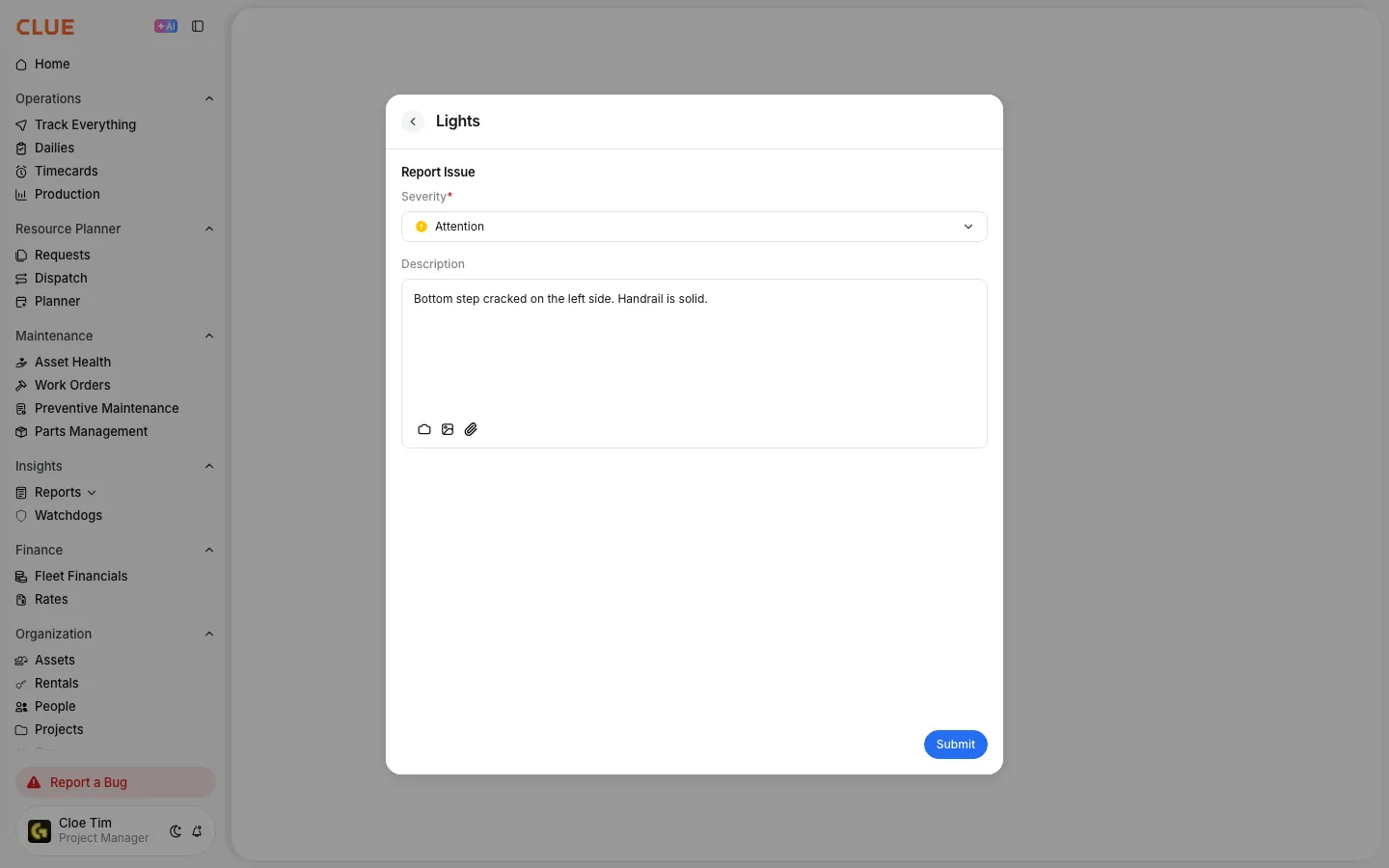
- Make reporting easy: Let operators log a defect at the machine with a photo and a short note, and get it to the shop the same shift.
- Review and expand: Check completion rates and repeat defects weekly, fix unclear steps, then add crews once the pilot holds.
Steps five and six are where the tooling earns its place. Operators run the checklist in the mobile app that ships with Clue's safety and inspection tools, marking each item Pass, Fail or N/A and attaching photos. A failed item becomes an inspection issue the shop can convert into a repair inside Clue's equipment maintenance software, which is what closes the loop step five asks for.
An Example: One Loose Guard, Two Outcomes
For example, an operator spots a loose engine guard during a pre-shift walkaround. Under a working program they log it with a photo. The shop sees it that morning. A technician torques it at the next planned stop. Without one, reporting meant a radio call nobody answered. The guard vibrates free mid-shift. The machine comes out of service in the busiest week of the job. Same defect, same moment, opposite outcome.
Common Mistakes
Four mistakes account for most stalled autonomous maintenance programs, and each has the same root: the daily routine asked for more than the shift could give.
- Checklist runs too long: Keep the daily list short enough to finish during the shift, or operators will sign it without doing it.
- No feedback after reports: Give operators a status or next step, so they know the shop received the issue.
- Tasks need a technician: Keep jobs needing special tools, lockout, diagnostics or repair skill with the shop.
- Fleet-wide launch at once: Start with one crew or machine type, then carry the lessons into the next rollout.
Why Autonomous Maintenance Pays Off
Autonomous maintenance pays off by catching faults while they are still small, which moves work out of the reactive column where it costs the most.
DOE's O&M Best Practices Guide puts the average facility at more than 55 percent reactive, 31 percent preventive and 12 percent predictive. It estimates a preventive program saves 12 to 18 percent against a reactive one. Facilities running a working condition-based program see breakdowns fall 70 to 75 percent and downtime fall 35 to 45 percent, according to DOE. Operators supply the earliest signal in that chain, because they are the only people who see the machine every shift.
Autonomous Maintenance Questions From the Field
Fleet and shop managers ask these autonomous maintenance questions most often when starting a program. Each answer stands alone, so you can reuse one in a training document. Where a requirement comes from OSHA or a figure from DOE, the source is named.
Is autonomous maintenance part of TPM?
Autonomous maintenance is one of the TPM pillars, within a broader approach that also includes planned work by the shop. The pillar covers daily operator care and early reporting. It sits alongside planned maintenance rather than replacing any part of it.
Does autonomous maintenance replace the maintenance team?
Autonomous maintenance does not replace the maintenance team. Operators take on basic daily care and early reporting. Technicians still handle diagnosis, scheduled service and skilled repairs. The pillar is designed to free technician hours for work that needs their training, not to reduce headcount.
How long does an autonomous maintenance rollout take?
An autonomous maintenance rollout starts with a pilot on one crew, which can begin within weeks. A fleet-wide rollout takes longer and depends on fleet size, machine types and how much training each group needs. Expand only after the pilot holds for several consecutive weeks.
Is a daily operator check legally required?
A daily operator check is legally required for vehicles in use on construction sites. OSHA's 29 CFR 1926.601(b)(14) requires a check at the beginning of each shift covering brakes, tires, horn, steering, coupling devices, seat belts, operating controls and safety devices, with all defects corrected before the vehicle is placed in service.
What tasks should operators never do?
Operators should never perform tasks needing lockout, diagnostics, hydraulic or electrical work, or any repair affecting how the machine stops, lifts or moves. Those stay with the shop regardless of how minor they look. An operator tightening the wrong fastener creates a larger problem than the one reported.
How do you measure an autonomous maintenance program?
Measure an autonomous maintenance program on checklist completion rate, the number of defects reported by operators, and how many repeat on the same machine. Rising operator reports early on is a good sign, because it means faults are surfacing sooner rather than appearing as breakdowns later.