Top 10 Construction Inventory Management Software in 2026


Hi, I’m Maham Ali. I write about construction equipment management, helping teams use fleet data and maintenance intelligence to improve uptime, control costs, and run smoother jobsites.
Construction inventory moves constantly between shops, warehouses, service trucks, crews, and jobsites. Without accurate records, contractors may reorder items they already own, lose tools, delay repairs, and struggle to track material or maintenance costs.
The right construction inventory management software shows what is available, where it is stored, how it is being used, and when it must be reordered. It can also connect inventory with purchasing, vendors, work orders, job costs, barcode scanning, and mobile field updates.
Different contractors need different systems. This guide compares 10 platforms for equipment parts, tools, project materials, truck stock, and warehouse inventory based on construction fit, stock control, purchasing, mobile access, integrations, and reporting.
How We Evaluated Construction Inventory Management Software
We reviewed official product pages, support documentation, mobile capabilities, integration information, and public marketplace feedback available in July 2026.
The list includes several software categories because construction inventory is not a single workflow:
- Equipment maintenance platforms manage spare parts used on work orders.
- Material management platforms control requisitions, purchasing, receiving, inventory, and invoices.
- Tool-management systems track reusable tools, consumables, and transfers.
- ERP and warehouse platforms provide deeper accounting, valuation, procurement, and multi-location control.
- Project platforms track materials against schedules, locations, and installation status.
Products ranked higher when they combined meaningful inventory control with construction-specific workflows. General inventory products remained on the list when they offered strong mobile, barcode, warehouse, or accounting capabilities that contractors can apply effectively.
The ratings below are editorial assessments based on documented capabilities and construction fit. They are not hands-on product-testing scores. Clue is our product, but it was evaluated using the same criteria, and relevant limitations are included.
Marketplace ratings are linked where reliable public coverage was available. Review totals and averages can change as new reviews are published.
Evaluation Criteria
Compare the Best Construction Inventory Management Software
Below are the top construction inventory management software platforms to consider in 2026.
1. Clue

Best for: Heavy construction contractors that need parts inventory connected with equipment maintenance, work orders, vendors, and repair costs.
Clue connects parts inventory directly with equipment and maintenance workflows. Teams can track stock quantities, locations, unit costs, reorder points, vendors, and parts requests from one system.
Parts can be requested or added through construction work orders, allowing mechanics and shop managers to connect each item with the correct asset, repair, and cost. Inventory quantities can update when parts are used, while order statuses help teams see what is requested, ordered, received, or still unavailable.
Clue also connects inventory with preventive maintenance, equipment history, inspections, and supported construction equipment integrations. It is best suited to contractors managing fleet and maintenance parts rather than bulk project materials.
Our observation: Clue is the strongest fit for equipment-intensive contractors that want parts inventory connected directly with equipment maintenance. Contractors focused mainly on material procurement, supplier invoices, or installation tracking may need a dedicated materials platform.
Our rating: 9.5/10
Pros
- Connects parts with equipment records, work orders, and repair costs.
- Tracks quantities, locations, vendors, reorder points, and order status.
- Updates inventory when stocked parts are used on maintenance work.
- Integrates parts management with preventive maintenance and equipment data.
Limitations
- Focuses on fleet and maintenance parts rather than bulk project materials.
- Does not provide advanced supplier bidding or invoice-matching workflows.
- Requires accurate part numbers, locations, vendors, and stock data.
- Pricing is customized according to fleet size, modules, and integrations.
Clue Reviews
G2: 4.7/5 (3 reviews)
Capterra: 4.6/5 (11 reviews)
2. HCSS Equipment360

Best for: Heavy civil contractors that need parts inventory tied to mechanics, work orders, preventive maintenance, and shop costs.
HCSS Equipment360 includes construction parts inventory as part of a broader heavy-equipment maintenance environment. Teams can track parts across one or multiple warehouses, set reorder thresholds, monitor part utilization, and manage purchase orders, invoices, and receipts.
When a mechanic adds a part to a work order, Equipment360 can deduct it from inventory. That creates a clear connection between the repair, the part used, the equipment record, and the maintenance cost. The platform also supports mobile mechanic workflows and integrates closely with other HCSS products.
Our observation: Equipment360 is one of the strongest choices for heavy civil shops that already organize maintenance and job-cost workflows around HCSS. Its inventory capabilities are deep for repair parts, but it is not intended to replace a project-material procurement platform.
Our rating: 9.2/10
Pros
- Tracks parts across multiple warehouses and storage locations.
- Connects inventory usage with mechanics, work orders, labor, and equipment costs.
- Supports reorder thresholds, purchase orders, receipts, invoices, and part utilization.
- Fits heavy civil maintenance workflows and the wider HCSS ecosystem.
Limitations
- Delivers the most value to contractors already using other HCSS products.
- Implementation may require substantial equipment, parts, warehouse, and process setup.
- Focuses on fleet parts rather than materials moving from supplier to installation.
- Public pricing is not listed and requires direct consultation.
HCSS Equipment360 Reviews
Capterra: 4.2/5 (15 reviews)
G2: 4.6/5 (257)
3. Trimble Materials
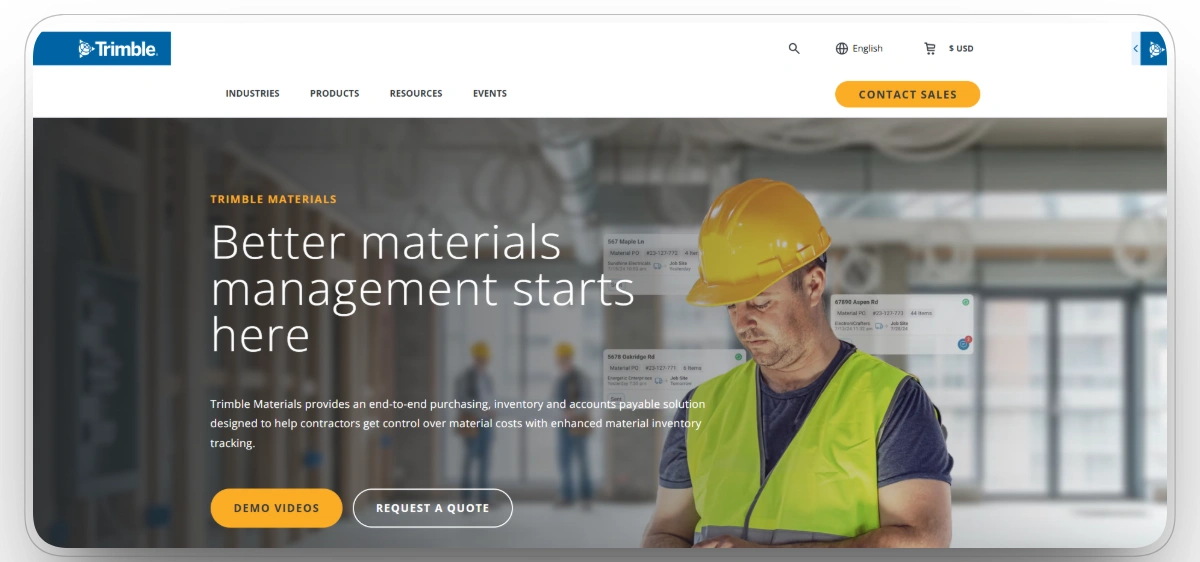
Best for: Self-performing and specialty contractors that need purchasing, material inventory, receiving, and accounts-payable workflows in one system.
Trimble Materials, introduced after StructShare joined Trimble in 2025, provides an end-to-end system for construction purchasing and material management. It connects field requisitions, purchase orders, suppliers, warehouses, receiving, inventory, invoice matching, and budget visibility.
Office, field, warehouse, and supplier teams can work through connected web and mobile applications. This makes the platform especially relevant to contractors that handle high volumes of fittings, electrical components, mechanical materials, or other job-specific stock.
Trimble Materials can also connect with Trimble Vista and Spectrum, allowing purchasing and material information to flow into accounting and job-cost processes.
Our observation: Trimble Materials is the strongest option in this list for contractors whose primary problem is material purchasing and supply-chain control. It provides more procurement and invoice depth than fleet-focused platforms, but it is not designed to manage heavy-equipment maintenance parts as its main use case.
Our rating: 9.0/10
Pros
- Connects field requisitions, purchasing, inventory, receiving, and invoice matching.
- Gives office, field, warehouse, and supplier teams a shared material workflow.
- Tracks material quantities, locations, orders, deliveries, costs, and budget impact.
- Integrates with Trimble construction accounting products, including Vista and Spectrum.
Limitations
- Focuses on contractor materials rather than equipment maintenance and service parts.
- Delivers the greatest integration value inside the Trimble ecosystem.
- Implementation requires supplier, item, approval, warehouse, and accounting configuration.
- Pricing is customized and not publicly listed.
Trimble Materials Reviews
Capterra: 3.9/5 (13 reviews)
G2: 4.4/5 (2,064)
4. ToolWatch by AlignOps
Best for: Contractors managing tools, small equipment, materials, and consumables across warehouses, service centers, and jobsites.
ToolWatch is a construction asset and inventory platform designed around the movement of tools, materials, equipment, and consumables. Teams can organize inventory catalogs, check items in and out, count stock, transfer inventory, create pick tickets, and maintain visibility across jobsites and warehouse locations.
The system supports construction-specific labeling and scanning workflows, including durable tags suited to field environments. Its strength is accountability for reusable tools and distributed inventory rather than deep project purchasing or fleet-parts costing.
Our observation: ToolWatch is a strong fit when the central problem is knowing who has each tool, where material was transferred, and what remains in the warehouse. Contractors primarily managing repair parts or supplier invoices may need a maintenance or procurement system with deeper financial workflows.
Our rating: 8.8/10
Pros
- Built specifically for construction tools, materials, equipment, and consumables.
- Supports check-in, check-out, transfers, pick tickets, inventory counts, and warehouse workflows.
- Uses mobile scanning and durable labels to improve field accountability.
- Tracks inventory across warehouses, service centers, and active jobsites.
Limitations
- Full deployment may require tags, scanners, labeling standards, and process changes.
- Purchasing and invoice-matching capabilities are less central than in material-procurement platforms.
- Fleet maintenance and equipment-parts costing may require other systems or integrations.
- Smaller contractors with simple stock counts may not use the platform’s full scope.
ToolWatch Reviews
Capterra: 4.2/5 (62 reviews)
G2: 3.7/5 (11)
5. Sortly

Best for: Small and midsize contractors that want straightforward mobile inventory, visual item records, and barcode or QR scanning.
Sortly is a general inventory platform with a dedicated construction use case. Teams can organize materials, tools, equipment, and supplies using folders, photos, custom fields, tags, and location records. Its mobile app supports barcode and QR scanning and can continue working offline before syncing updates.
Low-stock alerts, date-based reminders, label generation, pick lists, reporting, and user permissions make it practical for contractors replacing spreadsheets. It is easier to deploy than a full ERP or construction operations platform.
Our observation: Sortly is one of the easiest options for teams that need clean stock visibility without a complex implementation. Its simplicity is also the trade-off because it does not provide the same maintenance, procurement, job-cost, or project-material depth as construction-specific systems.
Our rating: 8.6/10
Pros
- Offers mobile barcode and QR scanning with offline capability.
- Uses photos, folders, custom fields, and tags to make items easy to identify.
- Supports low-stock alerts, label generation, pick lists, and reporting.
- Can be adopted without implementing a full construction ERP or fleet platform.
Limitations
- General inventory software rather than a construction operations system.
- Does not provide deep equipment maintenance or work-order costing.
- Purchasing, invoice matching, and job-cost allocation are more limited than specialist platforms.
- Plan limits may affect item counts, users, integrations, and advanced reporting.
Sortly Reviews
Capterra: 4.5/5 (953 reviews)
G2: 4.3/5 (27)
6. Procore Materials
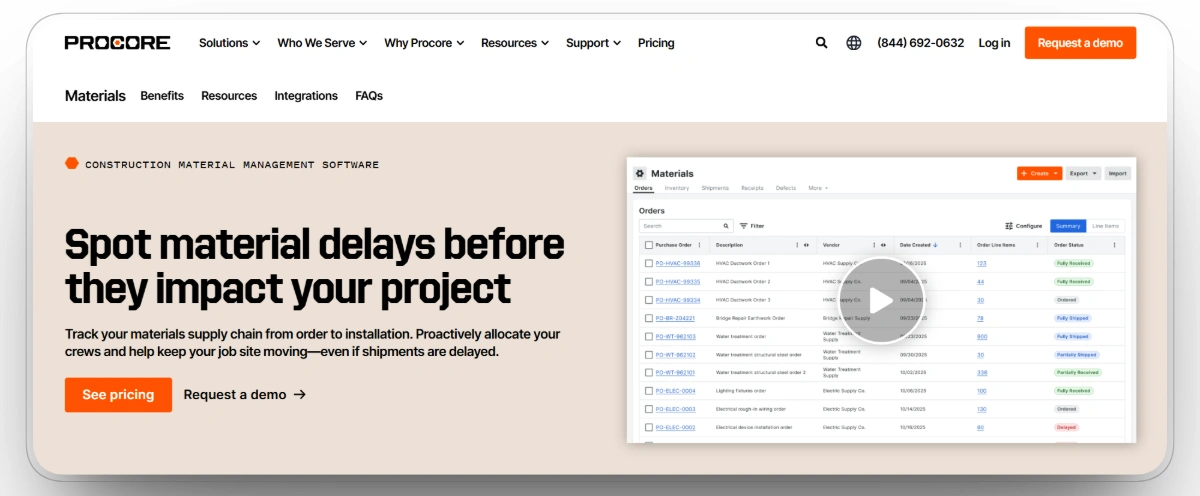
Best for: General contractors and project teams that need material visibility from order through delivery, storage, issue, and installation.
Procore Materials brings material tracking into the wider Procore project environment. Teams can monitor quantities that are required, ordered, received, issued, installed, or available and can view inventory by item or storage location.
Within the broader Procore environment, teams can coordinate material status alongside schedules, financial information, submittals, shipments, receipts, and field records. This helps project teams identify delivery constraints before they affect crew sequencing or installation work.
Our observation: Procore Materials is a strong choice when inventory visibility must remain inside the project record. It is more relevant to project materials than shop parts, tool cribs, or enterprise warehouse accounting.
Our rating: 8.5/10
Pros
- Tracks project materials from planning and ordering through receipt and installation.
- Shows inventory quantities and material status by item and location.
- Connects material information with schedules, submittals, costs, and field records.
- Gives office and field teams mobile access within the Procore environment.
Limitations
- Best suited to contractors already using Procore as a project platform.
- Does not replace a fleet-parts, tool-management, or manufacturing inventory system.
- Requires disciplined setup of requirements, locations, shipments, receipts, and issue workflows.
- Pricing and product access depend on the selected Procore package and agreement.
Procore Reviews
G2: 4.6/5 (4,210 reviews)
Capterra: 4.5/5 (2,665 reviews)
7. Ply

Best for: Specialty trades and service contractors managing materials across warehouses, service trucks, technicians, and jobs.
Ply is built around contractor inventory rather than traditional retail warehousing. It supports purchasing, purchase orders, receiving, stock transfers, truck inventory, field requests, cycle counts, material kits, job-level usage, dashboards, and replenishment.
Technicians can request materials through the app, SMS, voice, or AI-assisted workflows. The platform also supports stock across fixed warehouse locations and mobile service vehicles, making it especially relevant to electrical, plumbing, HVAC, and other material-intensive trades.
Ply connects with field service and accounting products such as ServiceTitan, Jobber, Housecall Pro, QuickBooks Online, and Sage.
Our observation: Ply is a focused option for specialty contractors that need to control truck stock and job materials without adopting an enterprise ERP. It is less relevant to heavy-equipment fleets that need maintenance history, telematics, and machine-specific parts costing.
Our rating: 8.4/10
Pros
- Built for materials moving between warehouses, trucks, technicians, and jobs.
- Connects purchasing, receiving, stock control, field requests, and job usage.
- Supports cycle counts, min-and-max levels, kits, transfers, and automated replenishment.
- Integrates with common field-service and accounting platforms.
Limitations
- Best aligned with specialty trades and service operations rather than heavy civil fleets.
- Does not provide the same equipment-maintenance depth as fleet platforms.
- Public marketplace review coverage is limited.
- Implementation still requires accurate catalogs, locations, supplier data, and usage processes.
Ply Reviews
G2: 4.8/5 (2 reviews)
Capterra: 5/5 (4 reviews)
8. Fleetio

Best for: Vehicle and mixed-fleet maintenance teams that need spare-parts inventory connected to service work.
Fleetio manages parts inventory as part of a broader fleet-maintenance platform. Teams can store part data, track quantities by location, transfer inventory, set reorder points, receive low-stock alerts, and add parts to work orders.
Purchase-order receiving can update inventory, while mobile users can scan UPC barcodes or QR codes, adjust stock, view locations, and issue parts to maintenance work. Fleetio also supports parts activity, warranty tracking, vendor data, costs, and inventory valuation methods.
Our observation: Fleetio provides strong parts control for contractors whose inventory is consumed mainly by vehicle and equipment maintenance. It is less suitable for building materials, tool checkouts, or project supply-chain tracking.
Our rating: 8.2/10
Pros
- Connects spare-parts inventory with work orders, service history, and maintenance costs.
- Tracks stock quantities, reorder points, locations, transfers, vendors, and usage.
- Supports mobile barcode and QR scanning through Fleetio Go.
- Includes purchase-order receiving, warranty records, reporting, and inventory valuation options.
Limitations
- Built for fleet maintenance across industries rather than construction materials.
- Does not manage project-material delivery and installation workflows.
- Tool check-in and field assignment are not its primary inventory use case.
- Some advanced inventory and integration capabilities depend on plan selection.
Fleetio Reviews
G2: 4.6/5 (209 reviews)
Capterra: 4.7/5 (246 reviews)
9. Oracle NetSuite
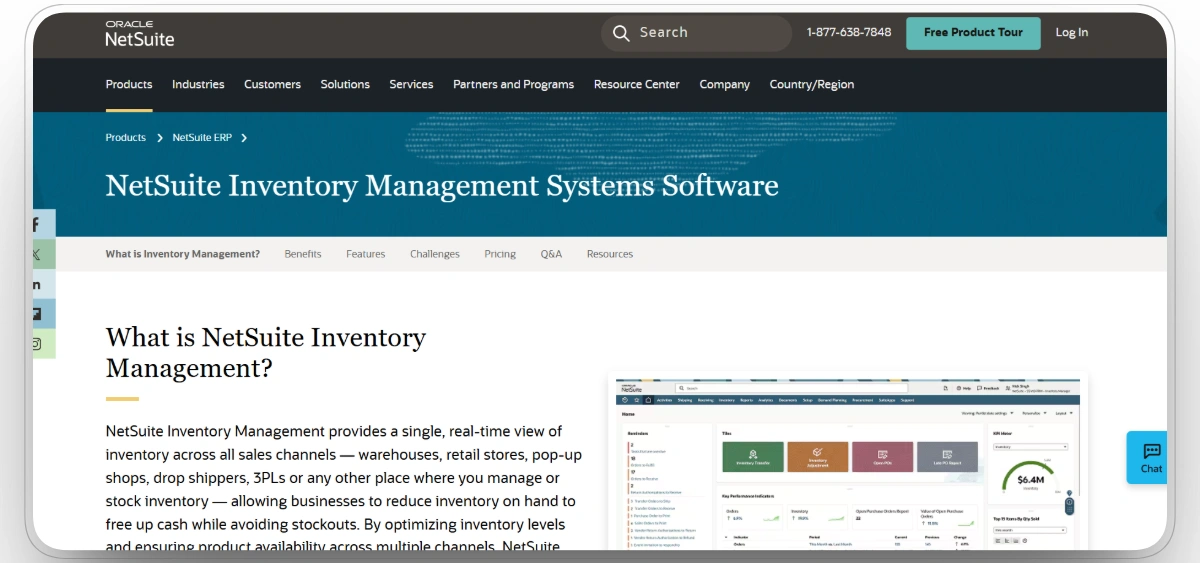
Best for: Large and growing contractors that need inventory, procurement, warehouse management, project accounting, and financials in one ERP.
Oracle NetSuite combines inventory management with purchasing, warehouse operations, financials, project management, and job costing. Contractors can use reorder points, barcode scanning and mobile warehouse workflows, mobile applications, role-based dashboards, and multi-location inventory control.
Because inventory and project finances share the same database, project managers can compare materials costs against budgets while procurement and finance teams monitor orders, vendors, commitments, and companywide inventory.
Our observation: NetSuite is a strong enterprise option when inventory must connect with financial control across multiple entities or locations. It is usually too complex for a contractor that only needs tool tracking, truck stock, or a simple parts room.
Our rating: 8.0/10
Pros
- Connects inventory, procurement, warehouse management, job costing, and financial reporting.
- Supports multi-location stock, reorder points, barcode scanning, warehouse workflows, and mobile access.
- Provides role-based dashboards for project, procurement, finance, and executive teams.
- Scales across multiple companies, locations, currencies, and operating units.
Limitations
- Requires substantial implementation, configuration, training, and data governance.
- Construction workflows may require partner solutions or industry-specific customization.
- Cost and complexity can be difficult to justify for small contractors.
- Field inventory workflows may feel less direct than contractor-focused mobile platforms.
Oracle NetSuite Reviews
G2: 4.1/5 (4,874 reviews)
Capterra: 4.2/5 (2045 reviews)
10. Fishbowl Inventory

Best for: Small and midsize contractors that need deeper warehouse inventory while keeping QuickBooks or Xero as the accounting system.
Fishbowl provides multi-location inventory, purchasing, receiving, barcode scanning, stock alerts, reorder workflows, transfers, picking, packing, and warehouse controls. Its accounting integrations make it relevant to contractors that have outgrown basic stock spreadsheets but do not want to replace QuickBooks or Xero with a full ERP.
The platform can manage parts, supplies, tools, and materials in warehouses or storage locations. It is especially useful when inventory accuracy and purchasing depth matter more than construction project management.
Our observation: Fishbowl is a practical warehouse-first option for contractors that want stronger inventory without a full enterprise ERP. Construction jobsite, maintenance, and field-assignment workflows may require configuration or connected software.
Our rating: 7.8/10
Pros
- Supports multi-location inventory, purchasing, receiving, transfers, and reordering.
- Provides barcode scanning, stock alerts, warehouse controls, and detailed item records.
- Integrates closely with QuickBooks and Xero accounting environments.
- Offers more inventory depth than lightweight mobile stock-counting apps.
Limitations
- General warehouse and inventory software rather than a construction-specific platform.
- Does not natively connect inventory with heavy-equipment maintenance in the same depth as Clue or HCSS.
- Project-level material status and installation tracking are not its primary strengths.
- Setup and accounting integration require careful item, location, and workflow configuration.
Fishbowl Reviews
Capterra: 4.2/5 (1,125 reviews)
G2: 4/5 (274)
Which Platform Should You Choose?
Frequently Asked Questions
What is construction inventory management software?
Construction inventory management software tracks the parts, materials, tools, supplies, and consumables a contractor stores, purchases, transfers, issues, installs, or uses. It can also connect inventory activity with warehouses, jobsites, service trucks, work orders, purchase orders, vendors, and project costs.
What types of construction inventory should contractors track?
Contractors should track maintenance parts, building materials, consumables, safety supplies, small tools, attachments, and stock held in warehouses, trucks, trailers, yards, or jobsites. Reusable assets should also be tracked, but they usually require additional records for assignment, location, inspections, maintenance, utilization, and lifecycle cost.
What is the difference between construction inventory and asset management?
Inventory is generally consumed, installed, or issued in quantities. Examples include filters, fittings, fasteners, pipe, cable, lubricants, and safety supplies. Assets are reusable items such as excavators, trucks, generators, attachments, and power tools. Inventory software tracks quantities and replenishment, while asset-management software tracks custody, condition, maintenance, utilization, and lifecycle history.
Which software is best for construction parts inventory?
Clue ranks first for equipment-intensive contractors because it connects parts requests, vendors, deliveries, work orders, maintenance history, and equipment records. HCSS Equipment360 is also a strong option for heavy civil shops, while Fleetio works well for vehicle-focused maintenance teams.
Can construction inventory software track stock across warehouses, trucks, and jobsites?
Yes, but location depth varies by product. Ply is designed around warehouses, service trucks, and jobs. ToolWatch manages tools and materials across warehouses and jobsites. Sortly supports flexible folders and locations, while enterprise products such as NetSuite provide multi-location warehouse control. Contractors should confirm whether transfers, receiving, issuing, and offline field updates are supported.
Can inventory software connect parts and materials with work orders or job costs?
Yes. Clue, HCSS Equipment360, and Fleetio connect parts with maintenance work orders. Trimble Materials, Procore Materials, Ply, and NetSuite connect material activity with purchasing, projects, budgets, or job costs. The correct platform depends on whether inventory is consumed by a repair shop, a service technician, or a construction project.
How much does construction inventory management software cost?
Pricing depends on the number of users, items, locations, assets, modules, integrations, and implementation requirements. Lightweight inventory apps may use monthly subscription tiers, while construction operations platforms and ERPs usually require custom quotes. Buyers should calculate the complete cost of software, onboarding, data setup, labels or scanners, integrations, training, and ongoing administration.
What features should contractors prioritize?
Prioritize multi-location stock visibility, mobile updates, barcode or QR scanning, low-stock alerts, purchase orders, transfers, receiving, issue history, user permissions, audit trails, and reporting. Also confirm that the platform connects inventory with the workflow that consumes it, such as equipment work orders, service jobs, project budgets, or material installation.
Conclusion
Construction inventory software helps contractors prevent missing stock, duplicate purchases, lost tools, and work delays. The right platform depends on whether the business mainly manages equipment parts, project materials, tools, truck stock, or warehouse inventory.
Clue is a strong choice for equipment-intensive contractors because it connects parts with equipment records, work orders, preventive maintenance, and repair costs. Before selecting a platform, contractors should test it using their actual inventory, locations, purchasing steps, and field workflows.
Transform Your Equipment Management