13 Best Construction Estimating Software for 2026


Hi, I’m Maham Ali. I write about construction equipment management, helping teams use fleet data and maintenance intelligence to improve uptime, control costs, and run smoother jobsites.
The best construction estimating software in 2026 is HCSS HeavyBid for heavy civil contractors bidding DOT and multi-phase work, STACK for fast cloud-based takeoffs, and Buildxact for small residential builders moving off spreadsheets.
The right fit comes down to three things: the work you bid (DOT, commercial, or residential), where your bottleneck sits (measuring quantities or pricing them), and where the estimate flows after you win (accounting, job costing, or project management).
One more input determines whether an estimating tool produces a reliable number: the cost data behind it. For equipment-heavy contractors, that means using real ownership and operating costs from construction equipment management software, not generic rate books.
This guide compares the 13 best construction estimating software platforms of 2026 across takeoff capability, estimating depth, bid workflow, integrations, and honest limitations, so you can shortlist fast.
How We Evaluated These Construction Estimating Software Solutions
Accurate estimates require more than quick calculations. Contractors need estimating tools that support reliable takeoffs, consistent cost data, bid organization, collaboration, and a smoother handoff from preconstruction to project execution.
Each platform was reviewed using product features, estimating workflows, takeoff capabilities, integrations, customer feedback, pricing transparency, and fit for different contractor types. Every vendor was scored against the same framework so the comparison stays consistent and fair. The criteria below explain how each solution was compared.
Evaluation Criteria
Our ratings are editorial assessments based on the weighted criteria above. They are not mathematical averages of G2 and Capterra ratings. Products with limited third-party reviews were assessed more heavily through product documentation, feature depth, market fit, and available customer evidence.
We deliberately excluded generic quoting apps, spreadsheet templates, and accounting tools with estimate modules bolted on. They can hold numbers, but they do not handle plan takeoffs, assemblies, pay items, or bid-day analysis, so they fail the construction-fit test no matter how polished the interface looks.
These criteria prioritize software that helps contractors produce faster, more reliable estimates while improving collaboration, reducing costly errors, and connecting preconstruction decisions with project execution. The strongest platforms are not always the most feature-heavy; they are the ones that best match a company's project type, estimating complexity, team size, budget, and long-term growth needs. The stakes are real: bad estimates do not just lose bids, they win unprofitable ones.
Sources
- Vendor websites and estimating product documentation
- Public information on takeoff, cost databases, bid management, proposal generation, and integrations
- Verified customer reviews and ratings on G2 and Capterra, checked live in July 2026, and contractor case studies
- Construction estimating and preconstruction technology resources
Editorial Review
Estimating solutions were reviewed around the needs of preconstruction and bidding teams, with attention to takeoff accuracy, cost database quality, proposal workflows, collaboration, integrations, and suitability for different contractor types. The stakes justify the scrutiny: a 2022 McKinsey analysis of more than 500 large projects found cost overruns averaging at least 79% against initial budget estimates, and peer-reviewed research on infrastructure cost overruns consistently identifies inaccurate estimates as one of the primary drivers of projects blowing past their budgets. Better estimating tools attack the problem at its source.
Key Considerations When Selecting Estimating Software
Before comparing individual platforms, it helps to weigh the factors that most often determine which estimating software actually fits. Four considerations matter most: the scope and size of your projects, whether you need cloud or on-premise deployment, how much training your team can absorb, and how pricing scales as you grow.
1. Project Scope and Company Size
Small firms often need simple, affordable solutions with basic estimating tools and easy onboarding, such as Buildxact or Contractor Foreman. Large companies handling multi-million-dollar projects benefit from robust platforms like Procore, HCSS HeavyBid, or Candy, which provide comprehensive tools for cost control, scheduling, and resource management.
2. Cloud vs. On-Premise Solutions
Cloud-based software provides flexibility and allows distributed estimating teams to collaborate remotely. Desktop-oriented platforms such as Candy and traditional Sage Estimating deployments may offer greater control over infrastructure, while hosted options such as Candy Cloud can also support remote access.
3. Usability and Training Requirements
Software like Bluebeam Revu or Sage Estimating offers deep, powerful tooling but requires more time to master. In contrast, Buildxact and Contractor Foreman have user-friendly interfaces with fast learning curves that small teams can adopt in days.
4. Budget and Scalability
Modular pricing models from vendors like Procore allow companies to pay for only what they need. It is also essential to factor in per-seat costs for additional estimators and long-term scalability as your bid volume grows.

Construction Estimating Software Comparison
Use this table to compare all 13 options at a glance before reading the full breakdowns below.
Below are the 13 best construction estimating software platforms to consider in 2026.
1. HCSS HeavyBid
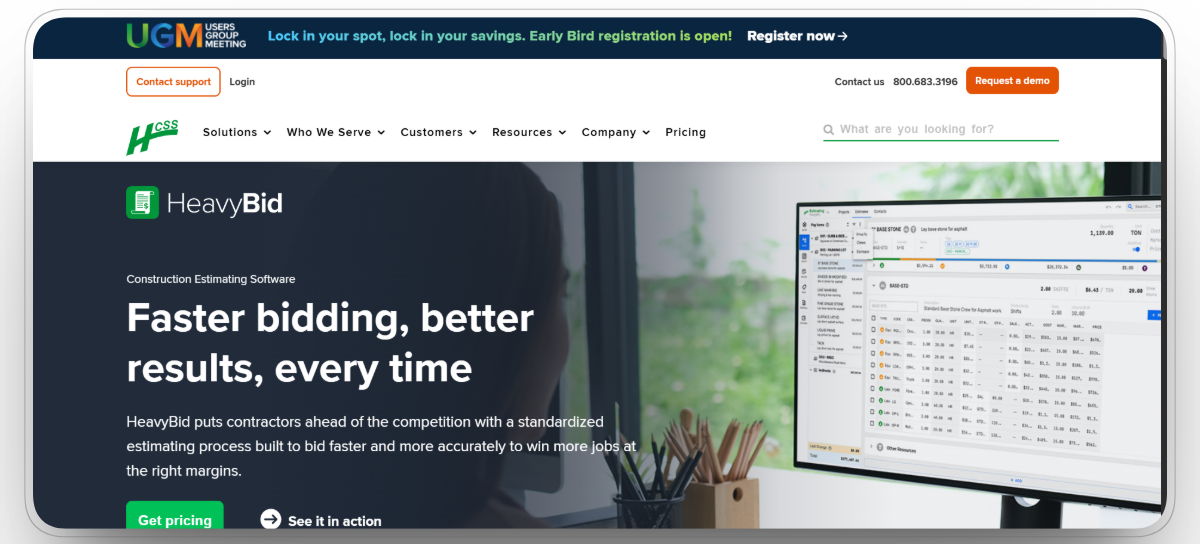
Best for: Heavy civil and infrastructure contractors bidding complex, multi-phase and DOT work.
HCSS HeavyBid is a construction estimating and bidding platform built for heavy civil contractors preparing complex, multi-phase, and DOT bids. It supports detailed activity-based estimates, crew and equipment costing, pay-item workflows, bid-day analysis, and standardized estimating processes.
HeavyBid integrates with accounting systems and the wider HCSS suite. Winning estimates can flow into HeavyJob, where field teams track production and job costs against the original budget. This connection makes HeavyBid a strong fit for contractors that need estimating data to remain useful after the project is awarded.
Our Observation: HeavyBid is one of the most established estimating platforms for heavy civil work in North America. Its strongest advantages are DOT pay-item workflows, detailed activity-based estimating, bid-day analysis, and integration with the wider HCSS suite. Reviews frequently praise its support and estimating depth, while cost, interface design, and training requirements remain common concerns. If DOT or unit-price work represents a major share of your bids, HeavyBid belongs on the shortlist.
Our Rating: 9.4/10
HCSS HeavyBid Pros
- Detailed activity-based estimating for complex heavy civil bids.
- Standardized DOT pay-item, crew, equipment, and bid-day workflows.
- Strong handoff to HeavyJob, accounting systems, and the wider HCSS suite.
HCSS HeavyBid Limitations
- New estimators need structured training before they can use the platform efficiently.
- Report and template customization may not fit every contractor’s workflow.
- Pricing and implementation requirements may be difficult to justify for smaller contractors.
HCSS HeavyBid Reviews
G2: 4.6/5 (257 reviews)
Capterra: 4.6/5 (506 reviews)
HCSS HeavyBid Pricing
Contact the vendor for pricing.
2. B2W Estimate
Best for: Heavy civil contractors that want centralized cost data and flexible pay-item, WBS, or hybrid bidding.
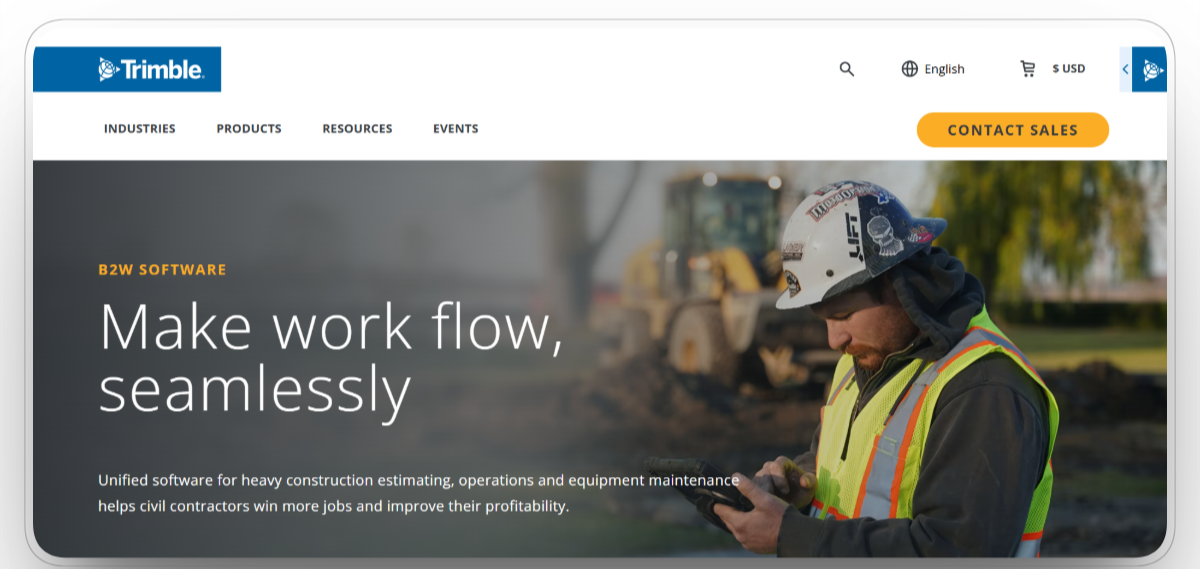
B2W Estimate is a comprehensive construction estimating software tailored for heavy civil contractors. Built on .NET and SQL Server technology, it offers centralized cost data, templates, and cost structures to streamline the bidding process. The software supports various bidding formats, including pay-item, Work Breakdown Structure (WBS), and hybrid bids, allowing multiple estimators to collaborate on a single estimate simultaneously.
With features like automated DOT bidding, vendor and subcontractor management, and cross-bid analysis, B2W Estimate, now part of Trimble, empowers contractors to bid with speed, accuracy, and strategy.
Our Observation: B2W Estimate competes head-to-head with HeavyBid for heavy civil work, and the choice usually comes down to ecosystem: B2W now sits inside Trimble's portfolio, which matters if you already run Trimble machine control or survey tools. Its G2 base is tiny, so weigh the far larger Capterra sample when comparing scores.
Our Rating: 9.1/10
B2W Estimate Pros
- Centralized, up-to-date cost data and structures for accurate and consistent estimating.
- Flexible bidding options, including pay-item, WBS, or hybrid formats.
- Automated DOT bidding with pre-populated pay items and import/export of bid forms.
B2W Estimate Limitations
- Extensive feature set means new estimators need structured onboarding before they are productive.
- Customization challenges for adapting the software to specific workflows.
- Higher pricing model, which may be a barrier for smaller businesses or independent contractors.
B2W Estimate Reviews
G2: 4.5/5 (3 reviews)
Capterra: 4.5/5 (200 reviews)
"Best ease of use cost to price Construction Estimating Product out there." Timothy L., via Capterra
B2W Estimate Pricing
Contact the vendor for pricing.
3. STACK
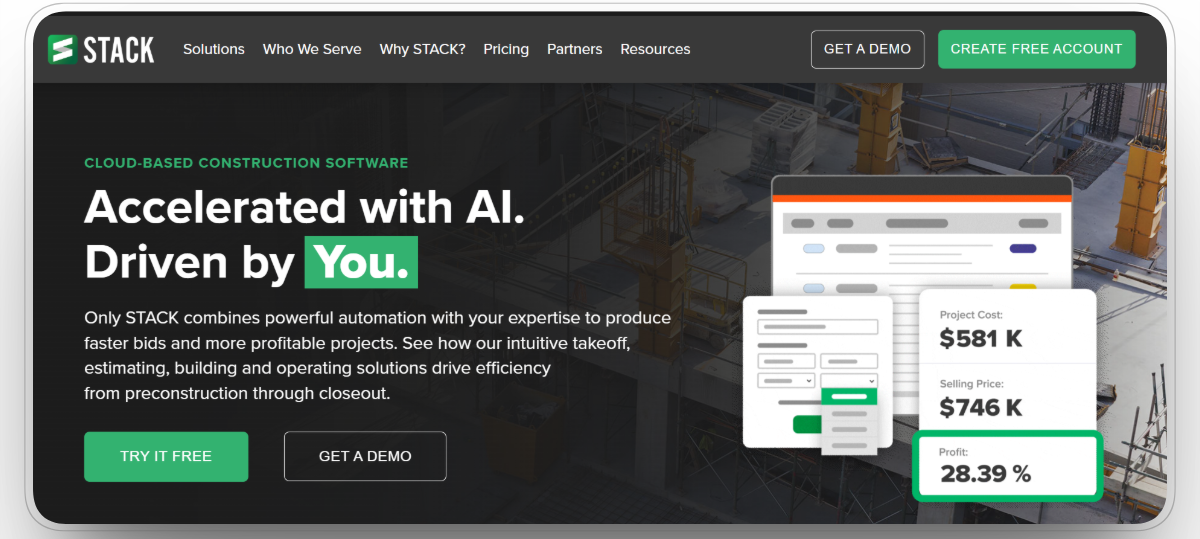
Best for: Contractors who want fast, accurate cloud takeoffs with estimating built on top.
STACK is a leading construction takeoff and estimating platform, offering a user-friendly interface, cloud access, and precise takeoff tools. It simplifies estimating with a detailed cost database, supporting accurate and competitive bids for projects of all sizes.
With its digital takeoff feature, STACK quickly calculates material quantities and integrates real-time cost data, making estimating faster and more reliable. Auto-count tools and a reusable assembly library speed up repetitive scopes. The software also integrates with project management and accounting systems, streamlining workflows and enabling collaboration from anywhere in a browser.
Our Observation: STACK is takeoff-first: reviewers rate its measurement speed and ease of use among the best in the category, while the estimating module is solid but secondary, and per-seat costs are the most common complaint. If your bottleneck is quantities rather than pricing workflows, STACK is the strongest cloud option on this list.
Our Rating: 9.0/10
STACK Pros
- Fast, accurate digital takeoffs with auto-count for repetitive items.
- Cloud-based, enabling real-time collaboration across teams with no installs.
- Reusable assembly libraries and integrations that streamline estimating workflows.
STACK Limitations
- New users may face a learning curve with advanced features and formulas.
- Limited customization options for reports and markups.
- Per-seat pricing can climb for multi-estimator teams.
STACK Reviews
G2: 4.1/5 (5 reviews)
Capterra: 4.5/5 (1,398 reviews)
STACK Pricing
Contact the vendor for pricing.
4. Sage Estimating

Best for: Commercial GCs standardizing on a deep cost database, especially firms running Sage 300 CRE or Sage 100 Contractor.
Sage Estimating is one of the longest-established estimating platforms in commercial construction, built on the WinEst lineage of database-driven estimating. Flexible assemblies, customizable cost databases, and formula-based calculations let estimating teams standardize formats and leverage historical data.
Integrated takeoff through eTakeoff Dimension and Bridge feeds quantities into estimates, while the BidMatrix tool supports bid leveling and subcontractor analysis on bid day. Its strongest advantage is integration with Sage 300 Construction and Real Estate and Sage 100 Contractor: accepted estimates flow into job costing and project management without re-entry.
Our Observation: Sage Estimating takes this spot in place of ProEst, which Autodesk now sells only inside its Forma for Preconstruction bundle rather than as a standalone product. Sage trades polish for depth: reviewers praise the database flexibility and the Sage 300 integration and knock the interface and onboarding effort. It suits established commercial estimating departments, not first-time software buyers.
Our Rating: 8.9/10
Sage Estimating Pros
- Deep, customizable cost databases and assemblies that standardize estimates across the team.
- Estimate-to-job-cost integration with Sage accounting removes duplicate entry.
- Integrated eTakeoff workflows and BidMatrix bid analysis strengthen bid-day decisions.
Sage Estimating Limitations
- Database-driven depth takes months, not days, to master, and the interface shows its age.
- Traditionally server-based; cloud access requires hosting arrangements.
- Premium pricing that smaller firms may find hard to justify.
Sage Estimating Reviews
G2: 4.1/5 (18 reviews)
Capterra: N/A
Sage Estimating Pricing
Contact the vendor for pricing.
5. PlanSwift by ConstructConnect
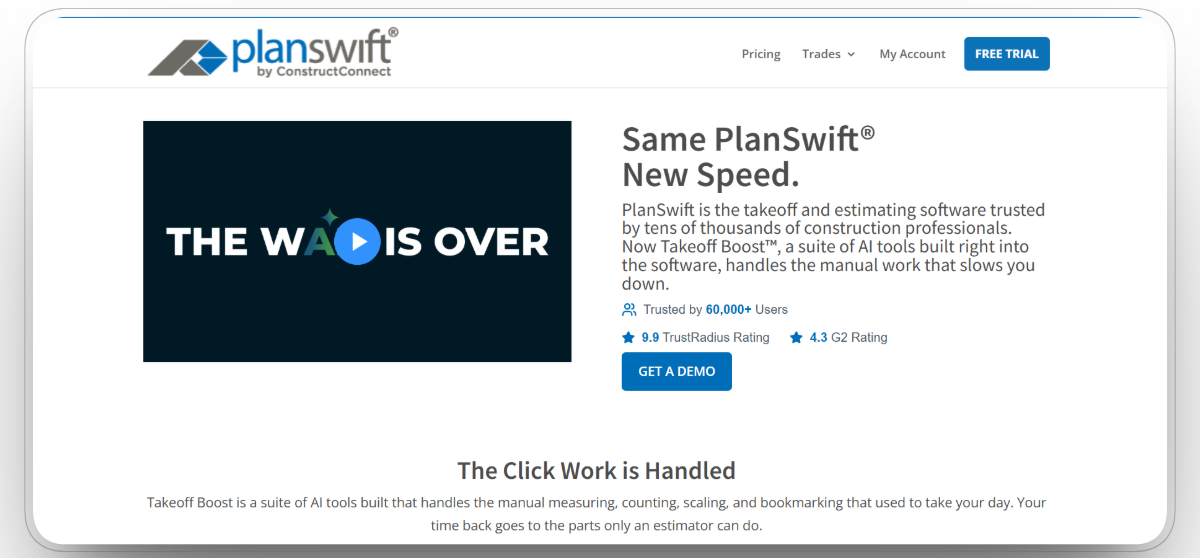
Best for: Estimators who want a proven desktop takeoff tool with drag-and-drop assemblies.
PlanSwift is a long-standing choice for construction takeoff and estimating. Its point-and-click interface allows contractors to measure areas, lengths, and counts directly from digital plans, saving time and reducing errors versus manual takeoffs.
The software integrates with tools like Excel and various estimating platforms, and its parts-and-assemblies system lets estimators build detailed, reusable takeoff templates. As a desktop application, PlanSwift favors single-workstation workflows; teams that need browser-based collaboration typically pair it with, or compare it against, cloud tools like STACK.
Our Observation: PlanSwift remains one of the most familiar takeoff tools in the industry, and reviewers still praise how intuitive it feels to anyone raised on paper plans. The caveats are structural: it is a desktop app in a cloud era, and recent licensing changes frustrated long-time owners. Evaluate it against STACK if collaboration matters to your team.
Our Rating: 8.7/10
PlanSwift by ConstructConnect Pros
- Easy-to-use drag-and-drop interface that beginners pick up quickly.
- Detailed parts and assemblies for accurate, repeatable takeoffs.
- Established ecosystem with wide familiarity among estimators.
PlanSwift by ConstructConnect Limitations
- Desktop-based, with no real-time cloud collaboration between estimators.
- Mobile access is limited.
- Long-time users report the move from perpetual licenses to annual subscriptions as a sore point.
PlanSwift by ConstructConnect Reviews
G2: 4.3/5 (35 reviews)
Capterra: 4.3/5 (401 reviews)
PlanSwift by ConstructConnect Pricing
Contact the vendor for pricing.
6. Buildxact
Best for: Small residential builders and remodelers who want takeoff, estimating, and job management in one simple tool.
Buildxact is a user-friendly construction estimating software, well suited to small and medium residential businesses. It combines takeoffs, estimating, quoting, scheduling, and job tracking in one intuitive cloud platform.
The software includes dealer catalog integrations that pull live material pricing into estimates, keeping quotes current, while QuickBooks and Xero integrations connect estimates to accounting. Scalable and simple to learn, Buildxact suits growing residential builders that want to move off spreadsheets without adopting an enterprise platform.
Our Observation: Buildxact is the small-builder pick on this list: reviewers consistently describe fast onboarding and takeoffs that are dramatically quicker than spreadsheets, and its dealer price feeds are genuinely differentiated. It is not built for commercial complexity, and that focus is exactly why it works for residential contractors.
Our Rating: 8.6/10
Buildxact Pros
- Easy-to-use interface, ideal for quick adoption by small teams.
- Live supplier and dealer price feeds keep estimates current.
- Cloud-based, with QuickBooks and Xero integrations for seamless quoting-to-invoicing.
Buildxact Limitations
- Lacks advanced features for large or complex commercial projects.
- Limited customization of reports.
- Subscription costs add up as teams grow.
Buildxact Reviews
G2: 4.3/5 (66 reviews)
Capterra: 4.6/5 (183 reviews)
Buildxact Pricing
Contact the vendor for pricing.
7. Candy by RIB Software

Best for: Large contractors and international projects needing estimating tied to planning and project control.
Candy by RIB Software is an advanced estimating and project-control platform used on large-scale projects worldwide. It helps contractors create accurate budgets, track costs in real time, and manage project planning with detailed cost breakdowns.
The software leverages historical data to improve estimating accuracy and links estimates to programs, cash flow, and valuations, keeping the estimate alive through project delivery. With its scalability and depth, Candy suits large firms and complex projects, particularly outside North America where its footprint is strongest.
Our Observation: Candy is the most internationally oriented tool on this list, with a large Capterra base built mainly outside the US and only a handful of G2 reviews. Its estimating-to-project-control integration is genuinely deep, but plan for training time and note that it installs on-premises rather than running in the browser.
Our Rating: 8.4/10
Candy by RIB Software Pros
- Accurate cost breakdowns with estimating linked to planning and project control.
- Leverages historical data for improved estimates.
- Strong international track record on large, complex projects.
Candy by RIB Software Limitations
- Expect a serious training investment before estimators are self-sufficient.
- Desktop-oriented architecture that feels less cloud-native than browser-first platforms.
- Complex interface that can be overwhelming for smaller teams.
Candy by RIB Software Reviews
G2: 4/5 (3 reviews)
Capterra: 4.5/5 (252 reviews)
Candy by RIB Software Pricing
Contact the vendor for pricing.
8. Edgevanta

Best for: Highway contractors that want AI-assisted bidding intelligence built for their niche.
Edgevanta is a construction estimating and bidding platform designed specifically for highway contractors. It offers a centralized hub that combines market analytics, automation, and AI to optimize bidding strategies.
With features like real-time data insights, historical bid analysis, and streamlined bid management, Edgevanta helps contractors price work competitively with minimal manual research. Although primarily tailored for highway construction, its analytics-first approach makes it an interesting complement to traditional estimating engines like HeavyBid or B2W.
Our Observation: Edgevanta is the wildcard here: a young, highway-only platform with no public G2 or Capterra review base yet. We include it because its AI bid-intelligence angle is genuinely different from everything else on this list, but validate its claims in a demo against your own historical bids before committing.
Our Rating: 8.2/10
Edgevanta Pros
- Centralized data hub automating insights on historical bids and competitor analysis.
- Pipeline and bid management designed specifically for highway contractors.
- Market analytics and AI to sharpen bidding strategy.
Edgevanta Limitations
- Industry-specific: primarily built for highway work, not general construction.
- Newer market entrant with fewer integrations than established tools.
- Pricing details are not publicly disclosed.
Edgevanta Reviews
G2: N/A
Capterra: N/A
Edgevanta Pricing
Contact the vendor for pricing.
9. Buildertrend
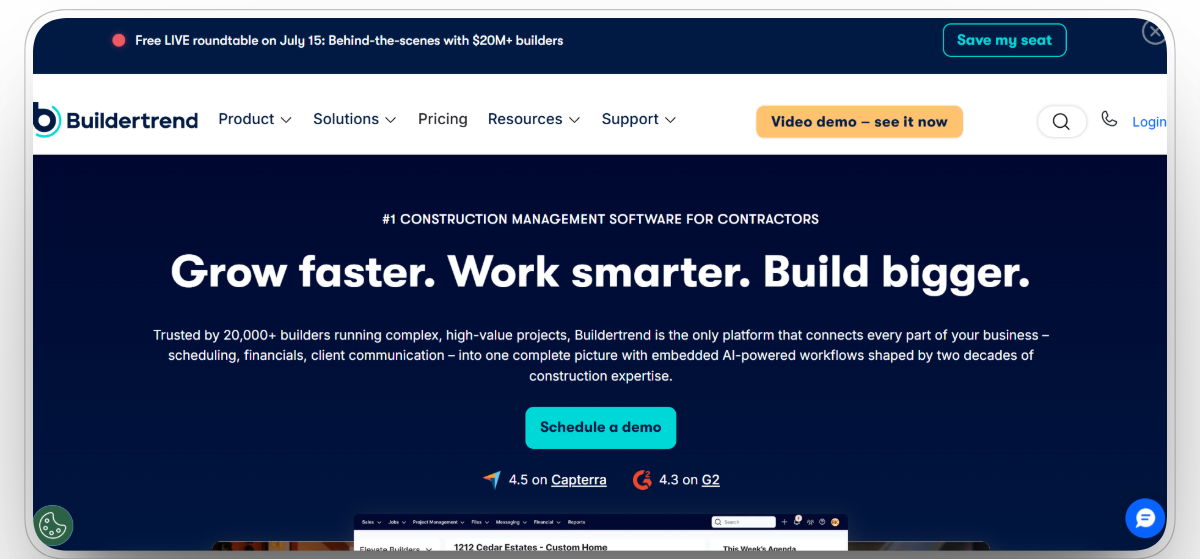
Best for: Residential builders and remodelers who want estimating inside an all-in-one management platform (and the home for former CoConstruct users).
Buildertrend is a cloud-based construction management platform for home builders, remodelers, and specialty contractors that folds estimating, takeoff, proposals, and change orders into one system alongside scheduling, invoicing, and client communication.
It replaces CoConstruct on this list: Buildertrend acquired CoConstruct in 2021 and retired it as a standalone product, migrating its customers and absorbing its best-loved features, including the client portal and selections management. With QuickBooks and Xero integrations and a polished mobile app, Buildertrend connects the estimate to everything that happens after you win the job.
Our Observation: Buildertrend earns this spot as CoConstruct's successor rather than just another alternative, and former CoConstruct users will find the client-facing features intact. The consistent reviewer gripe is complexity, and several call out the estimating workflow specifically, so demo that module before you buy rather than judging by the platform's breadth.
Our Rating: 8.1/10
Buildertrend Pros
- Estimation connected to scheduling, invoicing, and client communication in one platform.
- Client portal and selection management, carried over from CoConstruct, that homeowners actually use.
- QuickBooks and Xero integrations keep estimates and accounting in sync.
Buildertrend Limitations
- Feature-dense platform with a real learning curve during setup.
- Some reviewers find the estimating module click-heavy compared with dedicated tools.
- Costs can be hard to justify for very small teams.
Buildertrend Reviews
G2: 4.3/5 (229)
Capterra: 4.5/5 (2,486 reviews)
Buildertrend Pricing
Contact the vendor for pricing.
10. Procore
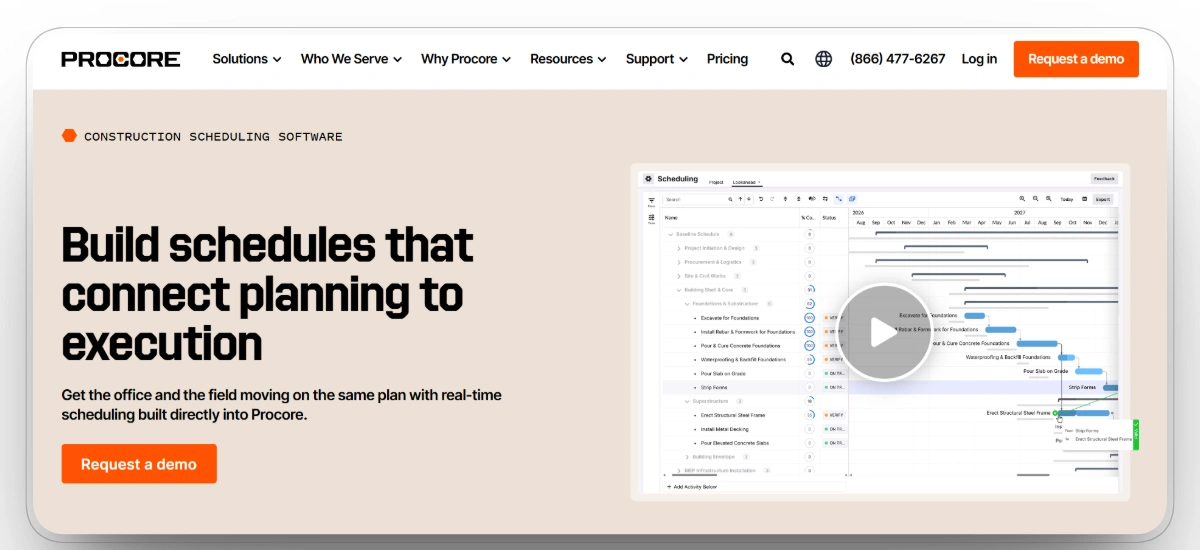
Best for: Large firms that want estimating inside a full construction management platform.
Procore is a powerful construction management platform whose estimating and cost-management tools sit alongside project management, quality, and safety. Its cloud-based system allows teams to create estimates and access real-time updates, improving collaboration across all project stakeholders.
What sets Procore apart is its integration breadth, from accounting software to BIM platforms, providing flexibility for varied project needs and keeping preconstruction connected to execution. In 2026, Procore remains a key player for firms that want a single platform of record rather than a standalone estimating tool.
Our Observation: Procore's case is the platform, not the estimating engine: if your company already runs projects on Procore, keeping estimates in the same system beats a best-of-breed tool you have to integrate. Smaller firms consistently describe it in reviews as more platform than they need, so match it to your scale honestly.
Our Rating: 8.0/10
Procore Pros
- Estimating and cost tracking connected to full project management.
- Real-time collaboration, ensuring all teams stay aligned.
- Deep integration ecosystem spanning accounting, BIM, and field tools.
Procore Limitations
- The platform's breadth means onboarding is a project in itself for new teams.
- High cost, especially for small businesses.
- Estimating depth is lighter than dedicated engines like HeavyBid or Sage.
Procore Reviews
G2: 4.6/5 (4,201 reviews)
Capterra: 4.5/5 (2,665 reviews)
Procore Pricing
Contact the vendor for pricing.
11. Bluebeam Revu

Best for: Estimators and project teams that live in PDFs and need precise markup and measurement.
Bluebeam Revu is a strong choice for PDF-based takeoffs and collaboration, offering powerful markup and measurement tools for accurate quantity extraction directly from digital plans.
Its Studio collaboration lets distributed teams mark up the same documents in real time, which speeds estimating reviews and keeps everyone aligned regardless of location. With customizable toolsets for measuring directly from plans, Bluebeam Revu reduces manual errors, though it pairs best with a dedicated costing tool since it is not a full estimating engine.
Our Observation: Bluebeam is on this list as the PDF and takeoff layer, not a complete estimating system: quantities come out of Revu, pricing happens elsewhere. Its review base is among the strongest here, and the recurring theme is that its depth rewards training. Pair it with a costing engine rather than expecting it to replace one.
Our Rating: 7.9/10
Bluebeam Revu Pros
- Precise measurements and takeoffs directly from digital plans.
- Real-time cloud collaboration for efficient team markups.
- Customizable toolsets tailored to estimating workflows.
Bluebeam Revu Limitations
- Its depth rewards training; casual users only scratch the surface.
- Per-user subscription costs add up for large teams.
- Lacks cost databases and bid management; it is takeoff and markup, not full estimating.
Bluebeam Revu Reviews
G2: 4.5/5 (461 reviews)
Capterra: 4.7/5 (976 reviews)
Bluebeam Revu Pricing
Contact the vendor for pricing.
12. RedTeam Flex
Best for: Mid-market general contractors that want estimating, budgeting, and change orders in one system.
RedTeam Flex is a cloud-based construction management platform that includes estimating, cost tracking, and real-time collaboration. Its interface makes managing project financial data straightforward for mid-market GCs.
The software excels at change order management, helping teams track and document adjustments to prevent cost overruns, while its document management keeps project files organized and accessible. RedTeam Flex combines estimating, budgeting, and forecasting in one solution, reducing the need for multiple tools across preconstruction and delivery.
Our Observation: RedTeam Flex sits in the practical middle: more financial workflow than a takeoff tool, less sprawl than Procore. Reviewers rate its change-order discipline highly, which is where mid-market GCs bleed margin. If estimating is your primary need, compare its module directly against a dedicated engine before deciding.
Our Rating: 7.8/10
RedTeam Flex Pros
- Real-time collaboration with cloud-based updates.
- Comprehensive cost tracking for budgets and forecasts.
- Efficient change order management to prevent cost overruns.
RedTeam Flex Limitations
- New users need a few weeks before the workflows feel natural.
- Fewer integration options than larger platforms.
- Estimating depth trails dedicated estimating engines.
RedTeam Flex Reviews
G2: 4.4/5 (53 reviews)
Capterra: 4.2/5 (195 reviews)
RedTeam Flex Pricing
Contact the vendor for pricing.
13. Contractor Foreman

Best for: Small to mid-sized contractors that want affordable estimating bundled with project management.
Contractor Foreman is an easy-to-use construction management platform that helps contractors create accurate bids and proposals quickly, and in 2026 it remains one of the most affordable full-featured options available.
Beyond estimating, it integrates project management tools like scheduling, invoicing, daily logs, and time tracking, streamlining workflows and reducing errors across small teams. Cloud-based and mobile-friendly, Contractor Foreman is a strong fit for small to mid-sized businesses that want maximum breadth per dollar.
Our Observation: Contractor Foreman wins on value: no other tool here delivers this much breadth at its price point, and its large review base backs that up. The flip side is depth, since each module, estimating included, is good rather than best-in-class. It is the right call when budget is the binding constraint.
Our Rating: 7.7/10
Contractor Foreman Pros
- Quick, accurate estimates for fast project turnaround.
- Combines estimating with project management tools, simplifying workflows.
- Highly affordable relative to the breadth of features included.
Contractor Foreman Limitations
- Some users face a learning curve across its many modules.
- Lacks advanced features for large-scale projects.
- Mobile app functionality trails the desktop experience.
Contractor Foreman Reviews
G2: 4.5/5 (378 reviews)
Capterra: 4.5/5 (833 reviews)
Contractor Foreman Pricing
Contact the vendor for pricing.
Which Estimating Software Fits Your Business
The right platform depends on the work you bid and who owns the estimate once it leaves preconstruction.
Match the Software to the Work You Bid
Match the Software to Who Owns the Estimate
FAQs
What is the best construction estimating software?
The best construction estimating software in 2026 is HCSS HeavyBid for heavy civil and DOT work, STACK for cloud-based takeoff-first estimating, Buildxact for small residential builders, and Sage Estimating for commercial GCs standardizing on a deep cost database. The right choice depends on the type of work you bid, your team size, and where the estimate flows after you win, so match the tool to your workflow rather than chasing a single winner.
How much does construction estimating software cost?
Construction estimating software costs range from affordable monthly subscriptions for small-contractor tools like Buildxact and Contractor Foreman to custom enterprise quotes for platforms like HCSS HeavyBid, Procore, and Sage Estimating. Takeoff tools are typically priced per user per year, while all-in-one platforms quote based on modules or construction volume. Several tools on this list, including STACK, PlanSwift, and Buildxact, offer free trials, and pricing changes frequently, so confirm current plans on each vendor's site.
What is the difference between takeoff and estimating software?
Takeoff software measures quantities from digital plans, including areas, lengths, volumes, and counts. Estimating software converts those quantities into a priced bid using labor rates, material costs, equipment costs, productivity assumptions, indirect costs, and markups. Some tools specialize in takeoff and markup, such as Bluebeam Revu. STACK and Sage Estimating connect takeoff and estimating more directly, while HeavyBid imports and integrates takeoff quantities into its heavy-civil estimating workflow.
What estimating software do highway contractors use?
Highway contractors primarily use HCSS HeavyBid and B2W Estimate because both support DOT pay-item bidding, agency bid-form import, and unit-price workflows that highway and heavy civil bids require. Edgevanta is a newer AI-driven platform built exclusively for highway contractors that focuses on bid strategy and market intelligence rather than traditional estimate building.
Does construction estimating software integrate with accounting tools?
Yes, most modern construction estimating software integrates with accounting tools. Buildxact and Buildertrend connect to QuickBooks and Xero, Sage Estimating flows estimates directly into Sage 300 CRE and Sage 100 Contractor job costing, and enterprise platforms like Procore and HCSS connect to major construction ERPs. Test the estimate-to-accounting flow in any demo, since re-keying estimates by hand is a top source of budget errors.
How do equipment costs affect estimating accuracy?
Equipment costs can materially affect estimating accuracy on heavy civil, infrastructure, earthmoving, and other equipment-intensive projects. Generic rate-book values may not reflect a contractor’s actual ownership, fuel, maintenance, repair, and utilization costs. Using fleet-specific hourly costs helps estimators price equipment closer to its real operating cost and identify work that may otherwise be underbid.
Final Thoughts
Every platform in this guide supports a different part of the estimating and preconstruction workflow. HCSS HeavyBid and B2W Estimate specialize in DOT and heavy civil bidding. STACK and PlanSwift focus on takeoff speed. Sage Estimating supports standardized, database-driven commercial estimates. Buildxact, Buildertrend, and Contractor Foreman connect estimating with the broader needs of residential builders and smaller contractors. Bluebeam supports measurement and markup, while Edgevanta adds highway bid intelligence rather than replacing a complete estimating engine.
Our overall pick for 2026 is HCSS HeavyBid because its detailed heavy-civil estimating, DOT pay-item workflows, bid-day capabilities, and connection to the wider HCSS ecosystem match the needs of contractors bidding complex infrastructure work.
Whichever tool you choose, test one of your own recent projects during the demo. Check how the platform handles takeoff revisions, labor and equipment rates, subcontractor quotes, indirect costs, bid review, and handoff after award. For equipment-heavy contractors, the final test is whether the estimate can reflect the real cost of the fleet rather than relying only on generic rate-book values.
Transform Your Equipment Management