Assets vs Inventory: What Construction Teams Need to Know


Hi, I’m Maham Ali. I write about construction equipment management, helping teams use fleet data and maintenance intelligence to improve uptime, control costs, and run smoother jobsites.
Assets and inventory both have value in construction, but they should not be managed the same way.
A filter, a hydraulic hose, a pallet of pipe, and a loader may all support the same jobsite, but each one creates a different operational need. Inventory has to be counted, stocked, issued, and replenished. Assets have to be tracked, assigned, maintained, inspected, and measured over their lifecycle.
That difference matters because poor inventory control can delay repairs, while poor asset visibility can delay entire jobsites.
This guide explains the difference between assets and inventory in construction, how to classify common items, and how contractors should track both without creating messy records or disconnected workflows.
Assets vs Inventory: The Simple Difference
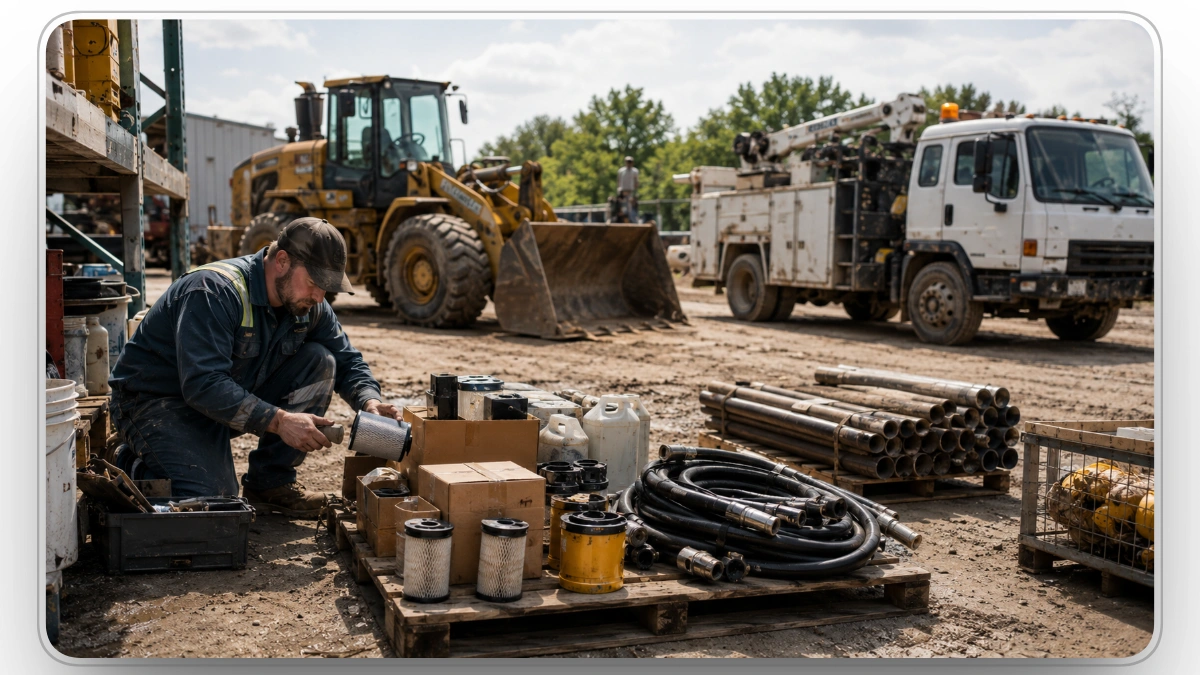
In construction, assets and inventory are easy to confuse because both cost money, both support operations, and both can sit in yards, shops, trucks, or jobsites.
But they do different jobs.
Inventory is usually used, consumed, installed, issued, or replaced.
Assets are usually tracked, assigned, maintained, moved, and used repeatedly over time.
- A filter is inventory.
- A loader is an asset.
- A hydraulic hose sitting on a parts shelf is inventory.
- The excavator that needs that hose is an asset.
- A pallet of pipe is inventory.
- A service truck is an asset.
The distinction sounds simple, but many contractors still manage both with the same spreadsheet, the same loose naming system, or the same “ask someone in the shop” process. That works until the fleet grows, the jobsite count increases, or maintenance starts waiting on parts that were supposed to be in stock.
That is why contractors need a clear system for both. Construction inventory management software helps teams track parts, materials, stock levels, and inventory movement so shops and jobsites are not guessing what is available.
Why the Difference Matters in Construction
This is not just an accounting topic.
For contractors, the difference between assets and inventory affects:
- Equipment availability
- Jobsite productivity
- Maintenance turnaround time
- Parts purchasing
- Material planning
- Rental decisions
- Project cost visibility
- Downtime control
- Fleet utilization
- Shop efficiency
When inventory is poorly managed, the team may not have the parts, materials, or supplies needed to keep work moving.
When assets are poorly managed, the team may not know where equipment is, whether it is ready, who has it, or whether it should be repaired, reassigned, replaced, or returned.
Both problems are expensive.
- A missing filter can delay a preventive maintenance job.
- A missing attachment can delay a crew.
- An idle loader on one jobsite can trigger an unnecessary rental on another.
- A service truck without the right parts can turn a simple repair into a full day of waiting.
This is why assets and inventory should be tracked differently, but connected operationally.
What Counts as Inventory in Construction?
Construction inventory includes the items a company stores, issues, installs, consumes, or uses to support field work, maintenance, and project delivery.
Inventory is usually managed by quantity, location, reorder level, and usage.
Common examples include:
- Filters
- Fluids
- Grease
- Belts
- Hoses
- Tires
- Batteries
- Fasteners
- Pipe
- Lumber
- Aggregate
- Concrete materials
- Electrical supplies
- Safety supplies
- Small replacement parts
- Shop stock
- Consumables
- Maintenance, repair, and operations supplies
Inventory usually moves through the business.
It may start in a central warehouse, move to a yard, get loaded into a service truck, then be used on a work order at a jobsite. If that movement is not tracked, the record falls apart quickly.
The inventory may technically exist in the company, but nobody knows where it is.
That is the daily pain.
Main Types of Construction Inventory

Construction inventory is not one clean category. Most contractors manage several types of inventory at the same time.
Materials Inventory
Materials inventory includes items used directly in project work.
Examples include:
- Pipe
- Gravel
- Concrete materials
- Lumber
- Rebar
- Drainage materials
- Electrical materials
- Road base
- Asphalt-related materials
- Fasteners
These items are usually tied to jobsite production and project cost. They need clear records because material waste, duplicate ordering, and poor delivery tracking can hurt margins fast.
Parts Inventory
Parts inventory supports construction equipment maintenance and repair.
Examples include:
- Filters
- Belts
- Hydraulic hoses
- Cutting edges
- Wear parts
- Fuses
- Batteries
- Tires
- Seals
- Bearings
- Lights
This is one of the most important inventory categories for equipment-heavy contractors.
If a critical part is missing, a repair stalls. If the repair stalls, the machine stays down. If the machine stays down, the jobsite feels it.
Consumables
Consumables are items that are used up during normal work.
Examples include:
- Gloves
- Safety glasses
- Welding rods
- Blades
- Drill bits
- Marking paint
- Rags
- Cleaning supplies
- Small shop supplies
Consumables may not need individual tracking, but they still need basic inventory control when they affect readiness, safety, or cost.
MRO Inventory
MRO stands for maintenance, repair, and operations.
This inventory supports the equipment and facilities needed to keep the business running.
Examples include:
- Lubricants
- Fluids
- Replacement parts
- Shop tools
- Cleaning supplies
- Safety supplies
- Maintenance materials
MRO inventory often gets overlooked because it does not always belong to one job. But when it is missing, everyone notices.
What Counts as an Asset in Construction?

A construction asset is a long-term resource the company owns, leases, rents, controls, or uses repeatedly.
Assets usually need their own record because they carry higher value, move across jobsites, require maintenance, and affect operations over time.
Common construction assets include:
- Excavators
- Dozers
- Loaders
- Graders
- Cranes
- Pavers
- Rollers
- Trucks
- Trailers
- Service trucks
- Generators
- Compressors
- Light towers
- Attachments
- Large tools
- Fleet vehicles
- Shop equipment
Assets are not usually consumed after one use. They stay in the operation and need ongoing visibility.
A good asset record should show:
- Asset name
- Asset ID
- Serial number
- Make and model
- Category
- Ownership status
- Rental status
- Current location
- Assigned jobsite
- Meter readings
- Utilization
- Inspection history
- Maintenance history
- Work orders
- Downtime
- Repair cost
- Replacement planning
That is a very different process from counting filters on a shelf.
Assets vs Inventory Comparison Table
The short version is simple:
Inventory tells you what stock is available.
Asset tracking tells you what equipment is available, where it is, and whether it is ready to work.
Is Inventory an Asset?
Yes, inventory can be an asset.
In accounting, inventory is usually treated as a current asset because it has value and is expected to be used, sold, installed, consumed, or converted into revenue. A current asset generally refers to an asset expected to be sold or used in business operations within one year.
But inventory is not the same as a fixed asset.
That is the important distinction for construction teams.
Inventory may be valuable, but it usually moves through the business quickly.
Fixed assets, such as heavy equipment and vehicles, stay in the business longer and are usually managed over their useful life. The IRS explains depreciation as recovering the cost of certain property over a number of years instead of deducting the full cost in one year.
That is why an excavator and a box of filters should not be treated the same operationally.
Both have value.
Only one needs GPS visibility, utilization tracking, inspections, maintenance history, and lifecycle planning.
Construction Examples: Asset or Inventory?

The easiest way to understand the difference is through real construction examples.
Excavator
An excavator is an asset.
It is high-value, used repeatedly, moved between jobsites, maintained over time, and tracked through location, hours, inspections, repairs, and utilization.
It should have its own asset record.
Hydraulic Filter
A hydraulic filter is inventory.
It sits in stock until it is used during maintenance or repair. Once used, it should be connected to the work order and the asset it supported.
Service Truck
A service truck is an asset.
It has mileage, maintenance needs, assignment history, operating cost, and location.
The parts inside the service truck may be inventory, but the truck itself is an asset.
Spare Tire
A spare tire is usually inventory while it is sitting in stock.
Once installed on a truck, loader, or trailer, it should become part of the asset’s maintenance and cost history.
This is exactly why inventory and asset records should connect.
Fuel
Fuel is usually managed as inventory, supply, or operating cost depending on the company’s accounting setup.
Operationally, fuel should be tracked by asset, jobsite, usage, and cost because it directly affects fleet operating expense.
Attachment
A bucket, hammer, grapple, fork, broom, or auger is usually an asset if it is valuable, reusable, assigned, and worth tracking.
A cutting edge or wear part for that attachment is usually inventory before installation.
Small Tools
Small tools can go either way.
A low-cost drill bit is usually inventory or consumable stock.
A reusable power tool may be treated as an asset if it is assigned, tracked, and valuable enough to recover.
The practical rule:
If it is consumed, stocked, issued, or reordered, manage it as inventory.
If it is reused, assigned, maintained, and worth recovering, track it as an asset.
Common Mistakes Contractors Make

Mistake 1: Managing Parts Like Equipment
A box of filters does not need the same record as a loader.
Parts inventory needs:
- Quantity
- Location
- Bin
- Reorder point
- Vendor
- Unit cost
- Usage history
Equipment needs:
- Asset ID
- GPS location
- Assignment
- Utilization
- Inspections
- Work orders
- Maintenance history
- Downtime
When contractors force inventory and assets into the same tracking method, the system becomes noisy and hard to trust.
Mistake 2: Managing Equipment Like Stock
Heavy equipment should not be treated as a generic quantity.
A company may have five loaders, but those five loaders are not identical from an operations standpoint.
One may be ready.
One may be down.
One may be assigned to a project.
One may be underused.
One may have recurring hydraulic problems.
That is why contractors need construction equipment tracking software, not just a list of owned equipment.
Mistake 3: Not Connecting Parts to Work Orders
This is a big one.
If a mechanic uses a belt, filter, hose, tire, or battery during a repair, that part should be tied to the work order.
Without that connection, the company loses three things:
- Accurate inventory counts
- True repair cost
- Complete asset history
The equipment record looks cleaner than reality.
The parts room looks better stocked than reality.
The maintenance report misses the real cost.
That is not a reporting problem. That is an operating problem.
Mistake 4: No Reorder Levels
Some items should never surprise the shop.
Filters, fluids, belts, grease, hoses, batteries, common wear parts, and safety supplies should have reorder levels.
Without reorder points, teams discover missing stock only when they need it.
By then, the delay has already started.
Mistake 5: Letting Every Yard Use Its Own System
One yard uses a spreadsheet.
One service truck uses handwritten notes.
One project manager orders directly from a supplier.
One shop relies on memory.
This might work when the fleet is small. It breaks when equipment, crews, jobsites, and maintenance needs start moving fast.
Construction needs local flexibility, but the company still needs one source of truth.
Why Inventory Control Affects Equipment Uptime

Inventory control is not just a warehouse issue.
It directly affects equipment uptime.
A preventive maintenance plan may be perfect on paper. The machine may be due for service. The technician may be available. The work order may be ready.
But if the filter or fluid is missing, the work stops.
That means inventory problems can create downtime even when the maintenance process is technically working.
Good inventory control helps maintenance teams:
- Confirm parts availability before work starts
- Avoid emergency purchases
- Reduce repair delays
- Improve PM completion
- Track parts used by asset
- Understand repair cost more clearly
- Keep service trucks stocked
- Reduce duplicate buying
This is where inventory management and equipment management start to overlap.
The asset tells the team what needs service.
The inventory tells the team whether the service can actually be completed.
Why Asset Tracking Affects Inventory Planning
Asset tracking also helps inventory planning.
If the fleet manager knows which assets are active, where they are working, how many hours they are running, and what maintenance is coming up, the parts team can plan better.
For example:
- More operating hours may increase filter demand.
- Harsh site conditions may increase wear part usage.
- A group of assets nearing PM intervals may require more fluids and service parts.
- A remote project may need additional service truck stock.
- Repeated repairs on one machine may increase demand for specific parts.
Without asset visibility, inventory planning becomes reactive.
Teams order after the problem appears.
That is expensive and slow.
Asset Management vs Inventory Management
Asset management focuses on long-term resources.
It answers questions like:
- Where is the asset?
- Is it ready?
- Who is using it?
- Is it assigned correctly?
- Is it due for service?
- How much is it being used?
- What does it cost to maintain?
- Should it be repaired, replaced, sold, or reassigned?
Inventory management focuses on stock.
It answers questions like:
- What do we have?
- How many are available?
- Where are they stored?
- What needs to be reordered?
- Who used it?
- Which work order used it?
- Which asset did it support?
- What did it cost?
The two processes are different, but they should not be disconnected.
Construction teams need both because equipment readiness depends on parts readiness.
How Assets and Inventory Connect Through Maintenance
Maintenance is where assets and inventory meet.
A typical workflow looks like this:
- A machine reaches a service interval.
- A preventive maintenance task is triggered.
- A work order is created.
- A technician is assigned.
- Parts and fluids are needed.
- Inventory is issued.
- The repair or service is completed.
- Parts usage updates inventory.
- The asset history updates.
- The equipment returns to work.
That workflow touches asset tracking, inventory, preventive maintenance, work orders, labor, parts, and cost.
If those records are disconnected, the team loses visibility.
Clue’s preventive maintenance helps teams create PM plans, customize services and checklists, and automate work orders when maintenance is due.
Work orders helps teams create mechanic work orders, automate tasks from fault codes and inspection findings, and track maintenance work more clearly.
That connection is important because maintenance does not happen in a vacuum.
A work order needs people.
People need parts.
Parts need inventory records.
The asset needs the service history.
How to Track Inventory Properly in Construction

A strong construction inventory process should answer basic questions without forcing teams to chase people.
Track What You Have
Every stocked item should have a clear name and category.
Examples:
- Engine oil
- Hydraulic filter
- Fuel filter
- Grease cartridge
- Hydraulic hose
- Cutting edge
- Battery
- Tire
- Safety gloves
- Marking paint
Avoid vague names like “misc parts” or “shop supplies” when the item affects cost, repairs, or availability.
Track Where It Is
Construction inventory moves.
It may be in:
- Main warehouse
- Yard
- Shop
- Service truck
- Jobsite trailer
- Mechanic bay
- Remote project location
Location matters because “we have it somewhere” is not good enough when equipment is down.
Track Quantity
Inventory needs quantity control.
Teams should know how many are available, how many are reserved, how many were used, and how many need to be ordered.
Set Reorder Points
Common parts and consumables should have reorder thresholds.
When stock drops below the set point, the team should know before the shelf is empty.
Connect Usage to Work Orders
Parts usage should be tied to the repair or maintenance event where possible.
That gives the company better visibility into:
- Repair cost
- Parts demand
- Asset history
- Inventory movement
- Maintenance planning
Review Slow-Moving Stock
Not all inventory is useful.
Some parts sit for years because equipment changed, vendors changed, or old machines were sold.
Slow-moving inventory ties up cash and shelf space. Contractors should review it regularly.
How to Track Assets Properly in Construction
Asset tracking requires more than a list of machines.
A strong construction asset process should show what each asset is doing and whether it is ready to work. That is where construction asset tracking software comes in, giving teams a live view of location, condition, and availability instead of relying on guesswork or phone calls to the yard.
Use a Clear Asset Record
Each asset should have a clean profile with:
- Name
- Asset ID
- Category
- Make
- Model
- Serial number
- Ownership status
- Rental status
- Current jobsite
- Assigned team
- Meter readings
- Maintenance history
Track Location
Equipment moves constantly.
A live map or updated location record helps teams avoid wasted calls, unnecessary rentals, and delayed dispatch.
Track Utilization
An asset can be owned and still underused.
Utilization data helps teams see which machines are working, sitting idle, or creating rental waste.
Track Maintenance History
Every service, repair, inspection, and issue should build the asset history.
That history helps teams make better decisions about repairs, replacement, and lifecycle cost.
Track Availability
Teams need to know whether equipment is:
- Available
- Assigned
- In use
- Down
- In maintenance
- Waiting on parts
- In transit
Availability is what dispatch and operations actually need.
When Construction Teams Blur the Line
The worst outcomes happen when assets and inventory are mixed together without clear rules.
Here is what that looks like:
- Equipment is listed as stock, but nobody knows the condition or availability.
- Parts are listed as assets, but nobody tracks quantities properly.
- Service trucks carry parts, but the central inventory does not update.
- Work orders use parts, but costs are not tied to the asset.
- Materials move to a jobsite, but the office cannot confirm what was used.
- A rented asset stays on site because nobody owns the return process.
- A critical part is ordered twice because one location could not see another location’s stock.
This creates messy reporting and slower decisions.
The fix is not more paperwork.
The fix is cleaner classification and connected workflows.
How Clue Helps Construction Teams Manage Assets and Inventory
Clue helps construction teams manage equipment operations in one connected system.
That matters because assets, inventory, maintenance, and work orders are not separate problems in the field.
They affect each other every day.
- A machine goes down.
- A work order is created.
- A mechanic needs parts.
- The part comes from inventory.
- The repair updates asset history.
- The asset returns to work.
If those steps live in disconnected systems, the team loses time and visibility.
With Clue, contractors can connect more of the operating picture across:
- Equipment tracking
- Inventory visibility
- Preventive maintenance
- Work orders
- Asset records
- Parts usage
- Jobsite assignments
- Maintenance history
- Cost visibility
Clue’s construction equipment management software is built for heavy construction teams that need to manage equipment, maintenance, work orders, costs, and operations from one system.
- That is the practical value.
- Not another spreadsheet.
- Not another disconnected tool.
One cleaner way to see what is available, what is missing, what is due, and what needs action.
Quick Checklist: Inventory or Asset?
Use this checklist when deciding how to classify an item.
Track It as Inventory If:
- It is consumed or installed.
- It is ordered in quantities.
- It sits in stock before use.
- It needs a reorder point.
- It is issued to a work order.
- It supports maintenance or project work.
- The main risk is running out, overbuying, or losing stock visibility.
Examples:
- Filters
- Fluids
- Hoses
- Belts
- Safety supplies
- Fasteners
- Materials
- Consumables
- Spare parts
Track It as an Asset If:
- It is used repeatedly.
- It has a meaningful replacement cost.
- It moves between jobsites.
- It needs maintenance.
- It needs inspection.
- It has utilization data.
- It is assigned to a person, crew, or project.
- The main risk is downtime, theft, underuse, or poor lifecycle visibility.
Examples:
- Excavators
- Trucks
- Trailers
- Generators
- Attachments
- Large tools
- Service vehicles
- Compressors
- Light towers
Final Answer: Assets vs Inventory in Construction
Assets and inventory are both valuable, but they are not the same thing.
Inventory includes the parts, materials, supplies, and consumables that move through the business.
Assets include the equipment, vehicles, tools, attachments, and machines that stay in the business and need long-term tracking.
Inventory needs stock visibility, reorder control, usage history, and location tracking.
Assets need GPS visibility, assignment history, inspections, utilization data, maintenance records, and lifecycle cost control.
The smartest contractors manage them separately, then connect them through maintenance, work orders, jobsite assignments, and cost reporting.
That is how construction teams reduce missing parts, avoid unnecessary rentals, improve equipment uptime, and stop small tracking gaps from turning into expensive field delays.
FAQs
What is the difference between assets and inventory in construction?
Assets are long-term resources such as equipment, vehicles, attachments, and tools. Inventory includes parts, materials, supplies, and consumables that are stored, issued, used, or installed.
Is inventory an asset?
Yes. Inventory is usually considered a current asset because it has value and is expected to be used, sold, installed, consumed, or converted into revenue.
Is construction equipment inventory or an asset?
Construction equipment is usually an asset. Machines such as excavators, loaders, trucks, trailers, cranes, and generators are used repeatedly and need long-term tracking, maintenance, and utilization visibility.
Are spare parts inventory or assets?
Spare parts are usually inventory before they are installed. Once used in a repair, they should be connected to the work order and the asset’s maintenance history.
Are tools assets or inventory?
It depends on value and usage. Low-cost consumable tools may be inventory. Reusable tools that are assigned, tracked, and worth recovering can be managed as assets.
Why do contractors need to separate assets and inventory?
Contractors need to separate them because they create different operational risks. Inventory problems cause stockouts, repair delays, and overbuying. Asset problems cause downtime, poor utilization, theft risk, and high ownership costs.
How should construction teams track inventory?
Construction teams should track inventory by item name, quantity, location, reorder point, vendor, usage, and work order connection.
How should construction teams track assets?
Construction teams should track assets by asset ID, location, assignment, utilization, inspections, maintenance history, work orders, downtime, and lifecycle cost.
Can one system manage both assets and inventory?
Yes. A connected equipment operations system can help contractors manage both assets and inventory while linking them to maintenance, work orders, jobsites, and cost reporting.
Transform Your Equipment Management