Types of Road Construction Equipment and How to Keep Them Productive


Hi, I’m Maham Ali. I write about construction equipment management, helping teams use fleet data and maintenance intelligence to improve uptime, control costs, and run smoother jobsites.
Road construction isn’t just asphalt and rollers, it’s a production system. Each phase (earthwork, grading, stabilization, paving, compaction, hauling, finishing) depends on the right equipment arriving at the right time, operating in-spec, and staying out of unplanned downtime.
The problem most road and highway contractors face isn’t a lack of machines. It’s lost production:
- equipment sitting idle because trucks are late or the next crew isn’t ready
- machines dispatched to the wrong site or wrong phase
- compaction rework because pass coverage and temperature control weren’t consistent
- maintenance done too late because the team didn’t have one reliable view of runtime, fault signals, and upcoming service windows
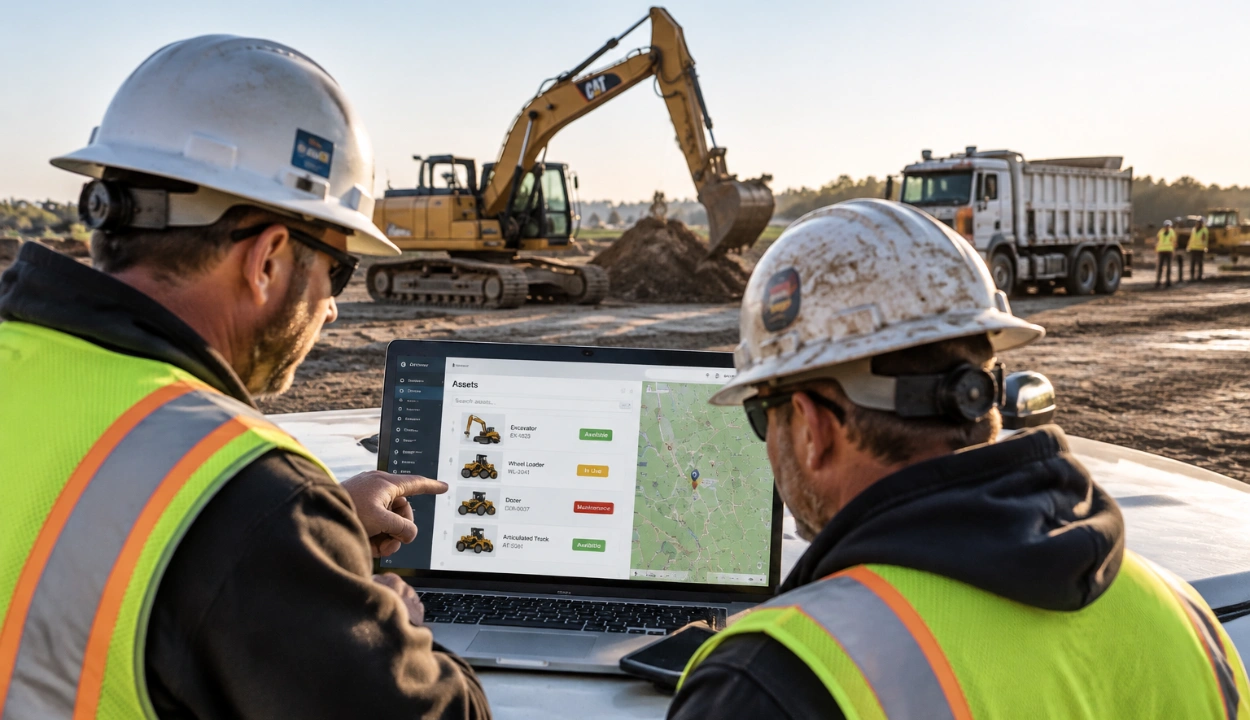
That’s why high-performing contractors treat equipment like a managed fleet, not a collection of iron. Clue is built for that reality. It centralizes location, utilization, idle time, maintenance, and jobsite activity into one operating view so field teams and fleet teams can make faster, more accurate decisions.
This guide breaks down the core types of road construction equipment used on U.S. road and highway projects. What each machine does, where it fits in the workflow, what usually kills productivity, and what to track so every hour in the field turns into output.
Road Construction Phases, Equipment, and What to Track
The Step-by-Step Process of Building a Road

Most road projects follow the same sequence:
- Clearing & Cutting: remove vegetation/debris and unsuitable material to expose a stable base
- Grading: shape to elevation and slope; establish drainage and uniform thickness
- Stabilization & Compaction: strengthen subgrade with rollers/stabilizers; add lime/cement/aggregate if needed
- Surface Prep: mill and clean surfaces where needed
- Paving: place asphalt (or concrete) to spec; keep material flow steady
- Compaction & Finish Rolling: hit density targets while temperature is workable
- Finishing: striping, barriers, signage, shoulders, guardrails, punch list
Every step has one requirement, visibility. If you can’t see where machines are, how long they’ve run, how much they’ve idled, and what service is coming due, you can’t control cost or output. The job wins or loses in that gap.
How to Choose the Right Equipment
Before listing machines, here’s the sizing logic elite contractors use:
- Haul distance (short vs medium vs long) determines scraper vs truck reliance
- Material type (granular vs cohesive) changes compaction strategy and drum type
- Geometry & constraints (urban lanes, traffic windows, tight access) changes machine class and attachment choices
- Production target (lane-miles/day or tons/hour) determines the number of trucks, rollers, and support assets, not just the paver
- Risk tolerance (backup units, rental strategy) determines what must be owned vs rented
With utilization and idle baselines by machine class, you can size fleets based on reality, what your teams actually use, not what a spreadsheet predicted.
Groundwork and Grading with Earthmoving Equipment

Every road starts with moving earth. Before a single layer of asphalt is placed, the ground has to be shaped, leveled, and compacted to form a stable base. This is where earthmoving equipment like bulldozers, excavators, scrapers, and motor graders come in.
1. Bulldozers
Role: clearing, stripping topsoil, rough grading, pushing fill, building a working platform.
Productivity killers: undercarriage wear, track debris buildup, overheating, idle waiting on haul or layout.
Keep them productive
- Clean tracks and manage tension (small neglect becomes major cost)
- Standardize daily walkarounds (leaks, cutting edges, track condition)
- Use grade control where practical to reduce rework and extra passes
- Match blade type to soil conditions and push distance
What to track
- idle % by site and by operator shift
- time-on-site vs productive runtime (are dozers waiting on trucks?)
- fault/temperature alerts to prevent catastrophic downtime
- movement between geofenced jobsites (who’s where, and for how long)
2. Excavators
Role: trenching, drainage, culverts, ditch work, slope shaping, loading.
Productivity killers: hydraulic contamination, long swing cycles, overheating, mismatched bucket size.
Keep them productive
- protect hydraulic cleanliness (filters, oil discipline, contamination control)
- shorten swing angle and position trucks intelligently
- clean cooling packs in dusty conditions
- standardize bucket selection by material density and target cycle time
How Clue helps
- utilization vs idle (are trucks arriving at the right cadence?)
- runtime trends (is this machine overloaded across multiple sites?)
- maintenance scheduling by actual hours, not calendar guesses
The CASE CX210D exemplifies intelligent hydraulics, automatically balancing power and speed. According to field studies cited by MDPI (2023), machine age, operator skill, and maintenance discipline are statistically significant factors in overall equipment operational performance, often outweighing pure engine output.
3. Motor Graders
Role: fine shaping for cross slope, crown, drainage, and uniform layer thickness.
Productivity killers: extra passes, inaccurate controls, worn moldboards/edges, operator variability.
Keep them productive
- keep cutting edges sharp; replace before rounding ruins accuracy
- calibrate control systems and verify slope/crown targets
- maintain tire pressure and hydraulic smoothness to avoid chatter and washboard
- build operator standards: fewer passes beats faster passes
Clue’s Assistance
- compare productivity by zone (time spent vs area completed)
- highlight rework patterns (machines returning to the same segment)
- balance grader deployment across sites so one crew isn’t overloaded
4. Scrapers
Role: cut, load, haul, and spread material efficiently over short-to-medium distances.
Productivity killers: dull cutting edges, tire issues, cycle imbalance with push support, waiting time.
Keep them productive
- maintain cutting edges to reduce load time and fuel waste
- manage tire condition and pressure for safe speed and stability
- synchronize cycles (push support, haul routes, dump locations)
- keep haul roads maintained, bad haul roads destroy cycle times and tires
Clue’s role
- cycle time patterns (when do scrapers slow down?)
- idle at load vs idle at dump (where the bottleneck lives)
- redeploy assets if one segment is waiting while another is starving
Stabilization and Base Preparation
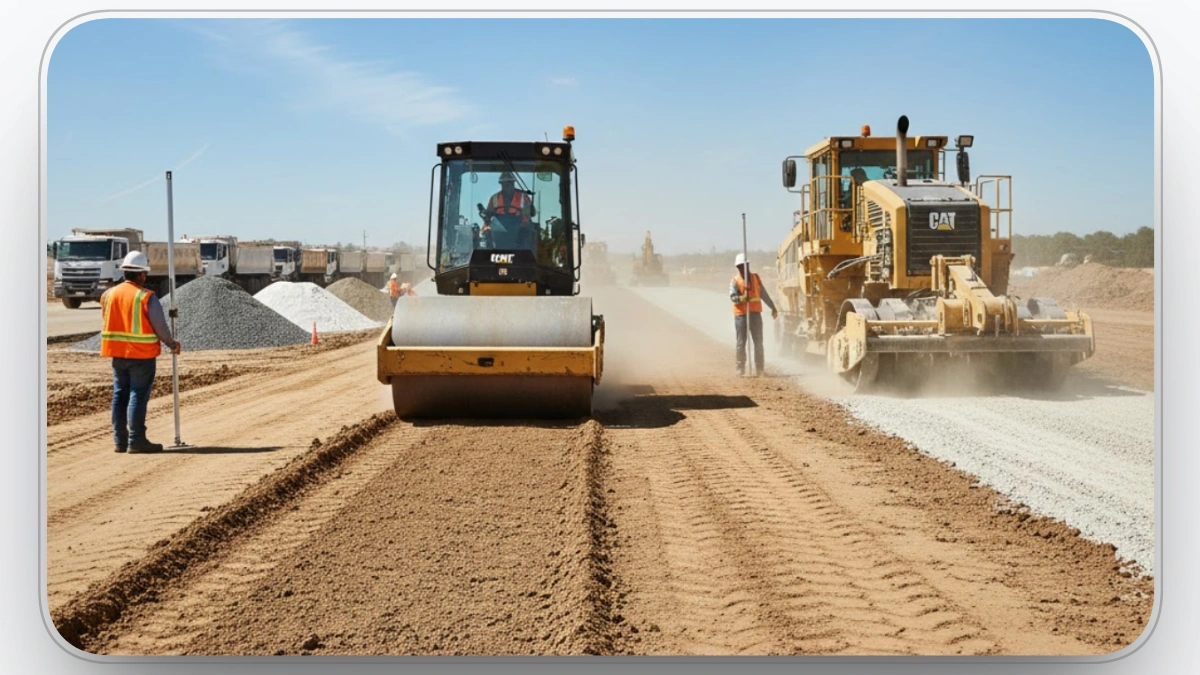
After grading, the subgrade must be compacted and stabilized to handle load and weather. This phase strengthens the foundation using rollers, stabilizers, and milling machines. Additives like lime or cement are mixed into weak soils to increase bearing capacity, while reclaimers recycle existing material for reuse.
The goal is simple, create a dense, uniform base that supports pavement layers and prevents future deformation.
1. Soil Compactors
Role: build density, remove voids, create a load-bearing subgrade.
Productivity killers: wrong amplitude/frequency for lift thickness, dirty drums, inconsistent moisture, missed coverage.
Keep them productive
- set vibration to match material type and lift thickness
- keep drums clean; maintain scraper bars and water systems
- coordinate moisture control (often needs a water truck plan)
- use coverage discipline: systematic passes beat “spot rolling”
Clue helps track compaction work
- runtime inside compaction zones (proof of coverage activity)
- utilization by roller type (are the right rollers assigned?)
- service intervals (rollers get punished; PM discipline matters)
2. Reclaimers / Stabilizers
Role: pulverize, blend additives, regrade in one pass; improve bearing capacity.
Productivity killers: wrong additive flow, worn bits, inconsistent mixing, clogging.
Keep them productive
- calibrate additive flow rates each shift
- keep bits sharp to maintain rotor efficiency
- keep mixing chamber clean
- align reclaimer output with compaction capacity so material doesn’t sit exposed
Clue helps keep phases aligned
- production continuity: is the reclaimer waiting on support or vice versa?
- planned vs unplanned downtime (bits, rotor wear, service windows)
- location and utilization history to plan upcoming phases accurately
3. Cold Planers / Milling Machines
Role: remove distressed asphalt to a precise depth/profile for overlays.
Productivity killers: dull bits, conveyor/hydraulic issues, grade sensor errors, sweeping delays.
Keep them productive
- replace bits before cutting quality drops and engine load spikes
- inspect conveyors/hydraulics daily
- verify grade control and depth consistency
- pair milling with sweeping and cleanup so paving isn’t delayed
Clue helps reduce milling delays
- downtime reasons by day (mechanical vs process delay)
- readiness of support assets (sweepers, trucks)
- service timing aligned to runtime, not assumptions
4. Water Trucks
Role: control moisture content for compaction, support soil stabilization, and manage dust on haul roads and active work zones.
Productivity killers: inconsistent moisture, overwatering/underwatering lifts, slow refill cycles, nozzle/clog issues, poor coordination with compactors.
Keep them productive
- pre-plan refill points and refill windows so rollers don’t wait
- calibrate spray patterns and check nozzles each shift
- assign moisture responsibility clearly (who decides “ready to compact”?)
- use consistent moisture passes per lift instead of spot spraying
- maintain pumps, valves, and hoses (small failures stall the whole compaction train)
How Clue helps
- verify time-in-zone during compaction windows (water support is either there or it isn’t)
- identify compaction delays caused by missing support assets
- track utilization across sites so water trucks don’t get trapped on low-priority work
- coordinate dispatch so moisture conditioning matches roller availability
Paving and Surfacing
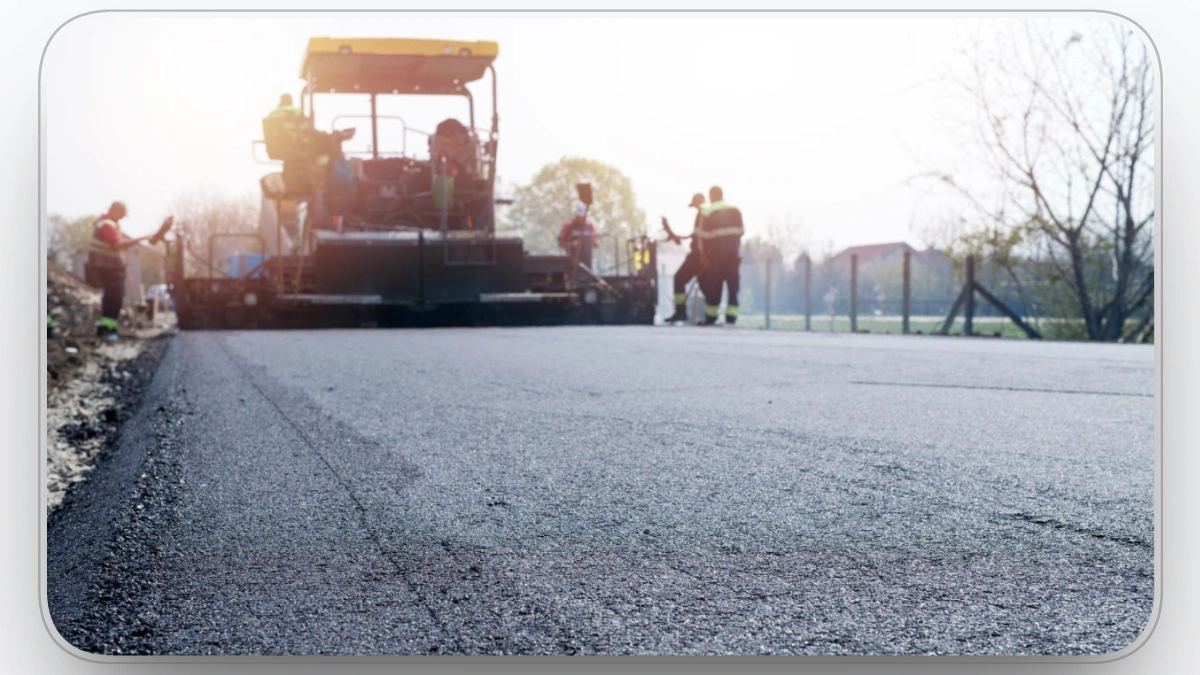
With the base ready, paving forms the finished surface. This phase uses pavers to place asphalt or concrete and rollers to compact it to design density and smoothness. Temperature control, uniform spreading, and consistent compaction are critical for durability and ride quality.
1. Asphalt Pavers
Role: place hot-mix evenly to spec thickness and cross slope.
Productivity killers: truck imbalance, hopper starvation, frequent stops, inconsistent mix temperature.
Habits That Preserve Output
- Maintain a continuous supply of mix; avoid hopper starvation.
- Clean augers, conveyors, and screeds at day’s end.
- Verify screed heaters and slope sensors.
Modern automatic control systems hold thickness and temperature steady across the mat. FHWA field demonstrations show that automation can cut manual correction time by nearly one-third while producing smoother International Roughness Index (IRI) values.
How Clue helps
- truck cycle times and queue time (the real driver of paver stops)
- jobsite flow visibility (is the paver waiting on trucks or the plant?)
- utilization vs idle to identify systemic delay not “operator blame”
2. Rollers and Finish Compactors
Role: reach density and smoothness; prevent cracking and early failure.
Productivity killers: inconsistent pass coverage, rolling too late, wrong vibration settings, poor coordination with paver speed.
- Match vibration settings. Adjust amplitude and frequency to the layer thickness and mix temperature.
- Control timing. Begin rolling while asphalt is between 240°F and 290°F for best compaction.
- Maintain drums and tires. Keep drums clean and tire pressures equal to prevent marking or slippage.
- Track coverage. Use onboard or GPS-based pass-count systems to verify uniform compaction.
How Clue helps
- utilization inside the paving zone (are rollers where they need to be?)
- timing and availability (do you have enough rollers for the mat width and speed?)
- maintenance adherence (rollers fail at the worst possible moment plan around runtime)
3. Material Transfer Vehicles (MTV) / Shuttle Buggies
Role: maintain steady feed, reduce segregation, protect mat consistency.
Productivity killers: not used when needed, poor integration with haul cadence, stoppage mismanagement.
Keep them productive
- deploy MTVs on longer hauls, high-spec jobs, or where segregation risk is high
- integrate into dispatch so the paver is never starved
- keep augers and conveyors maintained, MTV failure can halt the mat
How Clue helps
- identify segments where paver stops spike and decide when MTV use is justified
- compare production stability (stop frequency) before/after deployment
4. Tack Coat Distributor
Role: apply bond coat so layers adhere, one of the most important durability steps.
Productivity killers: poor surface cleanliness, inconsistent application, stoppages due to coordination failures.
Keep it productive
- ensure sweeping/cleanup is complete before application
- verify spray bar condition and calibration
- coordinate so tack timing aligns with paving windows
How Clue helps
- sequencing discipline: tack and paving must be planned as one system
- track asset availability and deployment timing across the corridor
To get more from these machines, see how to use equipment telematics for paving projects.
Material Handling and Support Equipment

Efficient material flow keeps paving and grading operations moving. Support equipment such as loaders, skid steers, dump trucks, and cranes supply, transport, and position materials where they’re needed. These machines prevent bottlenecks by ensuring that primary equipment, pavers, rollers, and graders, always have material on hand.
1. Wheel Loaders
Wheel loaders handle aggregate loading, asphalt batching, and general site cleanup. Popular U.S. models include the Caterpillar 950M, Volvo L120H, Komatsu WA320-8, and John Deere 644 P-Tier. Their role is to feed hoppers and trucks efficiently while maintaining tight cycle times. Onboard weighing systems such as Cat Payload or Volvo Load Assist prevent overloading and reduce rehandling. Regular lubrication and tire pressure checks sustain hydraulic response and driveline efficiency.
2. Compact Loaders and Skid Steers
Compact track loaders and skid steers work in tight zones around paving or grading crews. The Bobcat T76, CASE TV620B, Caterpillar 259D3, and John Deere 333G are standard across contractors’ fleets.
These machines switch quickly between attachments; buckets, forks, brooms, or cold planers, making them versatile for cleanup, backfilling, and support work. Track tensioning, cooling system maintenance, and clean filters keep them performing at full hydraulic power in dusty or hot conditions.
3. Dump Trucks and Haulers
Dump trucks move asphalt, aggregates, and spoil between job stages. Fleets typically use Volvo A40G articulated haulers, Caterpillar 725, Komatsu HM400-5, or highway-class Mack Granite dump trucks for asphalt haulage. Balanced dispatching ensures loaders and pavers operate continuously.
A coordinated haul plan like the one modeled in the ResearchGate productivity study achieved the optimal cost and time balance, 44 days to complete the section versus longer baselines with fewer trucks.
4. Truck-Mounted Cranes
Boom trucks and small cranes handle barrier placement, pole installation, and lifting heavy components around the site. Leading models include the Terex BT 70100, National Crane NBT60XL, and Manitex TC50155HL. Daily inspection of outriggers, hydraulic lines, and rotation bearings ensures stability and uptime. Well-maintained cranes reduce dependence on rentals and maintain tight construction schedules.

Road Construction Safety Equipment
Accidents and near-misses are the most expensive form of downtime. Safety isn’t separate from production. It’s a production requirement.
- PPE: enforce replacement cadence and compliance
- Work-zone devices: attenuators, barricades, arrow boards deployed consistently
- Visibility & comms: lights, cameras, alarms, radios/headsets for spotter coordination
- Preparedness: fire extinguishers, spill kits, lockout/tagout readiness
Clue gives complete equipment visibility and deployment tracking to prevent “missing device” stoppages and reduce chaotic starts.
Daily and Weekly Productivity Habits
Regular inspections and maintenance routines prevent downtime and extend the life of every machine. Operators should follow structured daily and weekly checks to keep performance consistent and avoid unexpected failures.
Daily Walkarounds
Operators should inspect the following at the start of each shift:
- Fluid levels and leaks: Check engine oil, coolant, hydraulic, and transmission fluids for proper levels and signs of contamination or loss.
- Tires, tracks, and undercarriage: Look for damage, excessive wear, or debris buildup that could affect traction or stability.
- Lights, horns, alarms, and mirrors: Confirm that all safety and signaling systems are working.
- Safety equipment: Verify that fire extinguishers, first-aid kits, and backup alarms are in place and functional.
A quick 10-minute inspection can prevent mechanical issues that would otherwise halt production for days.
Weekly Service
A deeper weekly inspection should cover:
- Lubrication: Grease all pins, bushings, and pivot points to reduce wear and maintain smooth motion.
- Cooling system maintenance: Clean radiators, coolers, and fans to prevent overheating during extended operation.
- Torque verification: Recheck torque on bolts, wheel lugs, and structural fasteners to prevent loosening under vibration.
- Telematics review: Analyze system alerts for abnormal temperatures, pressures, or fault codes that indicate early signs of component failure.
Following these routines ensures every unit performs reliably, reduces repair costs, and maximizes uptime across the fleet.
Fleet Data and Telematics
Telematics systems provide real-time insight into equipment performance and utilization. Platforms such as Caterpillar VisionLink, Komatsu KOMTRAX, and Volvo CareTrack help managers make data-driven operational care and deployment decisions.
Use these dashboards to:
- Track idle time and utilization: Identify machines running below target hours and reduce unnecessary fuel use.
- Schedule maintenance by operating hours: Replace calendar-based servicing with usage-based intervals for greater accuracy and less downtime.
- Redeploy underused assets: Relocate low-hour units to active sites to balance fleet workload and avoid overuse of key machines.
Fleet telematics make such coordination easier today. The Global Market Insights 2024 report shows the construction-equipment telematics market at USD 6.9 billion in 2024, projected to surpass USD 20 billion by 2034, with users reporting 10–15 percent fuel savings and 15–20 percent asset care cost reductions through predictive analytics and idle management.
Fleet Productivity KPIs to Track on Road Jobs
The easiest way to improve equipment productivity is to track a small set of KPIs consistently. These metrics reveal where production is leaking without relying on opinions.
Core KPIs
- Idle % by asset class: dozers, excavators, graders, rollers, trucks (idle shows planning or material-flow issues)
- Utilization hours per day: per machine, per site, per phase (who is underused vs overloaded)
- Truck turn time: plant → site → return (the biggest driver of paver stops)
- Queue/dwell time: at plant and at paver (pinpoints the bottleneck)
- Paver stoppages: count + total duration (stops hurt mat quality and compaction success)
- PM compliance by engine hours: prevents “fails on the mat” emergencies
- Rework signal: machines returning repeatedly to the same segment (often indicates grade/compaction inconsistency)
Clue’s Role
- standardize KPI reporting across jobsites and crews (one definition of idle, utilization, and time-on-site)
- surface bottlenecks early (haul imbalance, missing support equipment, phase scheduling gaps)
- turn telematics signals into action (maintenance windows, redeployments, dispatch fixes)
Why Road & Highway Contractors Run Equipment Operations via CLUE
Road work is hard on machines and harder on coordination. Clue is built for heavy construction fleets that need to manage:
- where equipment is (jobsite, yard, transit)
- how it’s being used (productive time vs idle time)
- what’s coming due (service windows, fault risk, work orders)
- how projects stay supplied (hauling flow and asset availability)
Clue also supports integration with common telematics and business systems so teams don’t spend their week reconciling dashboards and spreadsheets. The goal is simple: fewer surprises, fewer stoppages, and better production continuity
Best Practices for a Productive Fleet

A productive fleet depends on correct sizing, disciplined scheduling, and consistent oversight. These practices reduce idle time, control costs, and protect equipment life.
Match Equipment to Project Size
Use highway-class machines for long corridors and high-volume work. Use mid-class equipment for municipal roads, utility corridors, and confined sites. Oversized machines increase fuel burn and unplanned repairs without improving output.
Schedule Equipment by Project Phase
Assign machines based on construction stage. Earthmoving, stabilization, paving, and finishing require different assets. Phase-based scheduling prevents idle equipment and bottlenecks.
Stock High-Failure Spare Parts
Keep filters, belts, hoses, sensors, and wear items on hand. Immediate replacement prevents small failures from becoming multi-day shutdowns.
Monitor and Review Performance Data
Use telematics and fuel logs to track utilization, idle time, and service intervals. Review data regularly to identify inefficiencies and correct them early.
Treat Safety as an Operational Requirement
Plan traffic control, machine visibility, and crew coordination as part of daily operations. Fewer incidents mean fewer stoppages and more consistent production.
Conclusion
Every machine on a road job has one mission: produce consistent, quality work without interruption. Dozers and excavators shape the ground. Graders refine it. Stabilizers and compactors build a base that lasts. Pavers place the mat, and rollers lock it in.
The contractors who win consistently do one thing better than everyone else: they run equipment like a coordinated system. Clue supports that system by giving teams one view of utilization, location, maintenance, and jobsite activity so fewer hours get lost to idle time, mis-dispatch, and preventable downtime.
FAQs
1) What equipment is essential for road construction?
Most projects require earthmoving (dozers/excavators), grading (graders/scrapers), compaction (rollers/compactors), paving (pavers), hauling (trucks/haulers), and support (loaders, sweepers, traffic control gear).
2) What causes the most productivity loss on road jobs?
Truck imbalance, idle time, poor phase scheduling, rework from inconsistent grading/compaction, and maintenance issues that weren’t caught early.
3) Why is tack coat equipment important?
Bonding between layers is critical. Poor tack application increases the risk of delamination and premature surface failure.
4) How do I know if I have enough trucks for paving?
Track turn time (plant → site → return) and paver stoppages. If the paver is stopping for mix, you need dispatch changes, route adjustments, or more haul capacity.
5) How does Clue help road fleets specifically?
Clue centralizes fleet visibility, location, utilization, idle time, maintenance, and jobsite activity, so teams can reduce downtime, dispatch more accurately, and keep phases supplied.
Transform Your Equipment Management