Predictive maintenance is the most oversold phrase in fleet software. It is also one of the most valuable things a heavy-equipment operation can add. That combination is exactly why it is so easy to buy the wrong thing.
The promise is simple. Instead of fixing a machine after it fails, or servicing it on a fixed preventive maintenance schedule whether it needs it or not, you read the machine’s actual condition and act just before it breaks. The reality is a crowded market where many products that use the word do not do the thing.
This guide is written for construction, heavy civil, rental, and mixed fleets. It shows you how to tell real predictive capability from a dashboard with alerts, what the honest numbers look like, what it costs, and how these programs quietly fail.
What Is Predictive Maintenance Software?
Predictive maintenance software forecasts a specific equipment failure before it happens. It reads live condition data, compares it against how a healthy machine behaves, and flags the developing problem early enough to schedule the repair. The U.S. Department of Energy defines predictive maintenance as measurements that detect the onset of degradation, so the cause can be controlled before the part deteriorates (O&M Best Practices Guide, Release 3.0, PNNL-19634).
It is the sharp end of four maintenance strategies, not a replacement for the other three.
| Strategy | What triggers the work | Best used on |
|---|---|---|
| Reactive | The machine breaks | Cheap, non-critical, easy to swap |
| Preventive | A calendar date or an engine-hour interval | The bulk of a mixed fleet |
| Condition-based | A live reading crosses a set limit right now | Machines with reliable live readings |
| Predictive | A forecast that a reading is heading for that limit | Critical, high-cost, high-hour machines |
The line between the last two is where most of the confusion lives. Condition-based maintenance acts on the present. Predictive maintenance acts on the trend. For the full side-by-side on the calendar-versus-condition question, see preventive vs predictive maintenance.
How It Works on a Heavy-Equipment Fleet
On heavy equipment the mechanism usually runs on telematics you already have, not on retrofit sensors. The platform does four things:
- Ingests engine data, hydraulic pressure, temperatures, load, and fault-code patterns.
- Builds a baseline for how a healthy machine of that type behaves on your jobs.
- Watches for the drift that comes before a failure.
- Produces a plain-language alert tied to one component and a timeframe.
That last point is the one that matters. The output is not the dashboard. The output is the alert becoming a work order, with a tech assigned and parts checked, inside a planned downtime window instead of in the middle of a pour.
A useful forecast reads like “the hydraulic pump on this loader is trending toward failure in the next few weeks.” A fault code reads like a number.
This is the model a fleet-native platform like Clue is built around. It pulls condition data across a mixed fleet, scores each machine’s failure risk, and drops that risk into the same maintenance queue your shop already works from.
What Counts as Real Predictive Maintenance, and What Doesn’t?
Real predictive maintenance forecasts a failure before the warning signs are obvious. Most tools marketed as predictive alert you once a threshold has already been crossed. That is not prediction. It is a faster way to learn about something that already happened.
This is the most important filter in the whole buying process. The word gets applied to products ranging from genuine failure forecasting to a rules engine with a red icon.
The Test: Lead Time Before the Fault Code
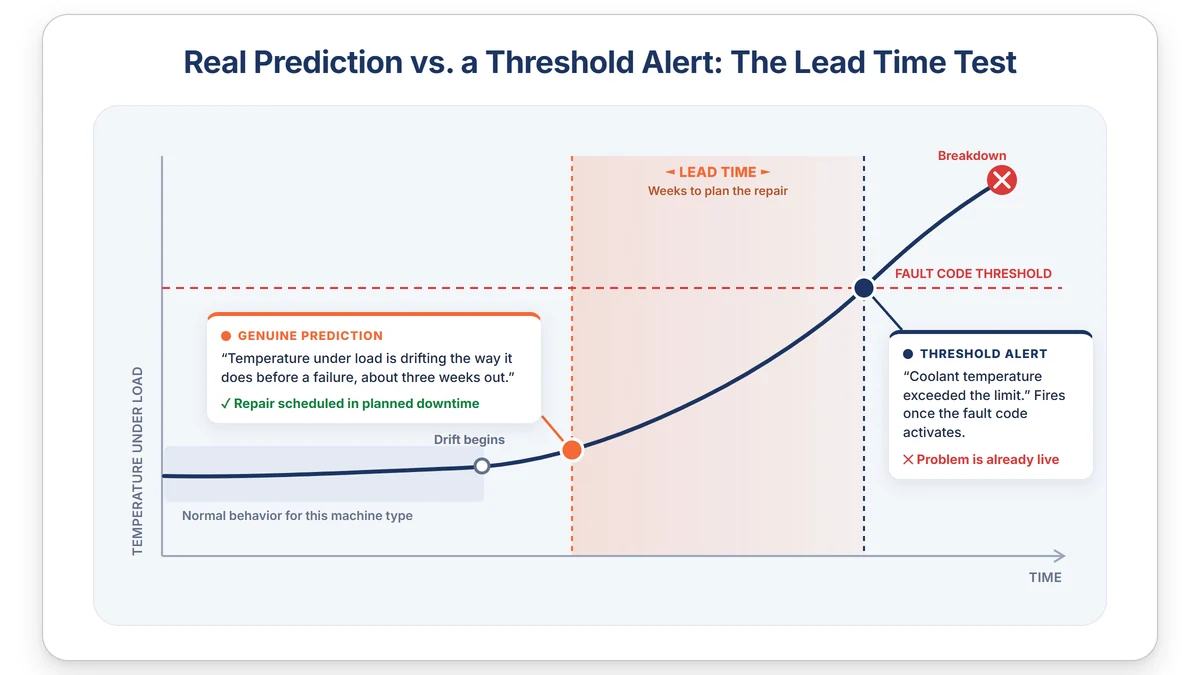
The practical test is lead time relative to the diagnostic trouble code. A fault code, by definition, activates after a condition has already gone out of range.
| What the vendor shows you | What it actually is | When it fires |
|---|---|---|
| “Alert me when coolant temperature goes above X” | Threshold alert | After the problem is live |
| “This machine’s temperature under load is drifting the way it does before a failure, about three weeks out” | Prediction | Before the fault code |
Both are useful. They are not the same product. You should not pay for the second and receive the first.

Five Questions That Separate Real From Fake
When a vendor says predictive, make them prove it on your equipment.
- Show the lead time on real fleet data, not a slide.
- Show one case where the system flagged a developing failure before a code activated.
- Explain how the model handles a machine type it has not seen much of.
- Explain what happens when a tech dismisses an alert.
- Tell me your false-positive rate and how you measure it.
Honest vendors have specific answers. The ones selling a dressed-up warning light answer with enthusiasm. This single line of questioning removes more unsuitable products than any feature comparison.
Why Do Predictive Maintenance Programs Fail?
Predictive maintenance programs fail far more often on false positives than on missed failures. A system that cries wolf trains your crew to ignore it, and an ignored alert is worse than no alert. This is the failure mode vendor marketing never leads with, and the one experienced maintenance leaders worry about first.
The mechanism is human, not technical. A tech who chases a string of false alarms learns to distrust the system. Before long a real warning gets waved off with the noise. The savings predictive maintenance can generate get eaten by the cost of chasing alerts that turn out to be nothing.
Most of the effort in this category goes into avoiding missed failures. It is the false positives that quietly make a program not worth the money. Each one spends technician time. Worse, each one spends trust.
What This Means for How You Buy
- Treat alert accuracy as a specification, not a nice-to-have. Ask every vendor for a false-positive rate and the method behind it. A vendor who has never measured it has never been held to it.
- Plan for a calibration period. Even strong systems start noisy and settle as they learn your fleet. Run predictions in shadow mode for a few weeks first, generating alerts without acting on them, so you measure accuracy before you ask anyone to trust it.
- Favor systems that learn from outcomes. When a tech confirms or dismisses an alert, that verdict should tighten the model rather than vanish into a void.
- Reward systems that admit what they do not know. A platform that marks a machine “not scored” when the data is thin is being straight with you. One that scores every asset with equal confidence is not.
The goal is not the most alerts. It is alerts your people believe.
Is Predictive Maintenance Worth It for a Construction Fleet?

Predictive maintenance is worth it on the right machines. It pays on high-value equipment whose downtime is expensive, and only when the predictions turn into completed repairs. It is not an automatic yes for every asset you own.
What the Honest Numbers Say
The most-quoted figures in this category come from the Department of Energy’s O&M Best Practices Guide. It reports industrial average savings from a functioning predictive maintenance program of 25% to 30% lower maintenance costs, 70% to 75% fewer breakdowns, 35% to 45% less downtime, and roughly ten times return on investment.
Read those with two caveats, because most vendor decks will not give you either.
First, they are plant-floor averages drawn from surveys, not construction fleet results. Your excavator on a job site is not a pump in a boiler room.
Second, the same guide gives a quieter and more useful number: a properly functioning predictive program saves 8% to 12% over a preventive program alone. That is the honest planning figure. The ten-times ROI compares predictive against running equipment to failure. If you already run a real preventive program, the 8% to 12% is the number your business case has to clear.
The guide is just as plain about the cost side. It lists higher spend on diagnostic equipment, higher spend on training, and savings that are hard for management to see. That last one closes more programs than bad models do.
Which Machines Justify It
| Asset profile | Right strategy |
|---|---|
| High value, high hours, failure stops the job (excavators, dozers, haulers, cranes) | Predictive, layered on preventive |
| Mid value, steady use, a spare exists (loaders, rollers, service trucks) | Preventive, with fault codes watched |
| Low value, light use, easy to swap (light towers, plate compactors, attachments) | Preventive, or run to failure |
| No telematics on the machine | Hour-based preventive, with inspections as the signal |
On a machine that costs six figures to replace and thousands a day to leave idle, a few weeks of warning is the difference between a planned shop visit and an emergency that strands a crew. On a light tower, the cost and the false-positive overhead exceed the benefit.
The mature position most maintenance leaders land on is a blend. Predictive on the critical iron. Hour-based preventive maintenance on everything else. A vendor who tells you every asset needs AI monitoring is selling, not advising.
What Data Does Predictive Maintenance Need?
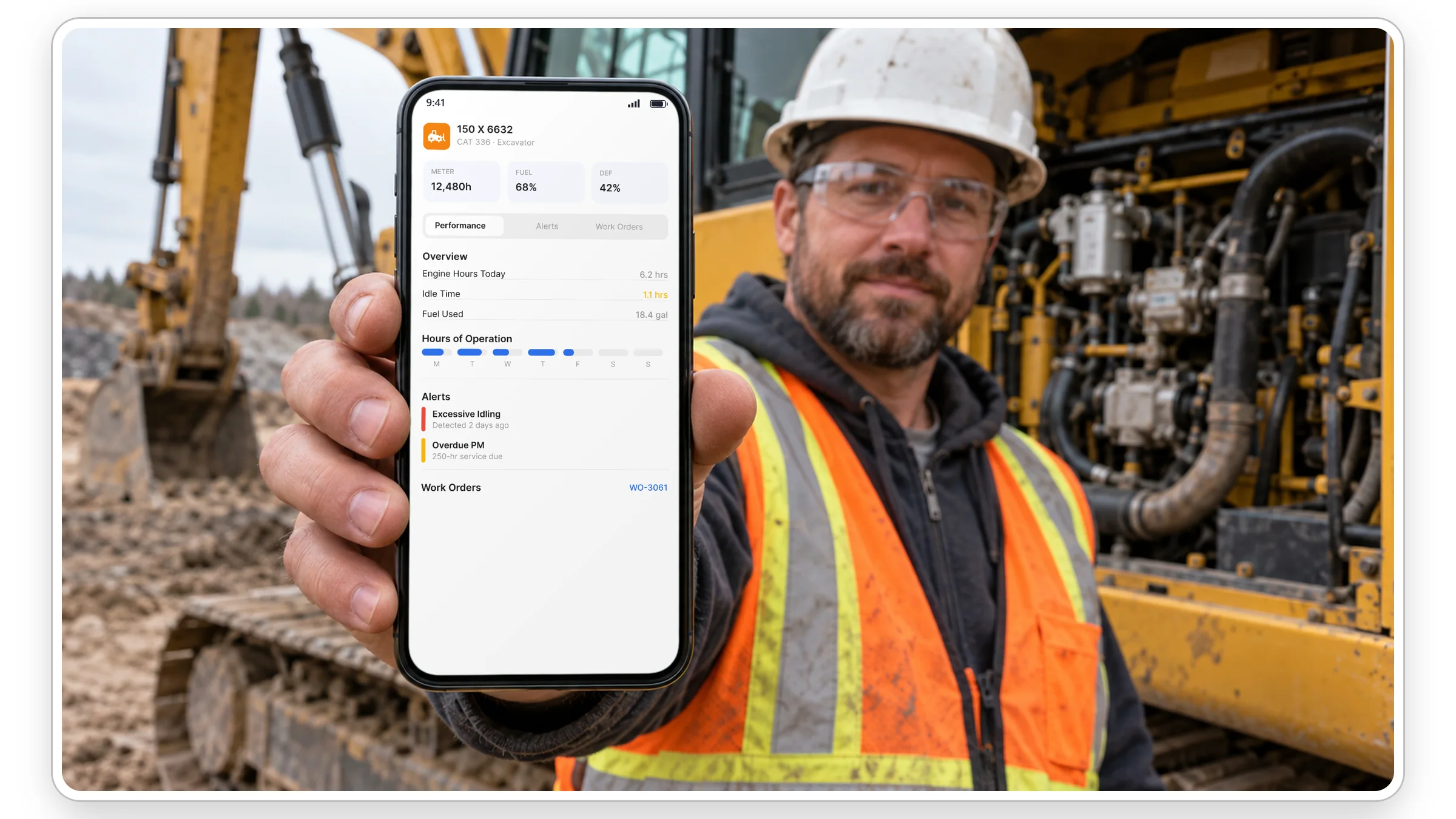
Predictive maintenance needs a consistent condition signal per machine, a clean asset record to attach it to, and enough repair history to learn from. On heavy equipment that usually means an OEM telematics feed plus your own maintenance records. No model survives bad asset data.
| Signal | Where it comes from | What it tells the model |
|---|---|---|
| Engine hours and odometer | OEM telematics feed | The wear clock and PM timing |
| Fault codes (SPN and FMI on J1939) | OEM feed or the ECM | Component-level fault patterns |
| Load, idle time, duty cycle | Telematics | How hard the machine actually works |
| Temperatures, pressures, fluid levels | Telematics | Drift toward a failure |
| Inspection results | Operator and tech inspections | Human-observed condition |
| Work order and parts history | Your maintenance system | Repeat offenders and failure history |
| Fluid and oil analysis | Lab samples | Wear metals and contamination |
The Standards Gap Nobody Mentions in a Demo
Mixed-fleet telematics data mostly arrives through ISO 15143-3, the AEMP telematics standard. It gives you a common way to pull hours, location, fuel, DEF, idle, and load across brands. It also carries a field for diagnostic codes.
Here is the part worth knowing before you buy: the standard does not define the fault codes themselves. Each OEM defines its own. So a platform can be fully standards-compliant and still hand you twelve brands of untranslated codes.
Normalizing those codes across your yard is work the software vendor either does or does not do. Ask to see it. Ask what happens to a code from your least common brand. This single question tells you more about OEM telematics depth than a logo wall does.
A Short Data-Readiness Check
- Every machine you care about exists once in the system, with the right make, model, and serial.
- Hours arrive daily, not when somebody remembers to key them in.
- Fault codes land automatically, with severity attached.
- Closed work orders record parts, labor, and the component that failed.
- Someone owns the asset list and keeps it clean.
If three of those are shaky, fix them before you buy prediction. A model fed from a stale asset list produces confident nonsense.
What Features Should You Look For in Predictive Maintenance Software?
The features that matter are the ones that turn a prediction into a completed repair. An accurate forecast nobody acts on changes nothing. Work orders, telematics, and inspections sit on every feature list. What separates real platforms is how cleanly a signal becomes an action.
Early Fault Detection With Proven Lead Time
The core capability is spotting the developing failure before the fault code, with enough warning to plan around it. Make the vendor demonstrate lead time on your equipment. Ask which components and failure modes the model actually covers. A system strong on engines can be blind to hydraulics or undercarriage.
A Closed Loop From Alert to Work Order
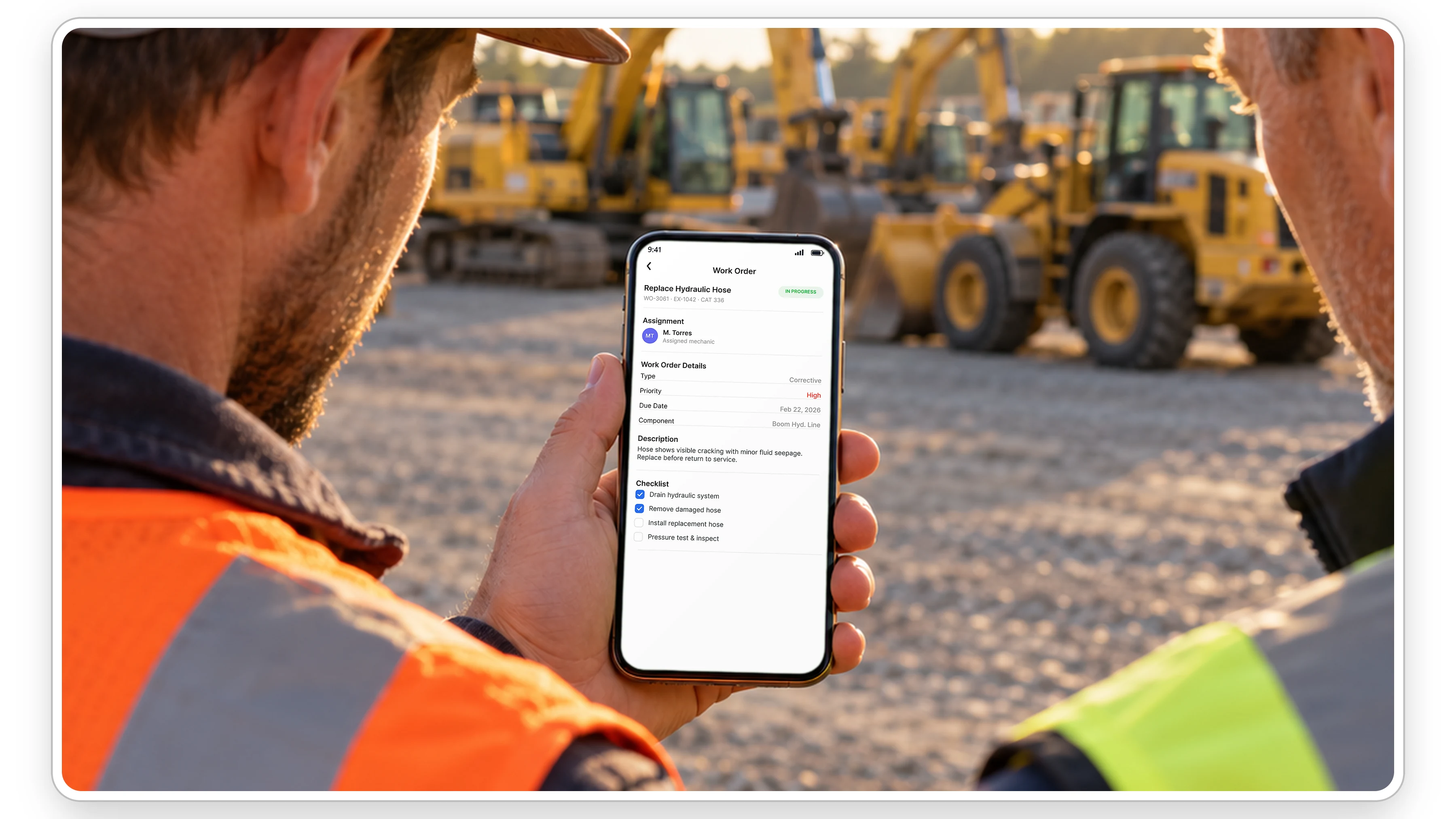
This is where the return actually lives. The platform should close the loop without anyone retyping anything:
- Risk detected
- Work order created
- Technician assigned
- Parts checked
- Downtime window set
- Repair closed and costed
Ask the vendor to walk that path end to end. Confirm the prediction lands in the same queue your team already works from, not a separate screen somebody has to remember to open.
Fault-Code Normalization Across Brands
A mixed fleet produces fault codes in several dialects. The platform should group them, rank them by severity, suppress duplicates, and tie them to a component on a specific machine. Without that, prediction across brands turns into a list nobody reads.
No Forced Hardware Swap
A predictive platform should work with the telematics and OEM feeds you already have. Replacing telematics across a fleet is expensive and disruptive. A vendor who requires their own sensors on every machine is adding cost and lock-in, and usually delay.
Mixed-Fleet and Multi-OEM Coverage
Construction fleets are never one brand in one yard. OEM programs can predict within their own machines and leave the rest of your fleet on reactive or preventive maintenance, with a separate portal per brand.
Confirm the platform ingests data across the OEMs you run, and still carries the machines with no telematics at all, so your utilization and health picture covers the whole yard instead of the connected part of it.
Learning From Technician Outcomes
Favor software that improves as your team uses it. Confirming or dismissing an alert should tune the model and push the false-positive rate down. A static rules engine does not get smarter. A learning system rebuilds trust one verified alert at a time. Ask specifically how technician feedback reaches the model.
A good way to test all of this at once is to trace one predicted failure end to end in the demo, on your own data. Signal, alert, work order, parts, closed repair. Every step that needs manual re-entry or a separate login is a place the program will stall in the field.
How Much Does Predictive Maintenance Software Cost?
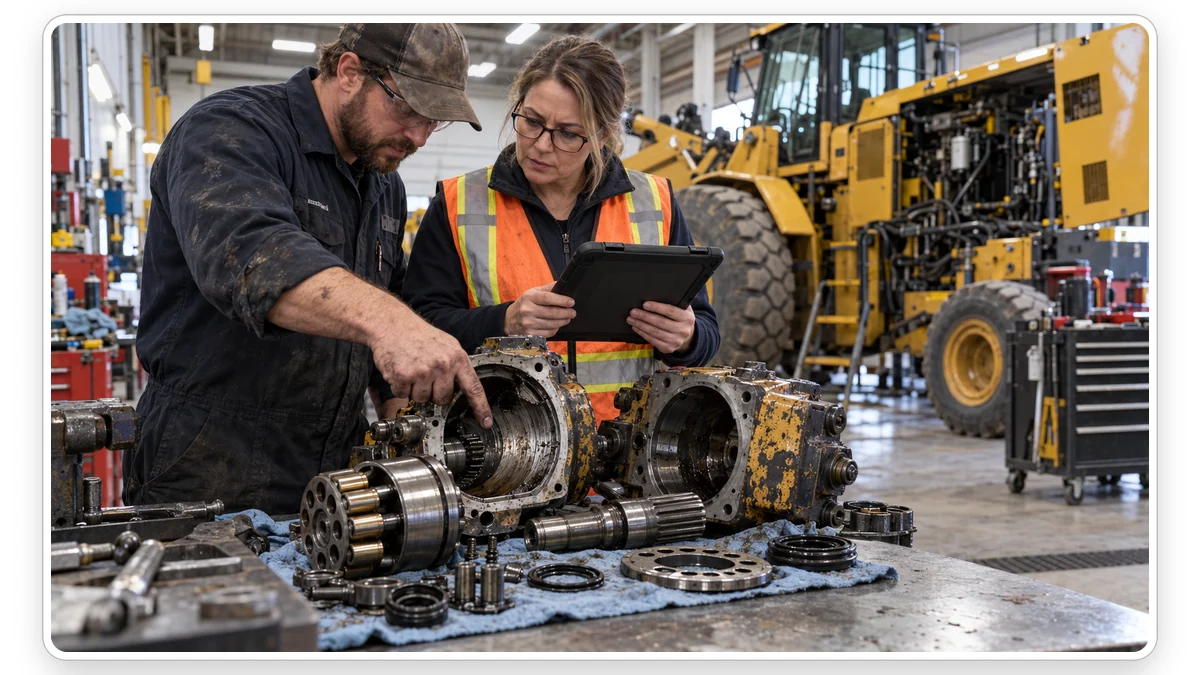
Predictive maintenance for fleets is usually priced per asset per month, most often bundled into a fleet platform subscription rather than sold as a separate line. Few vendors publish rates, so the useful question is total cost against avoided-breakdown value, not the sticker price.
What You Actually Pay For
The license is the part everyone quotes. It is rarely the part that breaks a budget.
| Cost line | Usually in the quote? | What to ask |
|---|---|---|
| Per-asset subscription | Yes | Which asset classes count as billable? |
| Implementation and data integration | Often missed | Is it a one-time cost, and who does the work? |
| Hardware for unconnected machines | Often missed | How many of my machines actually need it? |
| The calibration period | Almost never | How many weeks before we act on alerts? |
| Technician time on the new queue | Almost never | Who works these alerts, and when? |
| ERP or accounting integration | Often missed | Do repair costs post without retyping? |
Judging the Number
Compare the total against the breakdowns you expect to avoid. One unplanned heavy-equipment failure carries a direct repair bill and a larger indirect cost: the tow, the idle crew, the blown schedule, the rental to cover the gap. On a fleet of expensive machines, a modest drop in unplanned events can cover the software several times over.
Two rules keep the budget honest.
- Be skeptical of headline ROI percentages. Vendor material describes best-case, fully deployed fleets, not your first year. The research is clear that returns are real but conditional. They are strongest where failures are predictable and false positives are low.
- Match the spend to the asset. Paying per-machine predictive fees on equipment a preventive schedule would cover is how a program’s economics quietly go underwater.
How Do You Roll Out Predictive Maintenance Without It Becoming Shelfware?
You roll it out by starting narrow, proving value on a small set of critical machines, and expanding once the alerts are trusted. A big-bang deployment across the whole fleet is the fastest way to drown your team in noise and lose them in month one.
A 90-Day Sequence That Works
| Phase | Weeks | What happens | What good looks like |
|---|---|---|---|
| Data check | 1 to 2 | Confirm every pilot machine reports hours and fault codes | All pilot assets reporting daily |
| Shadow mode | 3 to 8 | Alerts generate, nobody acts on them | Every alert reviewed and labeled |
| Calibration | 7 to 10 | Techs confirm or dismiss; thresholds get tuned | False positives trending down |
| Live on the pilot | 9 to 12 | Alerts create work orders | Alert to work order inside 24 hours |
| Expand | 13+ | Add the next asset class | Techs ask for the next group |
Pick the pilot by downtime cost, not by which machines have the best data. Fixing data on ten critical assets is a smaller job than you think, and it is the job that proves the program.
The Cultural Piece Matters As Much As the Technical One
Tell your crew up front that accuracy improves over time and that their feedback is what improves it. Then the early false positives read as calibration instead of proof the system is junk.
Name one owner. Predictive programs with no owner drift back to reactive inside two quarters. Give that person a number to report, such as the share of alerts that became completed work orders.
The programs that survive are the ones where techs believe the alerts. The ones that fail are the ones where a noisy launch burned trust before the model settled.
How Does Predictive Maintenance Fit With Your CMMS and Preventive Program?
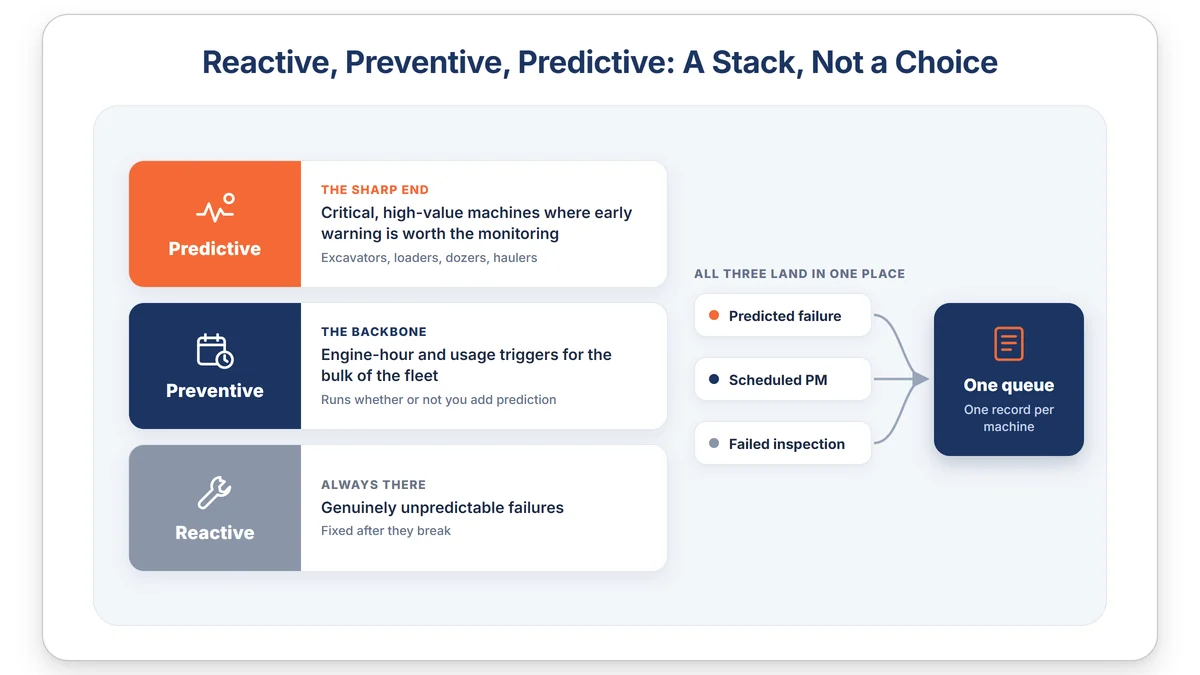
Predictive maintenance is a layer on top of your maintenance system, not a replacement for it. The right foundation is a working CMMS and a solid preventive program, with prediction added on the assets that warrant it.
Buying a standalone predictive dashboard that cannot create and track a work order is the classic mistake. The forecast has nowhere to go.
Think of the strategies as a stack, not a choice:
- Reactive will always exist, for the genuinely unpredictable failures.
- Preventive, driven by engine hours and usage, stays the backbone for most of the fleet.
- Predictive is the sharp end, applied to the critical assets where catching a developing failure early is worth the monitoring and the calibration.
The platforms that deliver value keep all three in one system, so a predicted failure, a scheduled PM, and a failed inspection land in one queue and one record per machine.
This is also why the “predictive versus preventive” framing some vendors push is misleading. You are not choosing between them. You are deciding which machines justify the predictive layer on top of a preventive program you should be running anyway.
A fleet that cannot yet execute preventive maintenance reliably is not ready to buy predictive software. A vendor who sells it to them anyway is setting up a failure.
Should Predictive Maintenance Be Built Into Your Fleet Software or Bought Separately?
For most equipment fleets, predictive maintenance belongs inside the system that already runs your maintenance. The value depends on the prediction becoming a completed repair, and that only happens where the work orders, inspections, and equipment records already live. A standalone dashboard can produce an excellent forecast and change nothing.
The Case for Built-In
A prediction is only useful when someone acts on it, in the right place, on the right machine. When risk scoring lives inside the fleet platform, a flagged risk becomes a work order in the queue your shop already works from, and a failed inspection feeds the same loop. The alert-to-repair path is closed by default instead of bridged by hand.
This is how Clue is built. It scores each asset’s failure risk from signals like fault codes and utilization, shows the top factor driving that risk and how the score is trending, marks assets as not scored when the data is too thin to be honest, and routes the result into the existing maintenance workflow.
Because it connects to your existing telematics across 80+ integrations rather than replacing it, the condition data arrives automatically from across the mixed fleet. Machines with no telematics still carry a record, which is the reality a single-brand OEM tool cannot cover.
Why the Surrounding System Decides the ROI
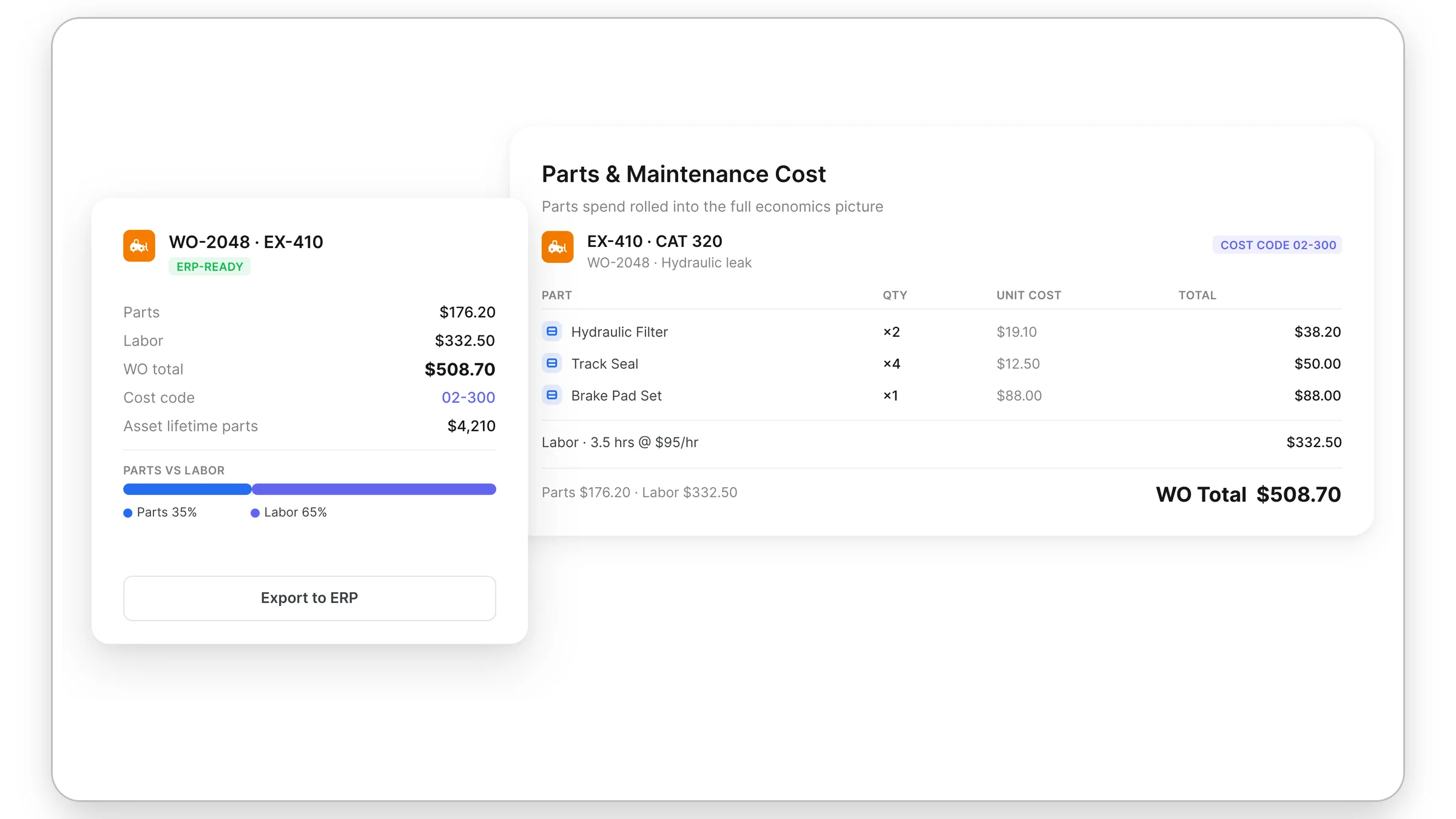
The return on a prediction is captured, or lost, in the system around it. A built-in platform carries the parts, the cost coding, and the lifecycle data that turn a forecast into a costed, closed repair.
- Labor and parts post to the right job through native ERP sync, so a predicted repair lands in your cost records without being retyped.
- Cost tracking turns a machine’s failure and repair history into a repair-or-replace signal.
- The enterprise fundamentals are in place too. Clue is SOC 2 Type II certified, with SSO and role-based access.
That consolidation is where the money is. The Palmetto Corp case study reports more than $1 million in first-year savings from bringing maintenance, data, and cost onto the same machine record.
When a Standalone Specialist Tool Is the Better Call
Built-in is not universal. If your need is deep sensor-level analytics on one critical asset class, the kind of vibration and acoustic modeling a process plant runs on a specific rotating machine, a dedicated specialist platform is the honest recommendation. Bolting that onto a general fleet system would underserve it.
That case is real. It is also narrow, and it is not the one most equipment fleets are in.
For a construction or mixed heavy-equipment fleet that needs prediction to turn into completed, costed repairs across the whole yard, the layer belongs inside the fleet system. Clue brings risk scoring, telematics integrations, work orders, inspections, parts, and equipment economics into one record per machine, so a flagged risk becomes a scheduled repair your shop actually closes, coded to the right job.
If your machines run on hours, move between job sites, and mix owned and rented iron, that is the fleet Clue was designed for. Predictive maintenance is one layer of equipment maintenance software, not a bolt-on you have to wire in yourself.
How Do You Choose Predictive Maintenance Software for Your Fleet?
You choose by testing vendors against the few things that decide whether a program succeeds, using your own equipment instead of a demo account. Those things are lead time, alert accuracy, the closed loop, mixed-fleet coverage, and fit with the maintenance system you already run.
Score It Instead of Reacting to It
| Criterion | Weight | What a strong answer looks like |
|---|---|---|
| Lead time before the fault code | 25% | Demonstrated on your machines, with dates |
| Alert accuracy and false-positive rate | 25% | A measured number, and the method behind it |
| Closed loop to a costed work order | 20% | Alert to parts to close, with no re-entry |
| Mixed-fleet and OEM coverage | 15% | Every brand you run, plus the unconnected machines |
| Fit with your maintenance system | 10% | Prediction lands in the queue the shop already uses |
| Cost matched to asset value | 5% | Priced per asset, applied only where it pays |
Score every vendor on the same six lines before anyone sees a second demo. A rubric written down in advance is the only thing that survives a good sales pitch.
Work Through It in Order
- Confirm it does real prediction. Make the vendor demonstrate lead time before a fault code on your data.
- Ask for the false-positive rate and how it is measured.
- Trace one alert end to end to a closed work order.
- Confirm mixed, multi-OEM coverage, including machines without telematics.
- Check it sits on top of, or includes, a maintenance system that already runs your preventive program.
- Map the cost to the machines whose downtime actually justifies it.
Two Rules That Keep the Choice Honest
- Define your non-negotiables before the first demo, so a polished pitch cannot quietly rewrite your requirements.
- Run a real pilot in shadow mode on a handful of critical machines before you commit. Measure accuracy and the alert-to-repair path on your own fleet rather than trusting a case study.
The fleets that get value from predictive maintenance are not the ones that buy the most advanced AI. They are the ones that buy prediction they can trust, wired into a system that turns it into completed work.
Frequently Asked Questions
What Is Predictive Maintenance Software?
Predictive maintenance software forecasts specific equipment failures before they happen by reading live condition data, usually telematics such as engine data, hydraulic pressure, temperatures, and fault-code patterns, and comparing it against normal behavior to flag a developing problem early. It differs from reactive maintenance, which fixes machines after they break, and preventive maintenance, which services them on a fixed schedule. The goal is to schedule a repair in a planned downtime window instead of suffering an unplanned breakdown.
What Is the Difference Between Predictive and Preventive Maintenance?
Preventive maintenance services equipment on a fixed trigger, a calendar date or an hour interval, regardless of the machine’s actual condition. Predictive maintenance reads real-time condition data and acts on how the machine is genuinely performing. Preventive is the reliable backbone for most of a fleet. Predictive is the sharper tool for critical, high-value assets where catching a developing failure early is worth the monitoring. Most strong programs run both.
How Is Predictive Maintenance Different From Condition-Based Maintenance?
Condition-based maintenance acts on the present. It triggers work when a live reading crosses a set limit, such as a temperature or a pressure that is out of range right now. Predictive maintenance acts on the trend. It forecasts that a reading is heading toward that limit and flags the machine before the limit is reached. Condition-based monitoring is often the data layer a predictive model is built on top of.
Is Predictive Maintenance Worth It for Heavy Equipment?
It is worth it selectively. On high-value machines whose downtime is expensive, such as excavators, loaders, dozers, and haulers, a few weeks of failure warning can turn an emergency into a planned shop visit and pay for the software many times over. On low-value, lightly used, or easily replaced equipment, the cost and false-positive overhead can exceed the benefit, and a preventive schedule is the better choice. The right question is which machines justify prediction, not whether the whole fleet should go predictive.
Why Do Predictive Maintenance Programs Fail?
The most common reason is false positives. When a system generates alerts that turn out to be nothing, technicians lose trust and start ignoring every alert, including the real ones, so the program’s value collapses even if the model is decent. Programs also fail when predictions do not become work orders, when the asset data foundation is poor, when nobody owns the program, and when a fleet that cannot yet execute preventive maintenance tries to jump straight to predictive.
How Much Does Predictive Maintenance Software Cost?
Fleet predictive maintenance is usually priced per asset per month and is most often bundled into a fleet platform subscription rather than sold separately. Few vendors publish rates, so quotes on your own asset list are the only reliable numbers. The subscription is only part of the cost. Budget also for implementation and data integration, hardware for unconnected machines, the calibration period before alerts are trustworthy, and technician time to work the new queue. Judge the total against the breakdowns you expect to avoid.
Do I Need New Sensors or Hardware for Predictive Maintenance?
Usually not for heavy equipment, because most predictive capability for fleets runs on the telematics and OEM data machines already produce. A good platform connects to your existing devices and feeds rather than requiring a fleet-wide hardware swap, which is expensive and disruptive. Be cautious of vendors who mandate their own sensors on every machine, as that adds cost and lock-in. Sensor-level monitoring is sometimes warranted on a single critical asset, but it is the exception.
What Data Does Predictive Maintenance Need?
It needs a consistent condition signal per machine, a clean asset record to attach it to, and enough repair history to learn from. In practice that means engine hours, fault codes, load and idle data, temperatures and pressures from a telematics feed, plus inspection results and closed work orders with parts and labor recorded. Oil and fluid analysis adds depth on critical components. If the asset list is stale or hours are keyed in by hand, fix that before buying prediction.
How Long Before Predictive Maintenance Starts Working?
Expect a calibration period measured in weeks, not days. A sensible pattern is to spend the first two weeks confirming data quality on the pilot machines, run several weeks in shadow mode where alerts generate but nobody acts on them, tune thresholds against what technicians actually find, and only then let alerts create work orders. Most fleets can get a trustworthy pilot running on a small set of critical assets within about 90 days.
How Is Predictive Maintenance Different From OEM Telematics Alerts?
OEM telematics can monitor and sometimes predict within a single manufacturer’s machines, but a construction fleet is rarely one brand, so OEM-only tools leave the rest of the fleet on reactive or preventive maintenance and give you a separate portal per brand. A fleet platform ingests data across the OEMs in your yard, carries the machines with no telematics at all, normalizes fault codes that each manufacturer defines differently, and routes every signal into one maintenance queue.
Can Predictive Maintenance Replace My CMMS or Preventive Program?
No. Predictive maintenance is a layer that sits on top of a maintenance system, not a replacement for it. You still need a CMMS to create and track work orders and a preventive program for the bulk of your fleet. Prediction is added on the assets that justify it. A standalone predictive dashboard that cannot generate and close a work order leaves the forecast with nowhere to go, which is why the platforms that deliver value keep prediction, preventive scheduling, and work orders in one system.
Does Predictive Maintenance Work for Small Fleets?
It can, but the economics are narrower. The value comes from the downtime cost of a specific machine, not from fleet size, so a small fleet with two or three critical, high-hour machines can justify it on those machines alone. What a small fleet should avoid is paying per-asset predictive fees across everything it owns. Start with the machines whose failure stops work, keep the rest on an hour-based preventive schedule, and pick a platform that includes prediction rather than charging for it as a separate product.

Transform Your Equipment Management