8 Best Mining Asset Management Software of 2026


Hi, I’m Maham Ali. I write about construction equipment management, helping teams use fleet data and maintenance intelligence to improve uptime, control costs, and run smoother jobsites.
Mining operations are high-stakes environments where every minute of equipment downtime translates into significant financial loss. In 2026, the difference between a profitable mine and an inefficient one often comes down to how well you manage your physical assets using advanced mining management software.
Effective mining asset maintenance is no longer only about fixing machines after failure. It is about preventing failures with condition signals, work execution discipline, and reliability programs. In mining, “asset management software” is often a stack: fleet and telematics visibility for heavy mobile equipment, an EAM or CMMS for work orders and compliance history, and an APM layer for predictive maintenance.
By centralizing data from telematics, inspections, and maintenance records, these platforms help mining teams reduce downtime risk, improve safety execution, and make better repair-versus-replace decisions.
What is Mining Asset Management Software?
Mine management software is a specialized digital platform designed to monitor, maintain, and optimize the lifecycle of heavy machinery and infrastructure. Unlike general tools, these systems are built for the rugged, remote, and complex nature of mining, integrating data from diverse sources like telematics and IoT sensors into a unified dashboard.
Importance of Asset Management in Mining
In an industry where equipment is the primary driver of production, effective management is critical. It ensures that assets are utilized at peak efficiency, reduces the risk of catastrophic failures, and maintains a safe working environment. Furthermore, it helps mining companies meet strict regulatory and environmental standards by providing transparent, automated logging of all maintenance activities.
How We Evaluated These Mining Asset Management Software
- We included three categories mining teams often combine: fleet visibility, EAM for work execution, and APM for condition and predictive maintenance.
- We scored each platform on asset coverage (mobile and fixed plant) and maintenance execution (work orders, preventive maintenance, inspections).
- We assessed reliability intelligence, including condition monitoring and predictive capabilities.
- We reviewed parts and MRO readiness, plus offline workflows for remote sites.
- We checked integrations with telematics, ERP, and data historians.
- We evaluated time to value, including implementation effort and usability.
- We validated key claims using vendor documentation and published product materials.
Comparative Overview of Top Mining Asset Management Software
1. Clue
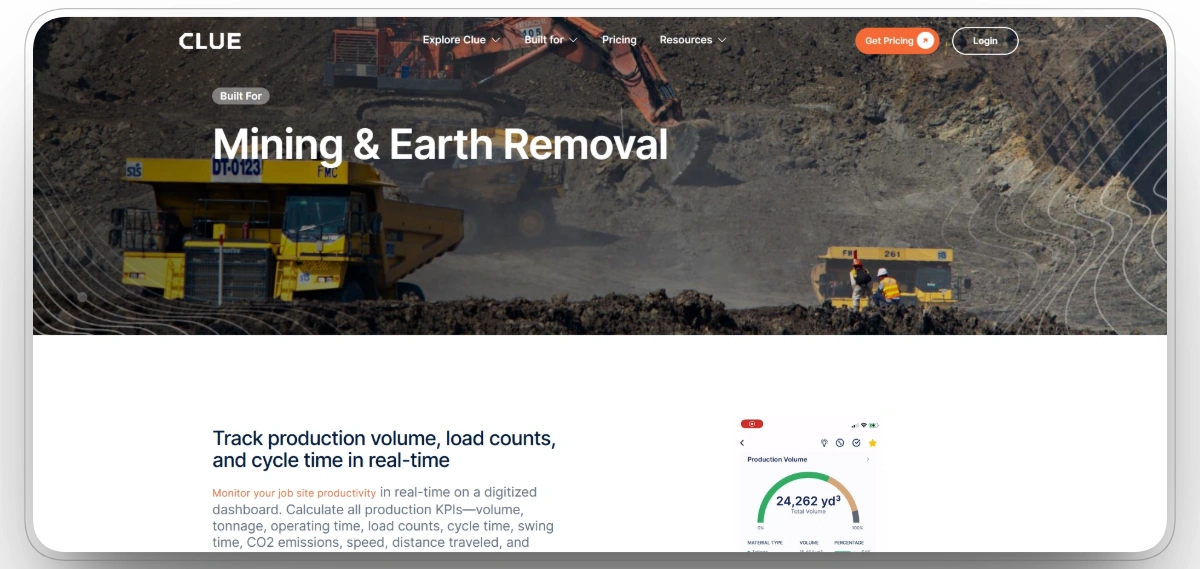
Best for: Unified fleet monitoring, automated maintenance, and maximizing equipment utilization across diverse mining and construction sites.
Clue is a comprehensive mining asset management software designed to act as a "single pane of glass" for your entire operation. It is trusted by miners, OEMs, and contractors worldwide for its ability to connect all assets regardless of brand into one centralized, easy-to-use digital hub.
The platform excels at automating complex workflows, from generating work orders to submitting safety inspections. By providing real-time visibility into every asset's performance, Clue helps mining and heavy equipment teams reduce manual coordination by centralizing equipment visibility, inspections, work orders, and preventive maintenance in one system.
With its advanced digital dashboard, Clue allows you to track critical KPIs like cycle time, CO2 emissions, and idle alerts. It’s an essential software for mining contractors looking to move away from manual processes and embrace a fully automated, data-driven approach to asset management.
Key Features:
- Preventive maintenance workflows: Schedule preventive services, track due items, and connect maintenance history to each asset so you can reduce missed services and repeated failures.
- Work order management: Capture issues, create work orders, assign technicians, and track status so maintenance work is executed and documented consistently.
- Inspections and field capture: Run inspections and capture equipment condition from the field so issues are logged faster and tied to the right asset record.
- Fleet visibility and utilization: Monitor location and utilization patterns to reduce idle time and redeploy equipment more efficiently.
- Cost visibility: Consolidate operating and maintenance costs so you can compare equipment performance and make better repair versus replace decisions.
Pros:
- Unified dashboard for all equipment brands and types.
- Can reduce manual coordination and downtime risk by centralizing equipment visibility, inspections, and maintenance execution.
- Seamless integration with existing telematics and IoT sensors.
- Highly intuitive mobile app for field technicians and operators.
Cons:
- Initial setup may require time to integrate all legacy equipment data.
Clue Overall Rating:
- Capterra: 4.6/5
- G2: 4.7/5
User Reviews:
Pricing:
Explore Clue's pricing options.
2. IBM Maximo
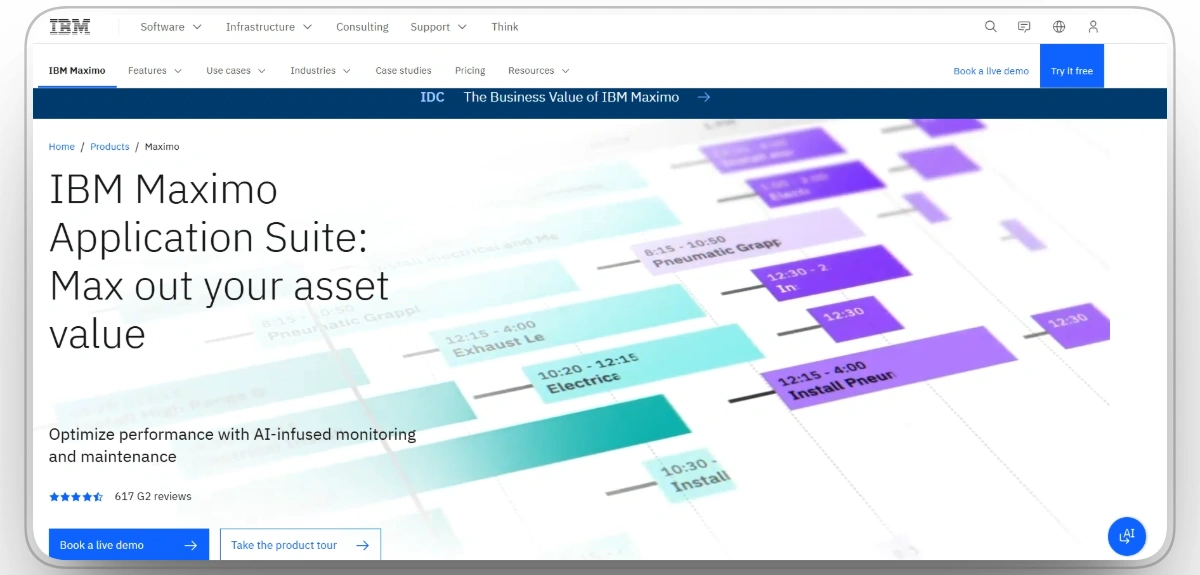
Best for: Large-scale mining operations requiring enterprise-grade AI and deep predictive analytics.
IBM Maximo is a global leader in Enterprise Asset Management (EAM), offering a unified suite that leverages AI, IoT, and analytics. It is a powerful miner management software designed to help mining companies extend the lifespan of their most critical assets while significantly reducing maintenance costs.
The platform provides a 360-degree view of all assets, allowing for strategic planning from procurement to decommissioning. Maximo Collaborate (a Maximo Application Suite app) can provide AI-powered guidance using a maintenance knowledge base to help technicians diagnose issues faster and improve first-time fix rates.
Pros:
- Industry-leading AI and predictive maintenance capabilities.
- Highly scalable for global, multi-site mining operations.
- Deep integration with a wide range of IoT and sensor hardware.
- Comprehensive asset lifecycle management from cradle to grave.
Cons:
- High total cost of ownership, including implementation and licensing.
- Extremely complex interface that requires extensive user training.
- Implementation can take several months to fully deploy.
- Ongoing administration is often handled by internal IT and asset management teams, especially in large multi-site deployments.
IBM Maximo Overall Rating:
- Capterra: 4.2/5
- G2: 4.4/5
User Reviews:
IBM Maximo Pricing
Contact the vendor for details.
3. HxGN EAM
Best for: Holistic enterprise asset management with reliability programs, compliance support, and sustainability initiatives.
HxGN EAM (formerly Infor EAM) is a highly flexible mining contractors software tailored for asset-intensive industries. It focuses on improving asset reliability and performance by aligning maintenance strategies with broader enterprise objectives.
HxGN EAM is commonly used to support reliability programs, regulatory compliance, and sustainability initiatives, including efforts to reduce energy usage and improve environmental compliance tracking.
Pros:
- Exceptional flexibility and customization options for specific workflows.
- Strong fit for organizations prioritizing sustainability initiatives and environmental compliance alongside reliability programs.
- Advanced mobile workforce management for remote field teams.
- Robust reliability-centered maintenance (RCM) tools.
Cons:
- Customization can lead to a complex and cluttered user interface.
- Higher price point compared to mid-market CMMS solutions.
- Some users report a steep learning curve for advanced modules.
- Support response times can vary depending on the region.
HxGN EAM Overall Rating:
- Capterra: 4.2/5
- G2: 3.5/5
User Reviews:
HxGN EAM Pricing
Contact the vendor for details.
4. DINGO
Best for: Condition-based maintenance and reducing unplanned downtime through specialized data analytics.
DINGO specializes in condition management and predictive maintenance. Its Trakka platform is designed to help teams consolidate asset health data, apply analytics, and turn condition insights into maintenance decisions and workflows.
The platform's condition-monitoring system tracks equipment health in real-time, allowing teams to address minor issues before they escalate into catastrophic failures. DINGO is widely recognized for its ability to lower operational costs and improve fleet reliability.
Pros:
- Specialized focus on mining-specific equipment and conditions.
- Strong condition monitoring focus that helps teams prioritize maintenance based on abnormal condition signals.
- Best used as a condition management layer that complements an EAM rather than replacing it.
- Strong condition-monitoring capabilities for high-value assets.
Cons:
- Narrower scope compared to full-scale Enterprise Asset Management (EAM).
- May require integration with other tools for full financial tracking.
- Limited features for non-maintenance operational management.
- Pricing can be high for smaller fleets with fewer assets.
DINGO Overall Rating:
- Capterra: 4.2/5
- G2: 5/5
User Reviews:
DINGO Pricing
Contact the vendor for details.
5. RPMGlobal (AMT)
Best for: Dynamic lifecycle costing and optimizing the financial performance of large-scale mining fleets.
RPMGlobal’s AMT is a specialized asset management solution that utilizes a Dynamic Lifecycle Costing (DLCC) engine. This engine constantly updates based on real-time data, providing an accurate picture of an asset's financial position at any given moment.
RPMGlobal states that AMT is used to manage or track over 50% of the world’s large mining equipment, which is why it frequently appears in enterprise mining maintenance shortlists.
Pros:
- Unique Dynamic Lifecycle Costing (DLCC) for precise financial tracking.
- Deeply integrated with mining-specific operational workflows.
- Excellent for long-term strategic planning and capital budgeting.
- Trusted by the world's largest mining companies and OEMs.
Cons:
- Very specialized, which may make it overkill for smaller operations.
- Interface can feel dated compared to modern SaaS platforms.
- Requires high-quality data input to provide accurate financial forecasts.
- Can be difficult to integrate with non-mining corporate ERPs.
RPMGlobal Overall Rating:
- Capterra: N/A
- G2: N/A
RPMGlobal Pricing
Contact the vendor for details.
6. Lumada EAM
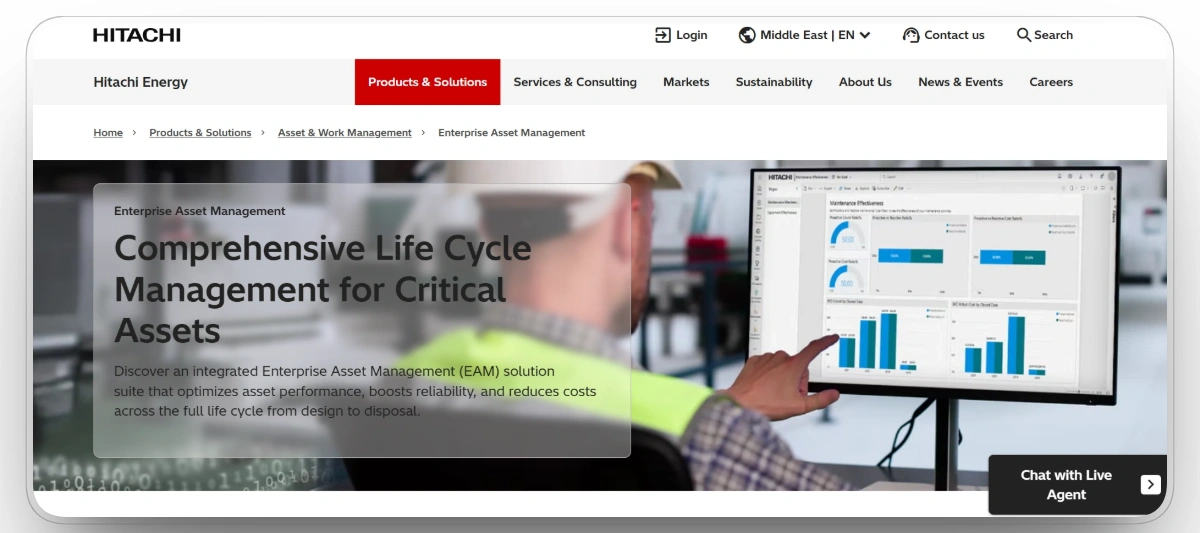
Best for: High operational reliability and connecting asset data to improve safety and production targets.
Lumada EAM (Hitachi Digital Services) is an enterprise asset management solution designed for large, complex, asset-intensive environments and aligned with ISO 55000 recommendations.
The platform empowers engineers to take a strategic approach to reliability-centered maintenance. By providing deep insights into asset health, Lumada EAM helps mining companies prevent critical failures while optimizing their overall lifecycle costs.
Pros:
- Strong emphasis on operational reliability and worker safety.
- Designed to support lifecycle asset management and operational performance improvement in asset-intensive environments.
- Robust supply chain and procurement integration for spare parts.
- Backed by Hitachi’s deep expertise in industrial energy and power.
Cons:
- Can be complex to configure for highly specialized mining techniques.
- Mobile app functionality may lag behind some competitors.
- Primarily targeted at very large, asset-intensive organizations.
- Implementation requires significant coordination across departments.
Lumada EAM Overall Rating:
- Capterra: 4/5
- G2: 4.3/5
User Reviews:
Lumada EAM Pricing
Contact the vendor for details.
7. Accruent
Best for: Managing complex, scattered infrastructure and aligning maintenance with real-time asset insights.
Accruent Maintenance Connection is a CMMS and maintenance management platform that centralizes work orders, asset records, and inventory workflows. It is built for multi-site teams that need consistent execution and documentation across locations.
Maintenance Connection supports mobile maintenance execution, including offline capabilities that let technicians update work orders, track time, and manage day-to-day records without a live internet connection.
Pros:
- Excellent for managing geographically dispersed mining assets.
- Strong document management and compliance tracking features.
- Good balance between ease of use and enterprise functionality.
- Effective at aligning maintenance with overall business goals.
Cons:
- Some modules may feel less "mining-specific" than competitors.
- Reporting tools can be difficult to customize for complex KPIs.
- Integration with legacy on-premise systems can be challenging.
- User interface consistency varies across different product modules.
Accruent Overall Rating:
- Capterra: 4.6/5
- G2: 4/5
User Reviews:
Accruent Pricing
Contact the vendor for details.
8. SAP Asset Performance Management
Best for: Real-time, data-driven insights and seamless integration with the broader SAP enterprise ecosystem.
SAP Asset Performance Management (APM) provides the tools needed to maintain critical equipment reliability. It integrates seamlessly with SAP EAM and ERP systems, allowing for a transparent flow of data between maintenance and finance.
SAP Asset Performance Management is an APM layer that connects asset strategy and asset health with maintenance execution through closed-loop integration with SAP Enterprise Asset Management.
Pros:
- Unmatched integration with SAP ERP and financial systems.
- Real-time visibility into asset performance and operational costs.
- Strong support for global standards and regulatory compliance.
- Leverages the vast SAP partner ecosystem for support and add-ons.
Cons:
- Extremely high cost of implementation and ongoing maintenance.
- Requires a significant investment in the broader SAP ecosystem.
- User experience can be overwhelming due to the sheer volume of data.
- Customization often requires specialized (and expensive) consultants.
SAP Overall Rating:
- Capterra: 4.7/5
- G2: 4.4/5
User Reviews:
SAP Pricing
Contact the vendor for details.
Choose the Right Software for Your Mining Needs
- Choose Clue if: You need a unified, brand-agnostic platform that automates maintenance and maximizes fleet utilization with a focus on ease of use.
- Choose IBM Maximo if: You are a large enterprise that requires the most advanced AI-driven predictive analytics and deep IoT integration.
- Choose HxGN EAM if: You need a flexible EAM solution that also helps you manage ESG goals and complex carbon reporting requirements.
- Choose DINGO if: Your primary goal is to reduce unplanned downtime through specialized, condition-based predictive maintenance.
- Choose RPMGlobal (AMT) if: You need to optimize the financial performance of your fleet using dynamic lifecycle costing and long-term strategy.
- Choose Lumada EAM if: You prioritize high operational reliability and want to connect asset data directly to safety and production targets.
- Choose Accruent if: You manage complex, scattered infrastructure and need a centralized system to align maintenance with real-time insights.
- Choose SAP APM if: You are already using the SAP ecosystem and need real-time reliability insights that sync perfectly with your financial data.
Conclusion
Selecting the right mining asset management software is a transformational step for any mining operation. In 2026, these digital tools are the bedrock of a more efficient, productive, and future-ready sector, solving today's problems while evolving with your company's needs.
By moving away from manual tracking and embracing automation, you can ensure your fleet stays in peak condition, your workers stay safe, and your profits stay high. Whether you choose the unified power of Clue or the enterprise depth of IBM Maximo, the right software will be your most valuable digital assistant in the field.
FAQs
What is mining asset management software?
It is a digital tool used to track, monitor, and maintain mining equipment and infrastructure to reduce downtime and extend asset life.
How does this software reduce operational costs?
By predicting failures before they happen and optimizing maintenance schedules, it prevents expensive emergency repairs and maximizes equipment uptime.
Can it track equipment from different brands?
Yes, platforms like Clue are designed to be brand-agnostic, connecting data from all your assets into a single dashboard.
Does it work in remote areas without the internet?
Many modern solutions offer offline capabilities, allowing field technicians to log data that syncs once a connection is re-established.
Is it difficult to integrate with existing systems?
Most top-tier solutions are built to interface easily with existing ERP, telematics, and IoT systems to eliminate data silos.
How does it improve worker safety?
It automates safety inspections and provides real-time alerts for equipment malfunctions, ensuring a safer environment for operators and maintenance crews.
Transform Your Equipment Management