Fleet Risk Management for Construction in 2026: A Complete Guide


Hi, I’m Maham Ali. I write about construction equipment management, helping teams use fleet data and maintenance intelligence to improve uptime, control costs, and run smoother jobsites.
Fleet risk management in construction is not just about safer driving. That is only one slice of the problem. For contractors, risk sits wherever equipment moves, idles, hauls, parks, reverses, gets inspected, misses service, or works too close to crews on a busy jobsite.
A construction fleet has a different exposure than a delivery fleet. Equipment moves between yards and jobsites. Operators work around ground crews, utilities, slopes, trenches, subcontractors, public traffic, poor visibility, and changing ground conditions. One weak process can turn into downtime, a safety incident, a compliance issue, an insurance claim, or a project delay.
That is why fleet risk management in 2026 needs to function like an operating discipline, not a binder on a shelf. For many contractors, that means using construction fleet management software to connect safety, compliance, maintenance, inspections, telematics, operator behavior, insurance readiness, and jobsite visibility into one repeatable system.
What Fleet Risk Management Means for Contractors
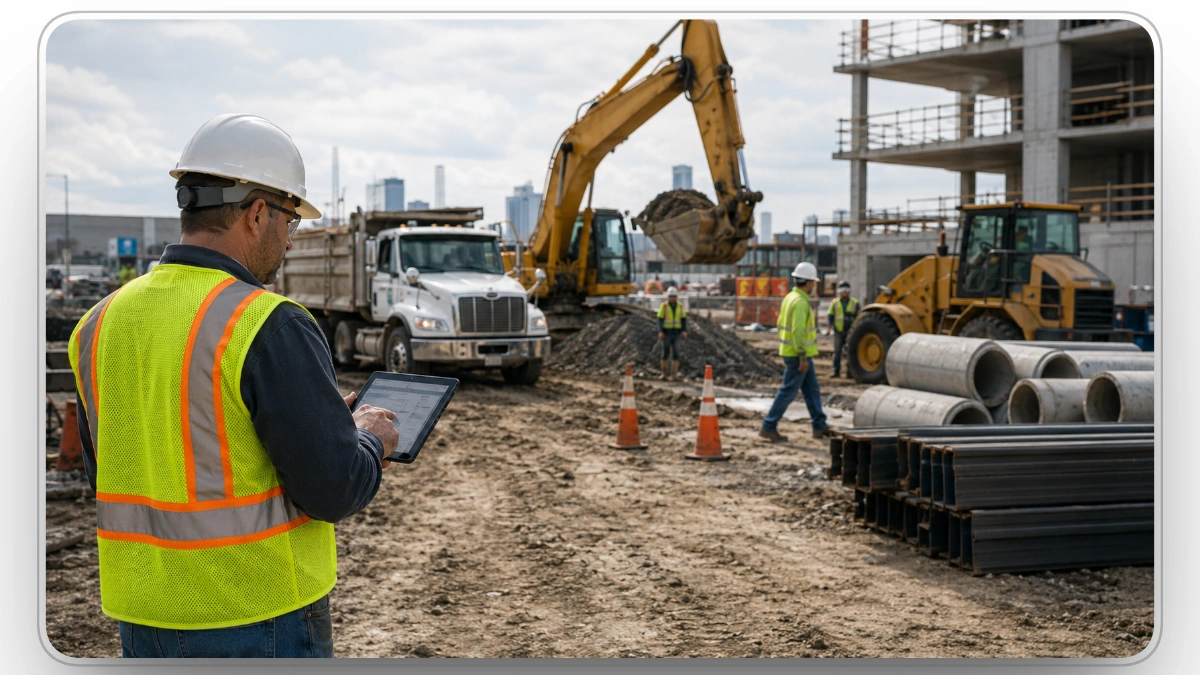
Fleet risk management is the process of identifying, reducing, tracking, and documenting the risks connected to vehicles, equipment, operators, field movement, and compliance obligations.
In construction, that includes:
- Heavy equipment working around crews and materials.
- Trucks hauling tools, trailers, attachments, and supplies.
- Service vehicles moving between jobsites.
- Operators using assets near utilities, slopes, trenches, or live traffic.
- Equipment parked overnight in unsecured areas.
- Assets with open defects, overdue service, or missing inspection records.
- Drivers or operators showing unsafe behavior patterns.
- Compliance files that cannot be produced when needed.
The goal is simple: know what can hurt people, delay projects, damage equipment, raise costs, or create liability, then build controls around it.
A good risk program answers three practical questions every week:
- Which assets, operators, sites, or workflows create the highest exposure?
- Which risks are most likely to affect safety, uptime, compliance, or cost?
- What evidence shows the company identified, assigned, corrected, or accepted the risk?
That last question matters. In construction, doing the work is not enough. Contractors also need defensible records that show inspections were completed, defects were routed, repairs were closed, and compliance requirements were handled on time.
Why Construction Fleet Risk is Harder in 2026

The risk is not theoretical. In 2024, construction and extraction workers experienced 1,032 fatal occupational injuries in the United States, while transportation incidents accounted for 38.2% of all fatal occupational injuries across industries. Pedestrian incidents involving motorized land vehicles also increased 19.0% from 2023 to 2024. For contractors, that makes vehicle movement, equipment condition, operator behavior, and jobsite traffic control core risk-management issues, not side concerns.
Road Risk and Jobsite Risk Now Overlap
A dump truck may spend the morning on public roads, back into a crowded jobsite before noon, haul material across uneven ground, then return to the yard after dark. That one asset moves through multiple risk zones in a single shift.
The old split between “fleet safety” and “site safety” does not work anymore. A single asset can create roadway risk, backing risk, struck-by risk, cargo securement risk, theft risk, and maintenance risk before the day is done.
Equipment Costs Make Every Failure More Expensive
Modern construction assets cost more to buy, repair, insure, and replace. A missed inspection or unresolved defect can remove a critical unit from service and trigger rental costs, crew delays, overtime, rescheduling, and margin loss.
The repair invoice is only the visible cost. The bigger damage often shows up in lost production, delayed handoffs, and emergency decisions made under pressure.
Telematics Created Visibility, Not Automatic Control
Many contractors already use GPS or telematics. That is useful, but raw data does not automatically reduce risk.
Knowing an asset moved is not the same as knowing whether it was inspected, assigned correctly, maintained, operated safely, secured overnight, or used productively.
Alerts only matter when they create a clear next step, an accountable owner, and a documented response.
Workforce Pressure Creates Shortcuts
Construction teams are under pressure to move faster and keep equipment working. That pressure often leads to quiet shortcuts:
- Skipped walkaround inspections.
- Assets used despite known defects.
- Operators moved between jobs without enough context.
- Ignored idle time because equipment appears available.
- Preventive maintenance pushed behind urgent field needs.
- Equipment assigned to work it was not designed to handle.
These choices rarely look dangerous in isolation. The problem is the pattern. Small exceptions go uncorrected long enough to become the new standard.
The Main Types of Fleet Risk Construction Companies Need to Control
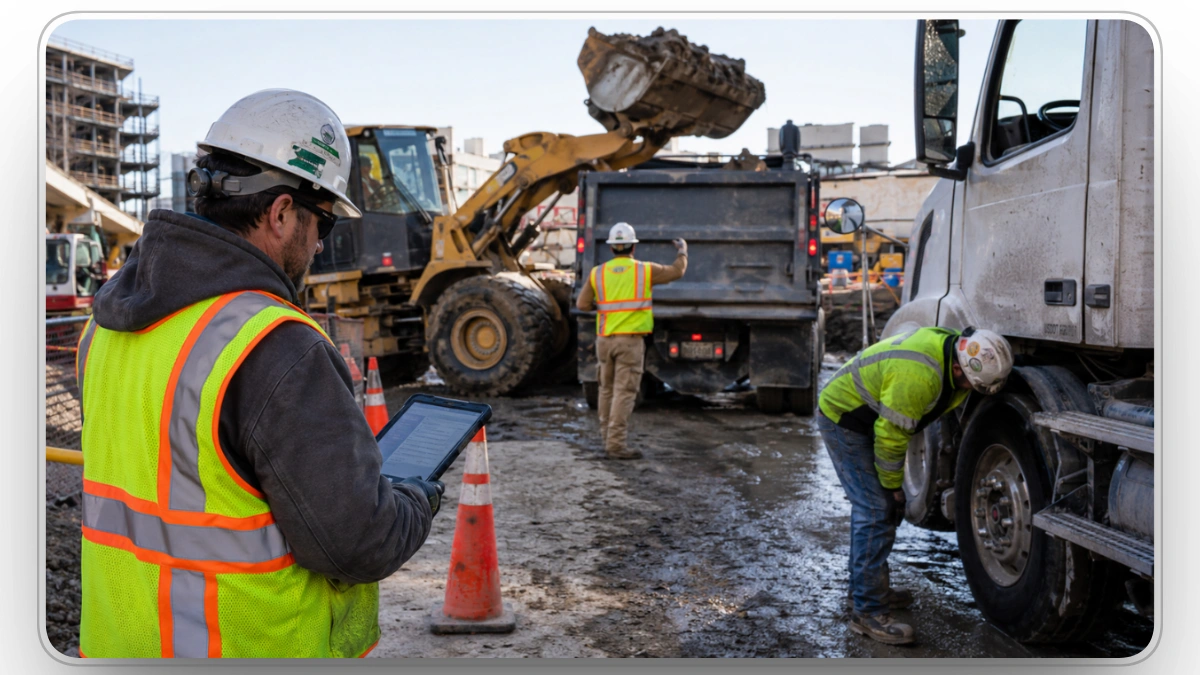
A strong risk program should not hide every issue under the broad label of “safety.” That makes reporting look clean but leaves managers with weak decisions. Construction companies need clear categories, defined owners, and measurable controls.
Driver and Operator Behavior Risk
This is the risk created by how people use trucks, service vehicles, heavy equipment, and site assets.
Common behavior risks include:
- Speeding
- Harsh braking
- Hard acceleration
- Distracted driving
- Seat belt non-use
- Fatigue
- Unsafe backing
- Weak spotter communication
- Ignoring warning lights
- Skipping required inspections
- Using equipment outside approved limits
For contractors, operator behavior is not limited to road performance. It also includes how equipment is used around people, materials, traffic control, utilities, and tight work zones. A telematics report may show speed, idle time, and location, but it will not always show whether an operator swung too close to a crew member or backed without a spotter.
That is why digital data and field observation both matter.
A practical behavior program should include:
- Written operating expectations by asset type.
- Training that matches the equipment and site conditions.
- Coaching based on patterns, not one-off punishment.
- Supervisor review after serious events.
- Recognition for safe operation.
- Escalation rules for repeated unsafe behavior.
The weakest approach is scorekeeping without coaching. If the same operator is flagged every week and no one acts, the company is not managing risk. It is only collecting evidence of a problem.
Equipment Condition Risk
Condition risk is created when assets are not inspected, serviced, repaired, or removed from operation at the right time.
This is one of the most expensive risk categories in construction because equipment can look “good enough” on a busy morning. A crew is waiting. The schedule is tight. The asset starts. So it gets used.
That logic breaks fast when a worn tire, leaking hydraulic line, weak brake system, faulty light, damaged mirror, or overdue service turns into an incident or breakdown.
Equipment condition risk should be managed in three layers.
Daily Readiness
This includes issues that should be caught before or after use:
- Visible leaks
- Tire damage
- Brake concerns
- Steering issues
- Broken lights
- Missing mirrors
- Attachment wear
- Backup alarms not working
- Seat belt damage
- Missing emergency supplies
Maintenance Execution
This includes the workflow behind service and repairs:
- Preventive maintenance schedules
- Defect reporting
- Work order assignment
- Parts availability
- Repair verification
- Return-to-service approval
- Maintenance history tied to each asset
Lifecycle Exposure
This includes the long-term cost and reliability picture:
- Repeated failures
- High repair frequency
- Low utilization
- Excessive idle time
- Aging assets kept too long
- Rentals used because owned equipment is unavailable
- Assets assigned to work outside their practical limits
The key shift is simple: maintenance is not just a shop function. It is risk control. Every open defect represents a decision the company must either correct, monitor, or formally accept.
Compliance and Documentation Risk
Compliance risk is what happens when required files, inspections, reports, or corrective actions are incomplete, late, or hard to prove.
For contractors operating regulated vehicles or mixed fleets, this may include:
- Driver qualification files.
- License and medical certificate tracking.
- Hours-of-service records.
- Electronic logging device compliance.
- Roadside inspection reports.
- Driver vehicle inspection reports.
- Preventive maintenance records.
- Periodic inspection reports.
- Drug and alcohol program documentation.
- Cargo securement records.
- Out-of-service correction evidence.
The common mistake is treating compliance as admin work. It is not. Compliance lives inside daily operations.
If a defect is reported and not closed, that is an operational risk. If a roadside inspection report is not returned or documented, that is a process failure. If driver files are incomplete, that is a governance issue. If cargo is not secured correctly, that is a field execution problem.
Contractors need a compliance calendar, record retention rules, and clear ownership. Otherwise, documentation turns into a scavenger hunt after something has already gone wrong.
Jobsite Movement Risk
Most fleet risk content focuses heavily on road safety. Construction companies need a wider lens.
On a jobsite, fleet risk includes how assets interact with people, space, materials, weather, ground conditions, and temporary work zones.
Key exposures include:
- Backing incidents
- Struck-by hazards
- Blind spots
- Tight access points
- Soft ground
- Slope instability
- Congested laydown areas
- Poor lighting
- Pedestrian and equipment crossings
- Poor haul route planning
- Missing signage
- Unauthorized equipment use
- Unclear parking or staging zones
This is where fleet and safety teams need to work from the same playbook. Fleet may own the asset record, but the hazard often lives on the site.
A strong jobsite movement plan should define:
- Equipment routes
- Reversing rules
- Spotter requirements
- Staging areas
- Speed limits by zone
- Pedestrian paths where possible
- Weather and ground condition checks
- Parking rules
- Visitor and subcontractor access controls
The best contractors treat movement like a controlled workflow, not background noise.
Theft, Misuse, and Unauthorized Access Risk
Construction equipment is often parked in yards, temporary lots, open jobsites, roadside staging areas, and remote locations. That makes theft and misuse a major fleet risk, especially when access control is loose.
This risk includes:
- After-hours movement
- Unauthorized equipment use
- Fuel theft
- Attachment theft
- GPS tampering
- Rental asset misuse
- Poor yard checkout and check-in processes
- Missing chain-of-custody records
The fix is not just GPS tracking. Contractors also need access rules, geofences, utilization review, after-hours movement alerts, and clear accountability for who used what, where, and when.
The Construction Fleet Risk Stack

Most fleet programs fail because they treat every issue with the same level of urgency.
A speeding alert, an overdue service, a missing inspection, and an insurance claim all appear on someone's dashboard, but they don't require the same response. Good fleet managers do not simply react to alerts.
They evaluate where risk is entering the operation and who is responsible for controlling it.
The Construction Fleet Risk Stack is a practical decision framework that separates day-to-day operational issues from broader organizational exposure. Instead of asking, "What's wrong?" it asks, "Where does this problem originate?"
When every issue can be placed into one of five layers, priorities become clearer, accountability improves, and recurring problems become easier to eliminate.
Layer 1: Execution
This is where work happens.
Every shift generates thousands of small decisions, equipment is dispatched, inspections are completed, defects are reported, machines are fueled, operators move between jobsites, and work continues under changing conditions.
Most individual events are minor. What matters is whether they happen consistently and according to company standards.
Questions to ask include:
- Are daily procedures actually being followed?
- Are required tasks being completed on time?
- Are exceptions becoming routine?
- Is work happening the same way across every crew?
Poor execution creates operational noise that eventually grows into larger problems.
Layer 2: Supervision
Execution only improves when someone owns it.
Supervisors, foremen, dispatchers, and fleet managers should spend less time collecting information and more time correcting patterns before they spread.
This layer focuses on management discipline rather than field activity.
Key questions include:
- Are recurring issues identified quickly?
- Are corrective actions assigned and verified?
- Do managers review trends instead of isolated events?
- Are crews receiving coaching instead of only reacting after incidents?
Without active supervision, the same failures repeat regardless of how many policies exist.
Layer 3: Systems
Even experienced employees struggle when the underlying process is inconsistent.
This layer evaluates whether technology and workflows make the right action the easiest action.
Instead of depending on memory, organizations should build systems that automatically support consistent execution.
Consider whether your operation has:
- Standardized workflows
- Automated reminders and approvals
- Connected operational data
- Clear ownership for every task
- Reliable reporting across departments
Strong systems reduce variation and remove unnecessary manual work.
Layer 4: Governance
Governance determines how the company defines acceptable risk.
This is where leadership establishes policies, responsibilities, performance expectations, and review processes that apply across every project.
Questions at this level include:
- Who owns each operational process?
- How is compliance verified?
- How often is performance reviewed?
- Which risks require executive attention?
- Are decisions documented consistently?
Without governance, every jobsite develops its own version of "good enough."
Layer 5: Business Impact
The final layer measures how operational performance affects the business itself.
Fleet risk is no longer just a maintenance or safety issue once it starts influencing profitability, customer confidence, insurance costs, project delivery, or future work.
Leadership should regularly evaluate how operational decisions affect:
- Equipment availability
- Project schedules
- Operating costs
- Insurance exposure
- Contract performance
- Client confidence
- Long-term profitability
This is where operational discipline becomes a competitive advantage rather than simply a compliance exercise.
Fleet Risk Management Strategies for Construction Companies in 2026

A strong fleet risk management program needs more than policies and dashboards. Contractors need strategies that change what happens in the field, in the yard, in the shop, and during project planning.
The best strategies are practical. They connect people, equipment, inspections, maintenance, compliance, and jobsite movement into one operating rhythm.
Strategy 1: Build Risk Profiles by Asset Class
Not every asset carries the same level of risk. A pickup truck, service van, dump truck, loader, crane, telehandler, skid steer, and trailer all create different exposures.
Contractors should group assets by risk profile instead of managing the entire fleet with one standard checklist.
High-Risk Assets
These usually include assets with higher safety exposure, higher replacement cost, tighter compliance requirements, or greater jobsite impact.
Examples include:
- Dump trucks
- Cranes
- Loaders
- Excavators
- Telehandlers
- Service trucks
- Trailers carrying heavy equipment
- Assets working near crews or public traffic
These assets need stricter inspection rules, tighter assignment controls, more frequent maintenance review, and better operator qualification tracking.
Medium-Risk Assets
These may not create the same exposure as heavy equipment, but they can still trigger downtime, liability, or compliance issues.
Examples include:
- Skid steers
- Compact equipment
- Light-duty trucks
- Jobsite utility vehicles
- Fuel or lube trucks
- Specialty attachments
These assets need routine inspections, usage tracking, and clear maintenance ownership.
Lower-Risk Assets
These may include smaller tools or support assets, but they should not be ignored. Theft, misuse, loss, and poor availability can still create cost leakage.
Examples include:
- Small equipment
- Attachments
- Power tools
- Temporary site assets
- Portable generators
This strategy helps contractors stop over-managing low-risk assets while under-managing the equipment that can actually shut down a jobsite.
Strategy 2: Use Pre-Use Inspections as a Risk Filter
A pre-use inspection should decide whether an asset is safe and ready for work. Too often, it becomes a checkbox exercise. That defeats the point.
The inspection process should separate minor issues from critical defects.
Critical Defects
These should stop the asset from being used until reviewed or repaired.
Examples include:
- Brake concerns
- Steering issues
- Hydraulic leaks
- Tire damage
- Missing safety guards
- Faulty backup alarms
- Broken lights on road assets
- Damaged seat belts
- Warning lights tied to safety-critical systems
Non-Critical Defects
These may not stop work immediately, but they still need tracking and due dates.
Examples include:
- Cosmetic damage.
- Minor wear.
- Non-urgent fluid seepage.
- Missing decals.
- Small attachment wear.
- Cab comfort issues.
The key is escalation. A defect found during a pre-use inspection should never just sit on a form. It should immediately become one of three things: a work order, a supervisor decision to hold the asset, or a documented call to accept and monitor the risk.

Strategy 3: Connect Operator Behavior to Coaching
Driver and operator scores are useful, but only when they lead to coaching. A low score without follow-up does not reduce risk. It only proves that the company saw the issue and failed to act.
A better strategy is to classify behavior patterns.
Immediate Coaching Triggers
These require fast supervisor attention:
- Repeated speeding
- Harsh braking near jobsites
- Unsafe backing
- Seat belt violations
- Operating equipment without inspection completion
- Unauthorized after-hours use
- Repeated idling in restricted areas
- Driving or operating outside approved zones
Trend-Based Coaching
This is used when behavior is not severe yet but is moving in the wrong direction.
Examples include:
- More frequent harsh events
- Increasing idle time
- Repeated inspection delays
- Minor damage patterns
- Complaints from site supervisors
- Frequent use of equipment outside planned assignments
Coaching should be specific. “Be safer” is not coaching. “Your last three backing events happened without spotter confirmation at congested staging zones” is coaching.
Strategy 4: Create Geofences Around Risk
Most companies use geofencing to see where equipment is. That is useful, but construction fleets can go further. Geofences should be designed around risk zones.
Useful Geofence Types
- Yard geofences for check-in and check-out control.
- Jobsite geofences for assignment accuracy.
- Restricted zone geofences for unauthorized use.
- After-hours geofences for theft detection.
- Maintenance bay geofences for service tracking.
- Public road interface zones for high-risk movement.
- Fuel area geofences for fuel control.
- Rental return zones for rental closeout accuracy.
This gives managers more than a map. It gives them a control layer. If a loader leaves the site after hours, the issue is not just location. It may be theft, misuse, poor assignment control, or a missing checkout process.

Strategy 5: Prioritize Preventive Maintenance by Risk
Calendar-based maintenance is better than reactive repair, but it is not enough for construction. Equipment risk changes based on use, site conditions, asset criticality, and failure history.
A smarter strategy is risk-based preventive maintenance.
Factors That Should Adjust Maintenance Priority
- Asset criticality
- Utilization hours
- Mileage
- Idle time
- Harsh operating conditions
- Repeated defects
- Repair history
- Age
- Cost of downtime
- Project dependency
- Safety exposure
- Availability of replacement assets
A crane assigned to a critical lift schedule should not be treated the same as a lightly used support asset. A loader working in mud, heat, dust, or steep terrain may need closer review than the same model working in easier conditions.
Risk-based maintenance helps contractors service the assets that matter most before they create bigger problems.

Strategy 6: Turn Near Misses into Operating Intelligence
Near misses are usually more useful than incident reports because they show risk before major damage occurs. The problem is that many companies ignore them because nobody was injured and nothing broke.
That is a mistake.
A near miss should trigger a short review:
- What happened?
- Which asset was involved?
- Who was operating?
- Where did it happen?
- Was visibility poor?
- Was the route unclear?
- Was the spotter missing?
- Was the equipment suitable for the space?
- Was the operator rushed?
- Was the site layout part of the issue?
The goal is not to blame. The goal is pattern detection.
If three near misses happen in the same access lane, the contractor does not have three random events. It has a site movement problem.
Strategy 7: Build a Weekly Fleet Risk Review
Annual safety meetings are not enough. Fleet risk moves too fast in construction.
A weekly review should cover the highest-risk signals from the previous week and the upcoming work schedule.
Weekly Review Agenda
- Critical open defects
- Overdue preventive maintenance
- Assets assigned to high-risk jobsites
- Repeated operator behavior alerts
- After-hours movement
- Inspection completion gaps
- Downtime caused by preventable issues
- Near misses
- Theft or misuse alerts
- Upcoming work requiring special equipment controls
- Compliance deadlines due soon
This meeting should be short and operational. The point is to assign actions, not admire dashboards.
Strategy 8: Tie Fleet Risk to Project Planning
Fleet risk often starts before the asset reaches the jobsite. Poor planning creates rushed deployment, wrong equipment selection, missing attachments, overloaded trailers, weak staging, and unplanned movement.
Project planning should include a fleet risk review before mobilization.
Questions to Ask Before Mobilization
- Which assets are needed?
- Are they available and ready?
- Are inspections current?
- Is preventive maintenance due during the project?
- Are operators trained for the assigned equipment?
- Are haul routes clear?
- Are staging areas defined?
- Are ground conditions suitable?
- Are attachments inspected?
- Are rental assets needed?
- Are theft controls in place?
- Are public road movements involved?
This strategy prevents a common construction problem: equipment arrives on site before anyone has fully thought through the risk.
Strategy 9: Use Risk-Based Access Control
Not everyone should be able to use every asset. That sounds obvious, but many jobsites still rely on informal access habits.
Risk-based access control means asset use depends on qualification, assignment, and authorization.
Practical Controls
- Assign operators to specific asset types.
- Track who used each asset.
- Restrict high-risk assets to approved operators.
- Require inspection completion before use.
- Review after-hours access.
- Lock out assets with critical defects.
- Require supervisor approval for reassignment.
- Document rental equipment handoffs.
This is especially important for mixed jobsites where employees, subcontractors, rental units, and multiple crews work in the same space.
Strategy 10: Build an Insurance-Ready Evidence Trail
An insurance-ready fleet risk strategy keeps evidence organized by asset, operator, jobsite, and date.
- Inspection records
- Defect reports
- Repair history
- Preventive maintenance logs
- Operator training records
- Telematics data
- Assignment history
- Incident reports
- Near miss records
- Corrective actions
- Photos and site notes
- Return-to-service approvals
This does not just help with claims. It also helps during renewals, audits, disputes, and owner prequalification reviews.
Strategy 11: Separate Leading Indicators from Lagging Indicators
Many contractors only track what already happened. That is lagging data. It matters, but it is too late to prevent the event.
A better strategy is to track both leading and lagging indicators.
Leading Indicators
These show risk before an incident:
- Near misses
- Missed inspections
- Open defect aging
- Overdue maintenance
- Repeated harsh driving
- Excessive idle time
- After-hours movement
- Operator coaching gaps
- Assets used outside assigned areas
- Unreviewed compliance deadlines
Lagging Indicators
These show what already happened:
- Crashes
- Injuries
- Claims
- Citations
- Breakdowns
- Theft losses
- Out-of-service events
- Equipment damage
- Project delays
Contractors should not ignore lagging indicators, but the real value is in leading indicators. That is where prevention still has a chance.
Strategy 12: Standardize Corrective Actions
A risk program fails when the same problem gets handled five different ways depending on who is in charge that day.
Corrective actions should be standardized by risk type.
Example Corrective Action Rules
- Critical defect: Remove assets from service, create work order, require repair approval before use.
- Repeated speeding: Supervisor coaching, documented review, follow-up monitoring.
- Missed inspection: Notify supervisor, block future assignment if repeated.
- After-hours movement: Verify authorization, check geofence rule, investigate misuse or theft.
- Near miss: Short review, root cause, site control update.
- Overdue maintenance: Prioritize by asset criticality and schedule impact.
- Unauthorized operator: Remove access, review training and assignment controls.
The purpose is consistency. When field teams know what happens next, the program becomes easier to enforce.
Strategy 13: Review Risk by Jobsite
Companywide fleet reports can hide serious jobsite-specific issues. A contractor may have acceptable overall numbers while one project is producing most of the risk.
Risk should be reviewed by:
- Jobsite
- Crew
- Supervisor
- Asset class
- Operator group
- Work type
- Time of day
- Route
- Project phase
This helps leaders see where the real exposure sits. A site with repeated backing issues may need a new movement plan. A crew with repeated inspection gaps may need supervisor intervention. A project with unusual idle time may have sequencing problems.
Strategy 14: Reduce Risk Through Utilization Control
Underused equipment may not seem risky, but poor utilization creates financial and operational exposure. Idle assets are easier to overlook, overworked assets are more likely to miss maintenance windows, and unnecessary rentals can add cost, movement, handoffs, and theft exposure.
Contractors should track:
- Assets sitting idle across jobsites.
- Equipment used only a few hours per week.
- Overworked assets with rising repair needs.
- Rental units kept longer than needed.
- Assets assigned to inactive projects.
- Equipment moved frequently without clear purpose.
Better utilization reduces unnecessary movement, improves availability, and helps maintenance teams plan instead of react.

Strategy 15: Make Risk Review Part of Closeout
Fleet risk does not end when the project finishes. Closeout is the best time to capture lessons, inspect returning assets, document damage, close rentals, and update future planning.
A project closeout risk review should include:
- Asset condition on return.
- Damage found after demobilization.
- Rental return accuracy.
- Maintenance needs created by the project.
- Near misses or incidents during the job.
- Utilization performance.
- Theft or loss issues.
- Operator feedback.
- Site movement lessons.
- Planning improvements for future jobs.
This turns every project into a source of operational learning. Without closeout review, contractors repeat the same problems job after job.
What a Fleet Risk Management Program Requires
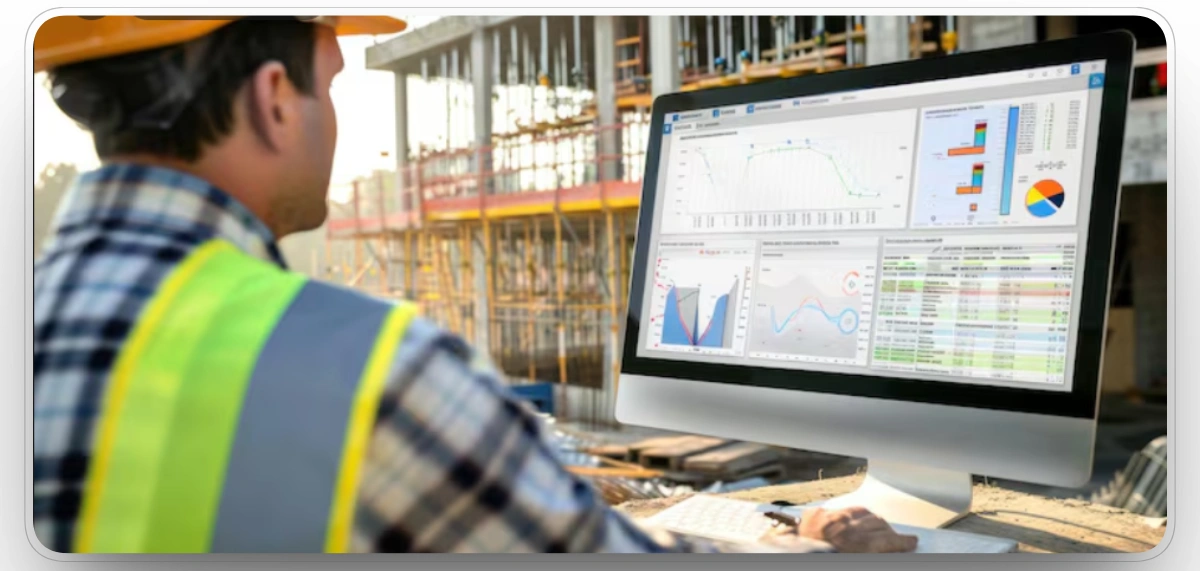
Strategies describe what to do. Requirements describe what has to be in place for those strategies to work in the field. Without them, fleet risk management becomes a set of good intentions that collapse the first time the schedule gets tight.
A robust program in 2026 is built on a short list of operating requirements. Each one turns a good idea into something the field can actually execute and the office can actually prove.
1. Connected Operational Data
Risk cannot be managed from systems that do not talk to each other. The first requirement is a single operating view where equipment data lives together instead of in silos.
At minimum, the program needs connected visibility into:
- Asset location and assignment.
- Inspection status and open defects.
- Preventive maintenance schedules and work orders.
- Telematics and utilization data.
- Operator assignment and behavior signals.
- Fuel and idle activity.
- Compliance documents and due dates.
The goal is not more dashboards. The goal is one place where a risk signal can be traced to the asset, operator, and jobsite behind it.
2. Clear Ownership for Every Risk
A risk with no owner is a risk that never gets closed. Every category needs a named person responsible for review and action, not a shared inbox that everyone ignores.
Ownership should be defined for:
- Daily inspections and defect routing.
- Maintenance scheduling and return-to-service approval.
- Operator coaching and behavior review.
- Compliance records and deadlines.
- Jobsite movement and staging plans.
- Theft, access, and after-hours alerts.
When ownership is clear, the question stops being "who handles this?" and becomes "what did the owner decide?"
3. Standardized Inspections and Defect Routing
Inspections only reduce risk when they decide whether an asset works that day. The program requires a consistent process that separates critical defects from minor ones and routes every finding to a work order or a documented decision.
The program needs a consistent rule that applies every time, regardless of who found the defect or which asset it's on: every defect gets routed to one of three outcomes: repair, supervisor review, or a recorded risk acceptance and the routing has to be traceable back to who made that call.
4. Risk-Based Maintenance Workflows
Calendar maintenance is a starting point, not a finish line. The program requires maintenance priority that adjusts to asset criticality, utilization, operating conditions, and failure history.
A crane on a critical lift schedule cannot be treated like a lightly used support unit. Priority has to bend to what's actually at risk, not just what's next on the calendar.
5. Compliance and Documentation Requirements
Depending on the fleet, jurisdiction, and vehicle type, required documentation may include driver files, HOS and ELD records where applicable, inspection records, preventive maintenance records, roadside inspection reports, out-of-service correction evidence, cargo securement records, and operator training documentation.
6. Real-Time Visibility and Alerting
Risk that is discovered at month-end is risk that already happened. The program requires alerts that fire while there is still time to act.
Useful alerts include:
- Critical defects that should lock an asset out of service.
- Overdue preventive maintenance on high-criticality assets.
- After-hours or geofence movement.
- Missed inspections before assignment.
- Repeated harsh-driving or unsafe operating events.
- Compliance deadlines coming due.
Data becomes risk management only when it triggers action.
7. Defined Controls and Escalation Rules
The program requires standard responses so the same problem is not handled five different ways depending on who is on shift. Controls should be written, consistent, and tied to risk type.
Every control should answer three things: what triggers it, who acts, and what evidence proves it was handled. That structure is what makes a program enforceable instead of optional.
8. A Review Cadence
Finally, the program requires a rhythm. A weekly fleet risk review keeps exposure visible, a project closeout review captures lessons, and periodic reporting connects fleet risk to business outcomes like insurance, downtime, and margin.
Requirements are what keep the strategies alive after the kickoff meeting ends.
Common Fleet Risk Management Mistakes

Most contractors do not fail at risk management because they ignore it. They fail because they manage it too narrowly, too slowly, or too late.
1. Treating Risk as a Safety-Only Problem
When every issue is filed under "safety," reporting looks clean but managers lose the detail they need to act. Risk needs clear categories, owners, and controls, not one broad label.
2. Collecting Data Without Acting on It
Telematics and GPS are useful signals, but they do not manage risk by themselves. Contractors still need a workflow that reviews alerts, assigns responsibility, verifies the response, and documents what happened.
3. Blaming Operators First
Operator behavior matters, but it is rarely the whole story. A speeding alert may trace back to unrealistic dispatch pressure. A backing incident may trace back to a congested staging zone. Blaming the operator without checking field context leaves the real problem in place.
4. Managing the Whole Fleet With One Standard
A pickup, a crane, and a dump truck do not carry the same exposure. One universal checklist over-manages low-risk assets and under-manages the equipment that can actually shut down a jobsite.
5. Tracking Only Lagging Indicators
Crashes, claims, and breakdowns matter, but they are too late to prevent the event. Programs that ignore near misses, open-defect aging, and missed inspections are always reacting instead of preventing.
6. Letting Defects Stay Open
A reported defect that is never closed is an accepted risk that nobody decided to accept. Open defects are where small problems quietly become incidents.
7. Reviewing Risk Companywide Instead of by Jobsite
Companywide averages hide the project creating most of the exposure. Acceptable overall numbers can still contain one site with repeated backing issues or one crew with chronic inspection gaps.
A 30, 60, 90-Day Fleet Risk Rollout
Fleet risk management does not need a massive launch. Build control in stages so the program survives contact with the field.
First 30 Days
The first month is about visibility.
Focus on:
- Pulling inspections, defects, maintenance, telematics, and compliance into one review.
- Identifying high-risk asset classes and the jobsites that use them.
- Listing every open critical defect and overdue service item.
- Assigning an owner to each risk category.
- Reviewing after-hours movement and access gaps.
- Separating owned and rental equipment.
Do not try to fix everything. Find the exposure that can hurt people or stop a job.
Days 31 to 60
The second month is about targeted correction.
Focus on:
- Closing critical defects and verifying return-to-service.
- Building risk profiles and inspection rules by asset class.
- Turning operator alerts into documented coaching.
- Setting geofences around risk zones, not just locations.
- Tightening jobsite movement, staging, and access controls.
This is where risk control moves from theory to field execution.
Days 61 to 90
The third month is about making risk control part of normal operations.
Focus on:
- Standardizing corrective actions by risk type.
- Reviewing risk by jobsite, crew, and supervisor.
- Building an insurance-ready evidence trail by asset and operator.
- Adding a fleet risk review to project mobilization and closeout.
- Connecting fleet risk reporting to downtime, insurance, and margin.
At this point, risk management stops being a side report. It becomes part of how the operation runs.
Conclusion
Fleet risk management in construction is not one policy, one device, or one safety meeting. It is the discipline of connecting people, equipment, jobsites, and compliance into one repeatable system.
Construction fleets rarely fail because of a single dramatic event. They fail through accumulation, the small skipped inspections, open defects, and quiet shortcuts that become normal until one of them becomes an incident.
Strong contractors do not just ask whether the work got done. They ask which asset created the exposure, who was operating, where it happened, what process allowed it, and how that pattern can be removed before it repeats.
That is the shift. Every risk has a source. The goal is to find it early enough to act, not explain it later in a claim.
Clue gives teams a clearer view of fleet risk alongside asset activity, geofencing, inspections, maintenance status, utilization, and compliance, so exposure is easier to catch while work is still active. The right platform does not just record what happened. It connects each risk signal to the action that can prevent the next problem.
FAQs
What is fleet risk management in construction?
It is the process of identifying, reducing, tracking, and documenting the risks tied to vehicles, equipment, operators, jobsite movement, and compliance. In construction it covers far more than safe driving, including equipment condition, jobsite hazards, theft, and defensible recordkeeping.
What are the main types of construction fleet risk?
The main categories are operator behavior risk, equipment condition risk, compliance and documentation risk, jobsite movement risk, and theft or unauthorized access risk. Managing them separately gives clearer decisions than filing everything under "safety."
What does a fleet risk program actually require?
It requires connected operational data, clear ownership for every risk, standardized inspections and defect routing, risk-based maintenance, compliance documentation, real-time alerting, defined controls, and a regular review cadence.
Are telematics and GPS enough to manage fleet risk?
No. Telematics and GPS are important inputs, but they are not a complete risk program. Contractors still need inspection workflows, maintenance follow-up, alert review, operator accountability, and documented corrective action.
How does fleet risk management lower insurance and claim exposure?
By keeping an organized evidence trail, inspections, repairs, training, assignments, and corrective actions, by asset and operator. That record supports claims, renewals, audits, and owner prequalification, and it demonstrates the company managed risk responsibly.
Where should fleet risk management start?
Start with visibility. Pull inspections, defects, maintenance, telematics, and compliance into one review, identify high-risk assets and jobsites, close critical defects, and assign an owner to each risk category before adding more tooling.
Transform Your Equipment Management