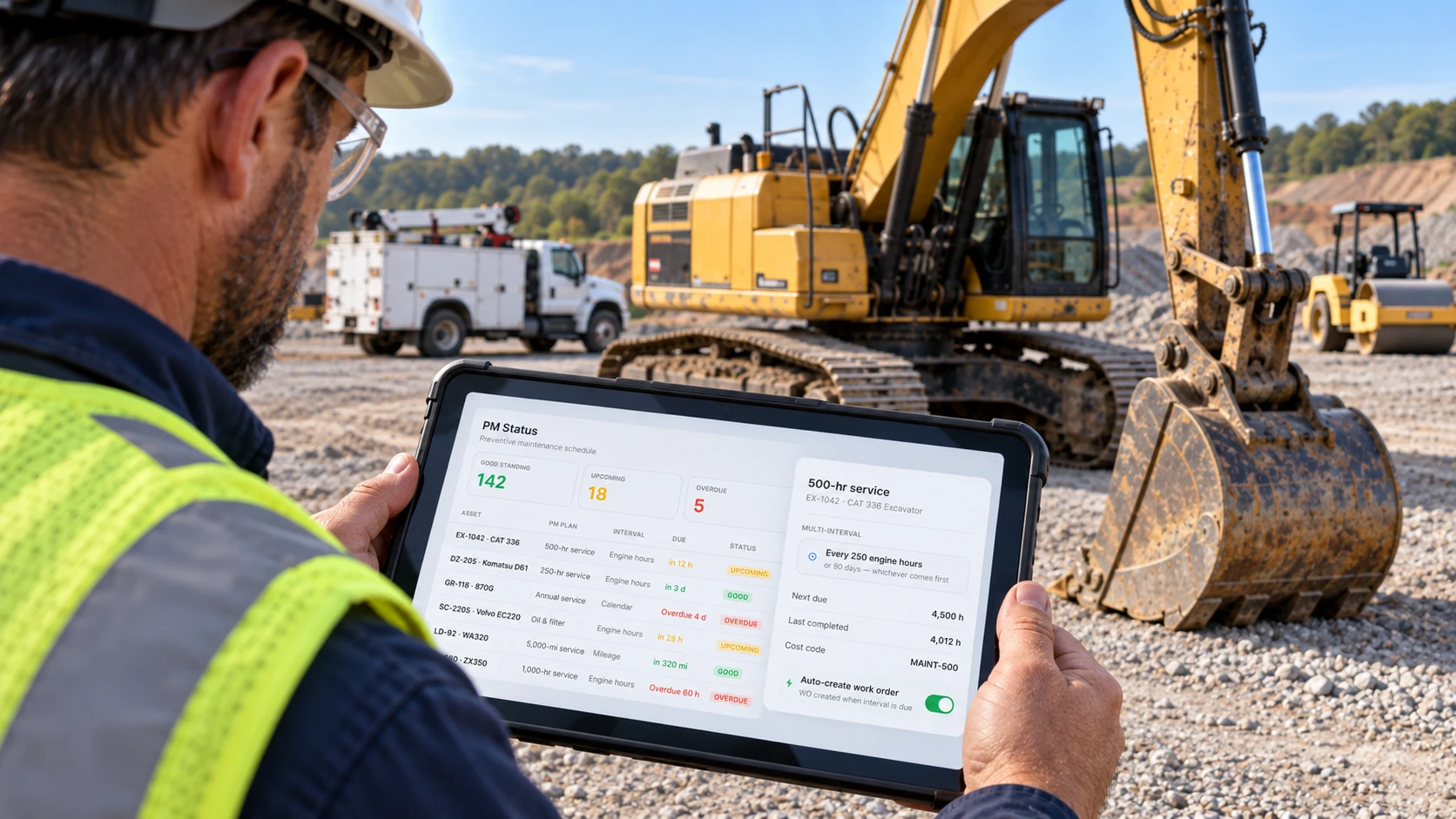
If you have been comparing maintenance software, you have run into CMMS and EAM, two acronyms that vendors use almost interchangeably. In short, a CMMS manages maintenance, while an EAM manages the whole life of an asset, from the purchase order to the day you sell it for scrap.
For a construction fleet, though, neither label fits cleanly. Heavy equipment sits in an awkward middle. It is expensive enough to demand EAM-style lifecycle thinking. It runs in a field environment that most EAM suites were never built for.
This guide explains what each system actually does, what an EAM adds, what the two really cost to run, and why a construction fleet usually needs a third door rather than either of the first two.
The Three Options at a Glance
| Option | What it is built for | Best fit |
|---|---|---|
| CMMS | Maintenance execution for work orders, PM, inspections, and parts | Single-site or facilities teams that need to keep equipment running |
| EAM | Full asset lifecycle for procurement, depreciation, capital planning, and disposal | Large, multi-site, multi-asset-class enterprises where finance drives asset decisions |
| Fleet-native platform | Maintenance with telematics, utilization, dispatch, owned and rented equipment, plus equipment economics | Construction and heavy-equipment fleets moving between job sites |
What is a CMMS, and What Does It Do?
A computerized maintenance management system, or CMMS, is software that runs maintenance execution. It schedules service, manages work orders, records inspections, tracks parts and labor, and keeps the history for every asset. In plain terms, it is the system that decides what gets serviced, when, by whom, and at what cost. It then proves the work happened.
The center of gravity is the present. A CMMS answers the operational question that keeps a shop running. It shows what needs attention today, this week, and this quarter. It shows whether that work is being handled. The core workflow is create and assign a work order, schedule recurring preventive maintenance, record inspection findings, log parts and hours against the job, and pull up any machine’s full service history on demand. Good reporting then puts open work and maintenance cost in front of the people accountable for them.
A CMMS is deliberately focused. It is laser-aimed at maintenance, which is both its strength and its boundary. It will tell you that a machine has cost more in repairs this year than last, and it will tell you its mean time between failures, but it was not built to tell you whether the machine is still worth owning, what it is worth on the books, or how to budget its replacement three years out. Those questions live one layer up. For most single-site teams and plenty of mid-market operations, that boundary is exactly right, and a CMMS is all the software they ever need. If you are past the definition and already shortlisting products, start with construction equipment management software built for heavy iron.
What is an EAM, and How is It Different from a CMMS?
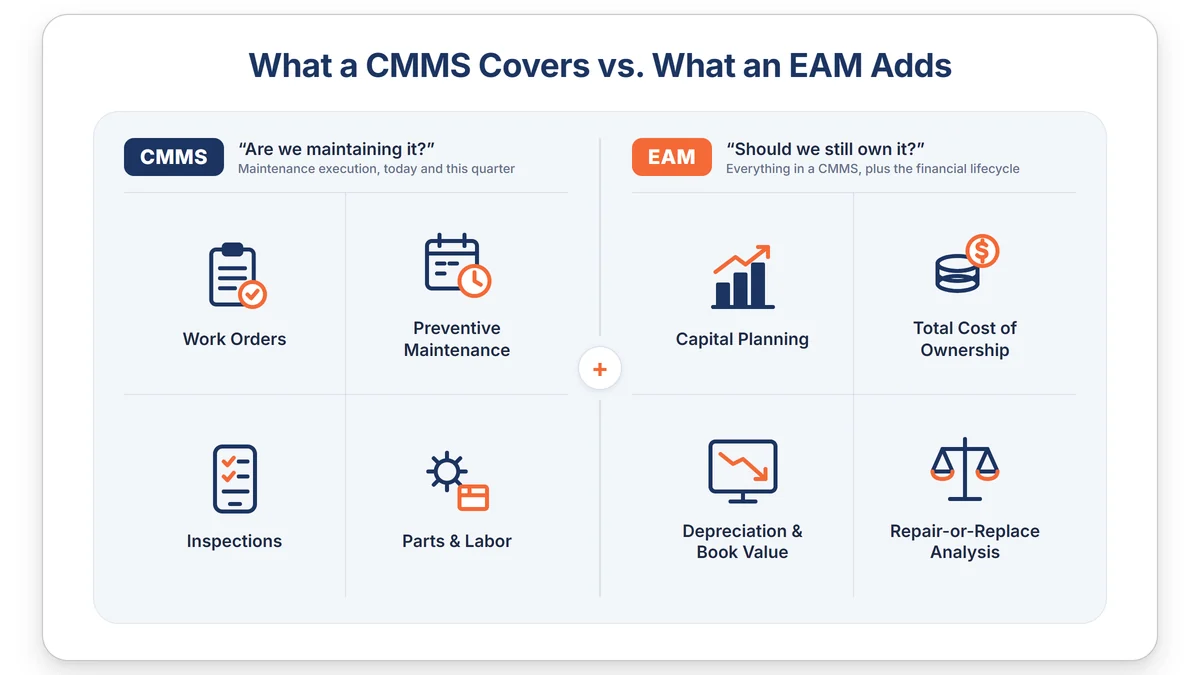
An EAM (enterprise asset management) system does everything a CMMS does. It then extends across the full asset lifecycle, from acquisition and commissioning through maintenance, depreciation, and disposal. The difference is not that an EAM maintains assets better. It is that an EAM manages the asset as a financial object, not just a thing to be serviced.
The cleanest way to hold the distinction is to compare the questions. A CMMS asks “is this asset being maintained properly?” An EAM asks a broader set of questions. They cover what condition the asset is in, what it has cost over its whole life, what it is worth now, and whether the smarter move is to keep it or replace it. EAM did not appear out of nowhere. It grew out of CMMS in the 1990s, when large, asset-heavy industries needed to connect maintenance data to procurement, compliance, and capital planning, so an EAM is best understood as a CMMS with a financial and strategic layer bolted on top, not a different species of software.
The discipline an EAM automates has a formal standard behind it. The ISO 55000 family covers asset management. ISO 55000 sets out the overview, principles, and terminology. ISO 55001 specifies the requirements for an asset management system. ISO 55002 gives guidance on applying it. The 2024 second edition of ISO 55001 added a requirement for an asset management decision-making framework. That framework is the criteria, methods, and tools an organization uses to decide about its assets. That is the cleanest statement of the split. A CMMS records the work. An EAM is where the decision rules live.
That extra layer is also why an EAM reaches outside the maintenance department. A CMMS usually serves one team. An EAM is designed to be an enterprise-wide platform where maintenance, finance, procurement, and operations work inside the same system, which is powerful when you need it and heavy when you do not.
What Does an EAM Add Beyond a CMMS?
An EAM adds the financial and lifecycle capabilities that a maintenance-focused CMMS leaves out, and in a construction context five of them matter most.
- Capital planning and replacement forecasting. An EAM models multi-year capital expenditure, so replacing equipment becomes a budgeted, forecasted decision rather than a surprise. In many organizations this is a board-level function, which is the tell that you are in EAM territory.
- Total cost of ownership per asset. An EAM tracks cumulative cost (labor, parts, downtime, and often fuel) against each machine across its life, producing the TCO figure that a pure maintenance log cannot.
- Repair-or-replace on financial grounds. This is the sharpest line between the two. In a CMMS, the repair-or-replace call is based on maintenance cost history and failure intervals. In an EAM, it is based on full financial analysis of remaining book value, total cost of ownership to date, projected remaining useful life, and replacement cost. All are weighed against continued maintenance spend. One reads the repair log. The other reads the balance sheet.
- Depreciation and asset accounting. An EAM connects maintenance data to financial statements, tracking depreciation and feeding asset values into the general ledger.
- Procurement, compliance, and deep integration. EAM platforms typically add contract and SLA management, procurement workflows, and tight integration with ERP, finance, GIS, and building systems, where a CMMS supports lighter, task-driven connections.
They also model asset types a CMMS often cannot, such as linear assets like roads and pipelines or boundary-based assets like parks, each with their own inspection and compliance rules.
The pattern is consistent. Everything an EAM adds points at finance, strategy, and the long horizon. If none of those are your problem, you are paying for a layer you will not use.
CMMS vs EAM vs Fleet-Native Platform: A Side-by-Side Comparison
The table below sets the three options against each other attribute by attribute, so you can see where each one stops.
| What you are comparing | CMMS | EAM | Fleet-native platform |
|---|---|---|---|
| Core question it answers | What maintenance work is due? | What is this asset worth across its life? | What does this machine cost, and should we still own it? |
| Primary user | Maintenance team | Finance, procurement, operations, maintenance | Equipment, fleet, and field teams |
| Work orders and PM | Core function | Included, inside a wider lifecycle | Core function, built for shop and field |
| Inspections | Standard maintenance forms | Part of asset compliance controls | Field forms that become work orders |
| Parts and inventory | Core stock, issue, and reorder | Enterprise inventory and procurement | Parts posted against each repair and job |
| Asset lifecycle and disposal | Basic status and retirement record | Full lifecycle, valuation, and disposal | Acquisition through disposal for mobile assets |
| Depreciation and book value | Outside the system | Formal depreciation, feeds the general ledger | Cost inputs only, not formal ledger treatment |
| Capital planning and replacement forecasting | Not standard | Multi-year capital plans and forecasts | Replacement timing from machine cost and use |
| Cost per hour and repair-or-replace | Repair history only, no ownership cost | Full financial analysis, rarely by engine hour | Cost per hour and margin per machine |
| Telematics and engine-hour triggers | Usually a bolt-on integration | Usually a bolt-on integration | Native, PM fires from engine hours |
| Owned and rented equipment in one view | Often split across records | Possible with configuration | Standard, owned beside rented |
| Offline use in the field | Varies by product | Rarely a design goal | Built for job sites with no signal |
| Typical implementation time | Weeks | 12 to 24 months | Weeks |
Why Doesn’t the CMMS vs EAM Question Fit a Construction Fleet?

The CMMS-versus-EAM question doesn’t fit a construction fleet cleanly because both categories were shaped around fixed plant assets, and heavy equipment breaks the mold in two directions at once. A construction fleet has the strategic questions of an EAM and the daily operating reality of a CMMS, and most tools in either category are built to serve one of those and not the other.
Look at how the two camps present themselves. A facilities CMMS assumes an asset sits still in a building on a predictable duty cycle. A full EAM suite assumes a head office, a finance team, and an IT department ready for a long, phased rollout. Neither assumes a dozer that runs on engine hours, moves between three job sites in a week, spends half its life out of cell coverage, and shares a yard with rented iron that goes back next month.
Fleet platforms, meanwhile, often lead with GPS and driver behavior and quietly assume someone else does the maintenance. The result is predictable. Fleets end up with construction asset tracking software that locates every machine but cannot turn a failed inspection into a work order, or EAM suites so broad that a 30-machine contractor pays for and never uses most of the platform.
That is why the honest framing for construction is a three-way choice, not a two-way one. The three options are facilities CMMS, full EAM suite, or a fleet-native platform built for how equipment runs. The rest of this guide works through which of the three your fleet needs. It starts with the question that decides it.
Does Your Fleet Have EAM Questions or CMMS Operations?
The single factor that determines what your fleet needs is its asset profile, specifically asset lifespan, replacement cost, and how tightly the financial lifecycle connects to capital planning. The more an asset is long-lived, expensive to replace, and sensitive to replacement timing, the more it generates EAM-style questions. The more your pain is reactive breakdowns, poor PM compliance, and no service history, the more it is a CMMS problem.
Heavy construction equipment scores high on both axes at once. That is the whole reason the choice is hard. An excavator is long-lived. It carries a six-figure replacement cost. Its replacement timing moves real money. This raises genuine EAM questions. What has this machine cost per hour? How much useful life is left? Is it cheaper to keep fixing it or to replace it? When should it be replaced?
At the same time, keeping it running is a field problem with CMMS-grade urgency. An hour-based service comes due on a job site. A failed inspection has to become a work order before the operator leaves the cab. A part has to reach the machine before the crew stands idle.
So the useful diagnostic is not “CMMS or EAM” in the abstract. The useful question is whether you have EAM-grade questions sitting on top of CMMS-grade operations. For most construction fleets, the answer is yes. That combination is what a fleet-native platform exists to serve. Before assuming you need a full EAM to answer the strategic questions, it helps to be precise about when each of the three options is the right call.
When Does a Construction Fleet Need a CMMS?
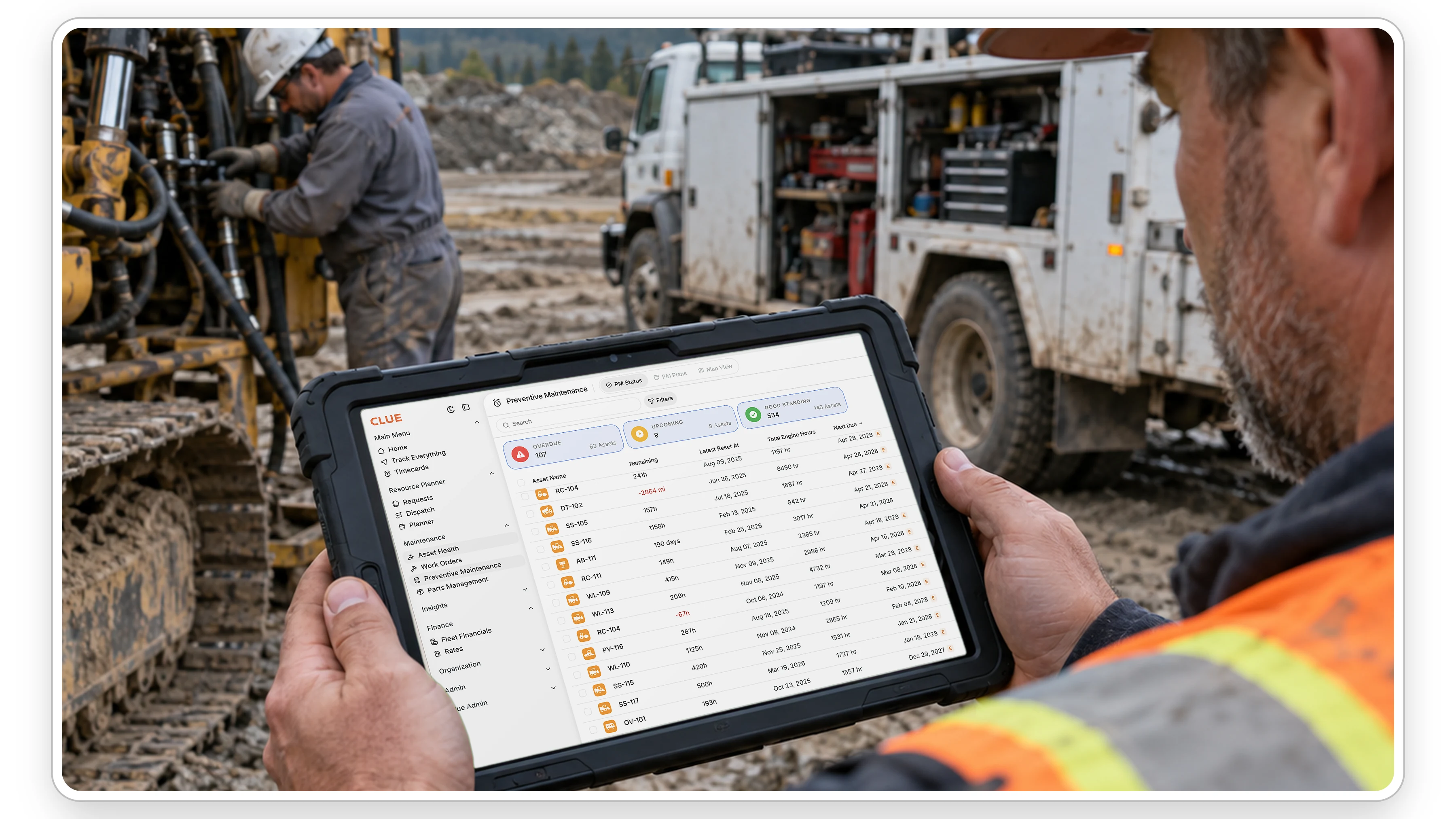
A construction fleet needs a straightforward CMMS when the problem is execution, not strategy. Equipment is breaking down. Preventive maintenance is slipping. Nobody can pull up a machine’s service history. Your honest description of the pain may be reactive maintenance, missed PMs, and no visibility into what has been done. That is a CMMS problem. The discipline a CMMS brings will fix more than any lifecycle module would.
A CMMS is usually enough when your operation is contained. That may mean a single yard or a few sites. The maintenance team owns the decisions. There is no pressing need to connect maintenance to finance, procurement, or capital planning. In that situation, an EAM’s extra layer is overhead. It takes work to configure. It gets no use. Its longer, costlier rollout buys you capabilities you do not have a user for.
The catch for construction is that a generic, facilities-oriented CMMS can be too contained. The maintenance logic may be excellent. The fleet logic may be missing. It may have no automatic engine-hour triggers from telematics. It may have no clean handling of untracked assets. It may have no owned-versus-rented view. It may have no offline capture for job sites with no signal.
So the right test is not only “do I need a CMMS rather than an EAM,” but “does this CMMS understand equipment that moves and runs on hours.” If it does not, you have bought a plant tool for a field fleet.
When Does a Construction Fleet Need an EAM?
A construction fleet needs a full EAM when the decisions have moved out of the shop and into the boardroom, and when more than the maintenance team needs to live inside the asset system. The clearest signals are structural rather than mechanical.
You likely need EAM capability when your CFO, procurement director, and capital planning team need direct access to asset data rather than reports forwarded by maintenance, when you must track each asset through depreciation and disposal for financial reporting, and when capital replacement is a formal, multi-year, board-level process rather than a judgment call. You also move toward EAM when you manage genuinely diverse asset classes beyond equipment (buildings, roads, water systems, land) or operate across many sites and regions that need standardized processes and a single source of truth from purchase order through final disposal. Public agencies and heavily regulated operators tend to land here, because citizen-facing reporting, audit-readiness, and multi-department stewardship are EAM requirements, not maintenance requirements.
The honest caveat is worth stating because the industry tends to leave it out. Many operations that believe they need an EAM can be served by a strong CMMS or fleet platform with good ERP integration. This applies to those without formal multi-stakeholder asset accountability. A full EAM is expensive. It is slow to deploy. Buying one to solve a maintenance-discipline problem is a well-documented way to spend a year and a large budget on a system your team works around. The question is not whether an EAM can do more. It is whether the “more” maps to a problem you have.
When is a Fleet-Native Platform the Right Answer?
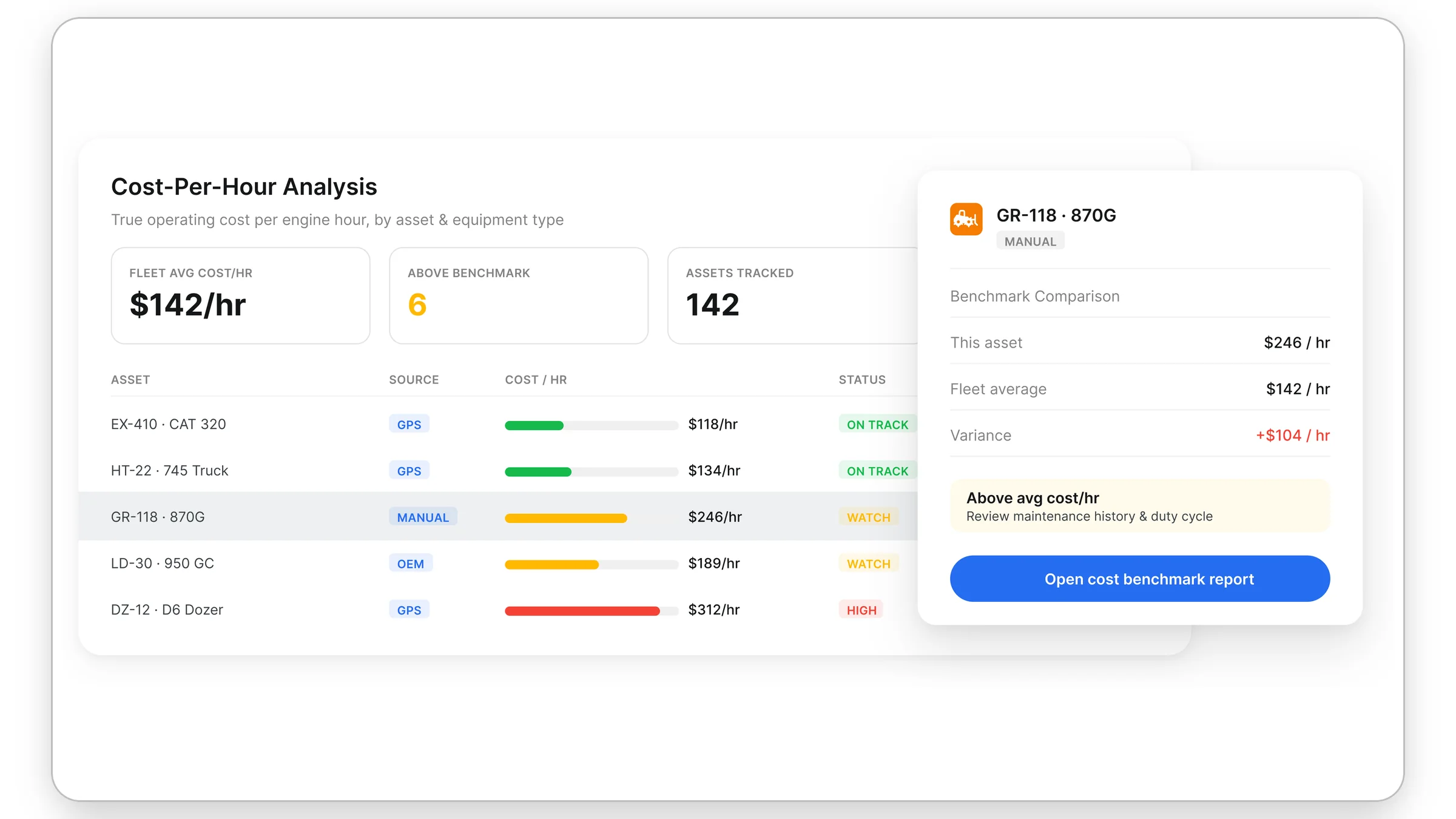
A fleet-native platform is the right answer when you have EAM-grade questions about expensive, long-lived equipment but your operation runs in the field, not in an office, which describes the large majority of construction and heavy-equipment fleets. It is the third door the usual comparison leaves out, and for contractors it is often the one that fits.
The logic is simple. You need the repair-or-replace answer, the cost-per-hour, the equipment utilization picture, and the replacement timing (the questions an EAM is built for), but you also need an hour-based PM that fires from telematics on a job site, an inspection that becomes a work order offline, a rented machine tracked beside an owned one, and labor and parts that post to the right job in your ERP without being retyped (the operations a fleet lives on).
A facilities CMMS gives you the second half and not the first. A full EAM suite gives you the first half in a form too heavy and too office-bound for the yard, and asks for a 12-to-18-month rollout to do it.
Clue is a fleet-native platform built to carry both halves. It runs the daily equipment maintenance and carries the equipment economics layer that answers the lifecycle questions.
The test for whether this is your lane has two parts. Are your most valuable assets mobile, hour-metered, and split across job sites? Do you need to know whether they are maintained? Do you need to know whether each one remains worth owning? If yes, a platform designed for fixed plant in either the CMMS or EAM camp will fight your operation. A fleet-native tool will fit it.
When Is a Fleet-Native Platform the Wrong Choice?
A fleet-native platform is the wrong choice when equipment is not where the value, the cost, and the work actually sit.
Sometimes the fleet is not the problem. If most of the asset value sits in buildings, plants, land, or linear assets such as roads and pipelines, equipment is a minority of the portfolio. A fleet tool then puts the smaller asset class at the center. Buy for where the money is, and let the fleet view feed the main system.
Sometimes finance has to own the asset record. If depreciation, book value, and disposal must live in one audited system alongside the general ledger, and the controller will not accept a feeder system, that is an EAM or ERP requirement. A fleet platform supplies cost inputs. It is not the book of record.
Sometimes the real problem is discipline, not software. If PMs are missed because nobody owns them, a new platform moves the problem to a new screen. A simpler CMMS the crews actually use beats a broader platform they route around.
And sometimes the rules choose the system. Public agencies and operators in regulated fields often carry reporting duties that name the system of record, along with the retention and audit trail it has to keep. That requirement outranks fit.
The honest test is whether equipment is where the value and the pain both sit. If it is not, the third door is the wrong door, and saying so costs nothing.
How Do You Calculate Equipment Cost Per Hour?
Equipment cost per hour is the machine’s ownership rate per hour plus its operating rate per hour. The US Army Corps of Engineers publishes the method the construction industry treats as the reference. It is Engineer Pamphlet EP 1110-1-8, the Construction Equipment Ownership and Operating Expense Schedule.
Ownership covers what the machine costs you to have. It has two elements.
Ownership rate per hour = depreciation per hour + facilities capital cost of money per hour
Depreciation uses the straight-line method. Take the total equipment value, subtract estimated salvage and tire cost, then divide what is left by the machine’s expected economic life in operating hours. Facilities capital cost of money is the cost of the capital tied up in the machine, defined in FAR 31.205-10.
Operating covers what the machine costs you to run. It has five elements, no more.
Operating rate per hour = fuel + FOG + repairs + tire wear + tire repair
FOG is filters, oil, and grease, and it includes servicing. Repairs include maintenance and major overhauls. Tire wear means replacement, and tire repair is counted separately.
The reason this method matters is that every line traces to a named cost. A contractor can defend the number to an owner, an auditor, or a claim. A spreadsheet average cannot do that.
The hours denominator is where fleets usually break. Economic life is measured in operating hours, so the rate is only as good as the hour reading behind it. ISO/TS 15143-3:2020, the telematics standard most OEMs publish to, carries cumulative operating hours, cumulative fuel, and idle time straight off the machine. That takes the hand-entered hour meter out of the calculation.
Most fleets remain unable to produce this number per machine. The inputs sit in four places. The maintenance system. The fuel card. The telematics feed. The accounting ledger. Pulling them together is the work. Neither a facilities CMMS nor a plant-oriented EAM does it for equipment that moves.
Take a dozer as a worked example. These input values are illustrative, not benchmarks, so use your own fleet’s numbers and the cost of money rate from the current schedule.
| Line | How it is derived | Rate per hour |
|---|---|---|
| Total equipment value | $450,000 | |
| Salvage value at 20% | $90,000 | |
| Economic life | 10,000 operating hours | |
| Depreciation | ($450,000 - $90,000) / 10,000 hours | $36.00 |
| Facilities capital cost of money | $270,000 average value x 3% / 1,200 hours a year | $6.75 |
| Ownership rate | $42.75 | |
| Fuel | $28.00 | |
| FOG (filters, oil, grease) | $4.00 | |
| Repairs | $22.00 | |
| Tire wear and tire repair | tracked machine, no tires | $0.00 |
| Operating rate | $54.00 | |
| Total cost per hour | $96.75 |
The dozer costs $96.75 per hour all in. That is $42.75 for ownership and $54.00 for operating. Repairs at $22.00 per hour are the line that moves with age, while depreciation is fixed at purchase. This is the number a fleet can defend, and the number that makes the next comparison possible.
When Does Cost Per Hour Say Replace Instead of Repair?
Cost per hour says replace when a machine’s cost-per-hour trend climbs above what the machine that would replace it costs per hour over the same expected hours.
There is a trap in the federal schedule worth knowing. EP 1110-1-8 leaves replacement cost out of the hourly rate on purpose, because replacement cost is not an allowable item of cost under FAR 31.105. So cost per hour, on its own, can never answer repair-or-replace. It tells you what the machine costs to own and run. It says nothing about what the alternative costs.
The method is to put both paths in the same unit. State the current machine as cost per expected operating hour, using its recent closed periods. State the replacement machine the same way, including its own depreciation and cost of money. A repair quote and a purchase price cannot be compared directly. Cost per hour against cost per hour can.
Run the same dozer against the machine that would replace it, on the same 10,000-hour life and the same 1,200 hours a year.
| Line | Current dozer | Replacement dozer |
|---|---|---|
| Total equipment value | $450,000 | $520,000 |
| Salvage value at 20% | $90,000 | $104,000 |
| Depreciation per hour | $36.00 | $41.60 |
| Facilities capital cost of money per hour | $6.75 | $7.80 |
| Ownership rate per hour | $42.75 | $49.40 |
| Fuel per hour | $28.00 | $24.00 |
| FOG per hour | $4.00 | $4.00 |
| Repairs per hour | $22.00 | $9.00 |
| Operating rate per hour | $54.00 | $37.00 |
| Total cost per hour | $96.75 | $86.40 |
| Cost at 1,200 hours a year | $116,100 | $103,680 |
Read the two columns and the call is clear. The replacement machine costs more to own, $49.40 against $42.75, because a higher purchase price carries more depreciation and more capital. It still wins by $10.35 an hour, because repairs drop from $22.00 to $9.00 and fuel drops with it. That is $12,420 a year on one machine, and it is invisible to anyone comparing a repair quote against a purchase price.
Two things keep the call honest. A single large repair is not the signal, a rising trend across several periods is. And utilization belongs in the decision, because a machine at a high cost per hour running 1,200 hours a year is a different call from the same machine at 300 hours. The rate can match while the annual bill does not.
This is the calculation that sits above a CMMS and below a full EAM. A CMMS holds the repair history but not the ownership cost. An EAM holds the ownership cost but rarely the engine hours. That gap is where most construction fleets live.
How Much Do CMMS and EAM Cost, and How Long to Implement?
The cost and timeline gap between a CMMS and an EAM is large and consistent. Exact figures vary by vendor and fleet. The ranges below offer orientation. Real quotes should confirm them before you budget. The direction is well established across the industry. A CMMS is cheaper. It deploys in weeks. An EAM has a higher price by a wide margin. It deploys in many months to well over a year.
In rough terms, a modern cloud CMMS is often live in roughly 30 to 45 days, while a full EAM suite commonly runs 12 to 24 months to implement, reflecting the cross-department scope it touches. Software cost scales the same way. CMMS licensing typically lands in the low tens of thousands of dollars range for a mid-size operation. Enterprise EAM programs (licensing plus services plus integration) routinely reach the mid-six figures and up.
Those specific dollar figures circulate mostly through vendor guides and should be re-checked for your scale and region. The shape is not in dispute. EAM’s lifecycle advantage comes with higher cost, more IT overhead, and a longer road to value.
Two cautions for the budget. First, cost the whole thing, not the license. Include implementation, data migration, integration labor, training, and annual escalation. Integration labor includes your own IT hours. Those hours do not appear on the quote. Second, match the spend to the problem. A five-figure CMMS your crews use transforms more operations than a six-figure EAM maintenance teams work around.
Why Do CMMS and EAM Implementations Go Wrong?
These projects go wrong on selection and on people, far more often than on software.
Start by dropping the folklore. The claim that “70% of ERP implementations fail” gets repeated everywhere with no traceable study behind it, and vendor articles quote anything from 55% to 75% without naming a source. Treating that as fact makes a normal project look doomed before the work starts.
The best available primary data says something less dramatic. Panorama Consulting Group’s 2026 ERP Report collected data from January 2025 to January 2026 across 170 respondents, with a median annual revenue of $200.5 million and a median project timeline of 9 months. More than a quarter of organizations reported that their project was over budget. Almost a quarter reported that it was over schedule. Those are cost and time figures, not a pass-or-fail verdict.
For the projects that ran over budget, the most common reason was the unexpected need for additional technology, which the report ties back to poor system selection. Organizations find a fatal misfit late, then patch it with more tools, more scope, and custom builds. For a fleet buyer the lesson is that the overrun starts at selection, not at build.
For the projects that ran over schedule, the most common reason was organizational. It was governance, resistance to change, and process redesign. The report gives the example of process owners resisting a standardized chart of accounts. That sends the design through another round. The delay is agreement, not code.
For a construction fleet that narrows to two questions worth settling before you sign. Whose number wins when the shop and the back office disagree. And which system holds the machine record, given the shop owns hours and service history while finance owns purchase cost and depreciation. Both are organizational questions, not technical ones.
A short, structured pilot on your two riskiest workflows is the cheapest insurance against both.
How Do You Choose Between CMMS, EAM, and a Fleet Platform?
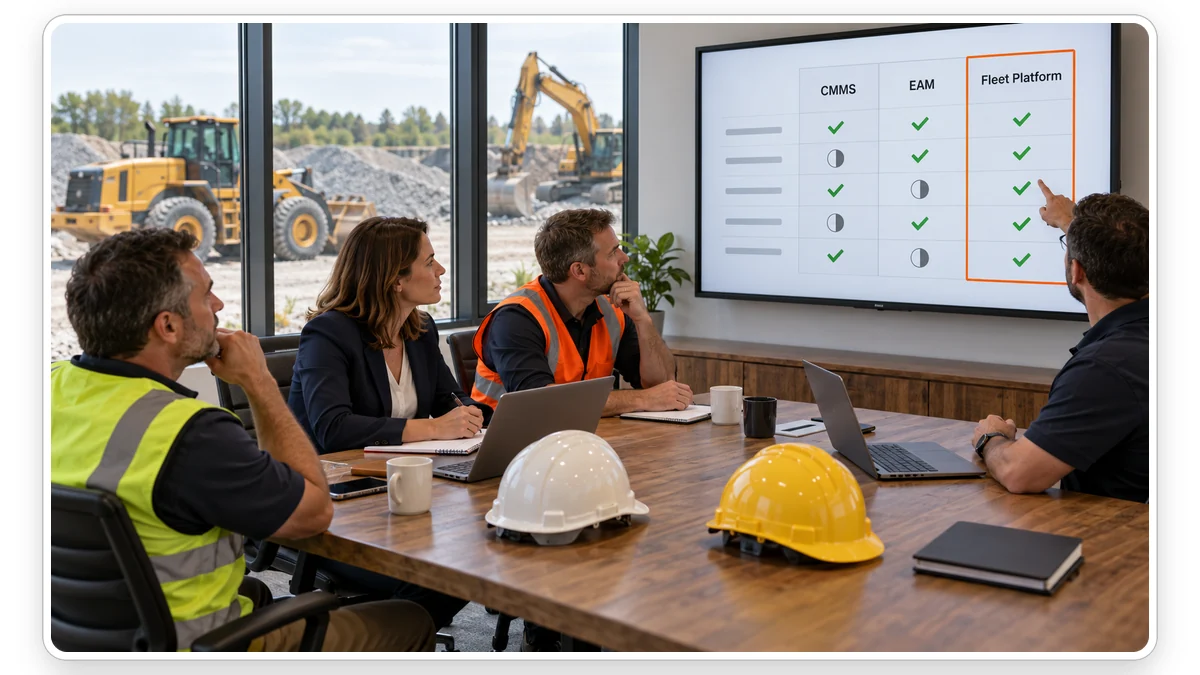
You choose by answering a short set of questions about your assets, your stakeholders, and your operating environment, and letting the answers point to one of the three doors. The decision is more reliable when you score it deliberately than when you react to a demo.
Work through these in order:
- What are your most valuable assets, and are they mobile? If they are hour-metered machines moving between job sites, that pushes you away from fixed-plant tools in both the CMMS and EAM camps and toward a fleet-native platform.
- Who needs the asset data? If it is the maintenance team, you need maintenance software. If your CFO, procurement, and capital planning functions need direct access, you are moving toward EAM.
- How far does the data need to reach? Light, task-driven links to your ERP point to a CMMS or fleet platform. Deep integration with finance, GIS, and building systems points to EAM.
- What is the real problem? Reactive breakdowns and missed PMs are a CMMS problem. Capital misallocation and no lifecycle visibility are an EAM problem. Both at once, on mobile equipment, are a fleet-platform problem.
- And how many asset classes do you manage? One asset class, equipment, favors a focused tool. Many asset classes, including equipment, buildings, roads, and land, favor an EAM.
Two rules keep the choice honest. Define your non-negotiables before the first demo, so a polished pitch cannot quietly rewrite your requirements. And whichever direction you lean, run a short structured pilot on your two riskiest workflows before you sign, using your own fleet and data rather than a demo account.
What Should a Fleet Platform Integrate With to Replace Separate CMMS and EAM Tools?
A fleet platform earns the right to replace separate maintenance and lifecycle tools only if it connects cleanly to the surrounding systems, because the value of consolidating is lost the moment your team is back to entering data twice. Integration is where the three-in-one promise is proven or broken.
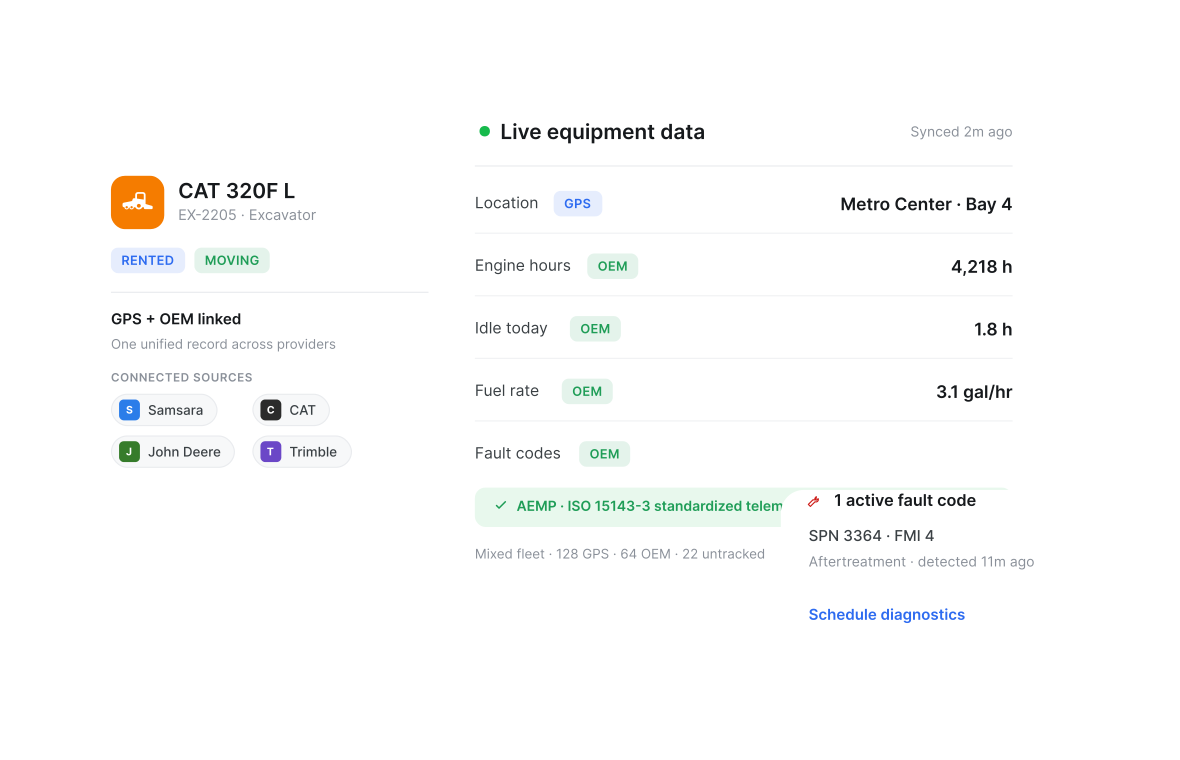
At minimum, confirm three connections. First, confirm telematics and OEM feeds, ideally through the ISO/TS 15143-3:2020 standard, still widely called AEMP 2.0. This lets engine hours, odometer, and fault codes arrive automatically rather than by hand, across the mix of brands in your yard. Second, confirm your ERP and job-costing system. This lets completed work post labor, parts, the asset, and the right project and cost code without re-entry. This is the connection that most often decides whether a platform actually saves time. Third, confirm payroll, where mechanic and operator time flows through without a second keying.
For each one, ask the vendor to demonstrate the specific records moving in both directions using your configuration, and ask what happens when a sync fails, rather than accepting a logo on an integrations page as proof.
Where Clue Fits
Clue fits the third door. It is a fleet-native platform built for construction and heavy equipment. It runs daily maintenance. It carries the equipment-economics layer that answers lifecycle questions. It does this without the weight of a full enterprise EAM. The design principle is a single source of truth. Every machine a company owns, rents, or operates lives in one place. Data is entered one time. It flows to every place that needs it.
It runs the maintenance a CMMS would, built for the field. Preventive maintenance triggers on hours, mileage, or dates using engine data from connected telematics. A failed inspection becomes a work order before the operator leaves the cab. The mobile app captures inspections and hours offline.
It closes the field-to-shop-to-ERP loop that double-entry usually breaks. It has native two-way sync to Trimble Viewpoint Vista and Spectrum and a connection to HCSS HeavyJob. It exports in the exact format the back office expects. It also carries the lifecycle layer that would otherwise send you shopping for an EAM. Fleet financials show revenue, cost, and margin per asset and per project. They surface the machines running a negative margin as an action rather than a number. This turns cost tracking into a repair-or-replace decision.
Predictive risk scoring flags failures before they land, a conversational AI assistant answers questions like “which equipment is down,” and enterprise fundamentals (SOC 2 Type II, SSO, role-based access, and 600K+ assets under management) mean it holds up as infrastructure.

Key Terms, Defined
These are the terms used in this guide.
- CMMS. A computerized maintenance management system plans and records maintenance work, parts, labor, and equipment history.
- EAM. Enterprise asset management tracks work, cost, risk, and value across an asset’s full life.
- ERP. Enterprise resource planning connects the core business records for finance, purchasing, payroll, inventory, and projects.
- APM, asset performance management. Uses condition, reliability, and risk data to improve uptime and guide maintenance choices.
- ALM, asset lifecycle management. Covers decisions and records from asset planning and purchase through use and disposal.
- Total cost of ownership, TCO. The full cost to buy, own, run, maintain, and dispose of an asset.
- Economic life. The useful life used for cost calculations, measured in operating hours for construction equipment, not years.
- Facilities capital cost of money, FCCM. The cost of capital tied up in a machine, as defined in FAR 31.205-10.
- Book value. An asset’s recorded cost minus accumulated depreciation and any recorded impairment.
- MTBF, mean time between failures. The average operating time from one repairable failure to the next.
- Cost per hour. The ownership rate plus the operating rate for one operating hour.
Comparing failure data between organizations is harder than it sounds. ISO 14224:2016 is the international standard for collecting and exchanging reliability and maintenance data. It standardizes the equipment, failure, and maintenance data categories that make those comparisons possible. It was written for the petroleum, petrochemical, and natural gas industries.
Final Thoughts
The CMMS vs EAM question has no universal answer. In most cases, it is the wrong question for a fleet. The right one is a three-way decision. Your asset profile and your stakeholders drive it. A facilities CMMS fits if your sole problem is maintenance execution on contained assets. A full EAM fits if finance and capital planning run your asset decisions across a diverse, multi-site portfolio. A fleet-native platform fits if you have EAM-grade questions about expensive, mobile, hour-metered equipment and CMMS-grade operations in the field.
Clue brings the maintenance, telematics, utilization, dispatch, and equipment-economics data construction fleets need into one place, so if your machines run on hours and move between sites, it belongs on your shortlist.
Frequently Asked Questions
What Is the Main Difference Between a CMMS and an EAM?
A CMMS manages maintenance execution (work orders, preventive maintenance, inspections, and parts), while an EAM manages the entire asset lifecycle. It adds capital planning, total cost of ownership, depreciation, and procurement on top of the same maintenance capabilities. The simplest way to remember it is this. A CMMS asks whether an asset is being maintained. An EAM asks whether you should still own it. An EAM includes CMMS functionality and extends it, which is why the two overlap so heavily in vendor marketing.
Do I Need a CMMS or an EAM for My Construction Fleet?
It depends on your asset profile and who uses the data, but most construction fleets fit neither category cleanly and are better served by a fleet-native platform. Heavy equipment raises EAM-style questions (repair-or-replace, cost per hour, replacement timing) while running on CMMS-style daily operations in the field. A facilities CMMS usually misses the fleet reality, and a full EAM is heavier and slower than most contractors need, so a platform built for mobile, hour-metered equipment is often the right answer.
What Is the Difference Between a CMMS, an EAM, and an ERP?
A CMMS runs maintenance work, an EAM runs the asset’s financial life, and an ERP runs the company’s money and projects. A CMMS holds work orders, service plans, and parts usage. An EAM holds asset value, lifecycle decisions, and disposal. An ERP holds the general ledger, job costing, and company finance. An EAM and an ERP overlap on asset value and depreciation, and that overlap is the most common reason an implementation stalls, because finance already owns the ledger. For most contractors the ERP stays. The only question is what feeds it.
Can Your ERP Replace a CMMS or an EAM?
Usually it can hold the asset’s money, not the maintenance work. Most construction ERPs include an equipment or maintenance module, and that module is built for job costing rather than for the shop. It often lacks engine-hour triggers, mobile inspections, offline capture, and parts issue at the bench. The practical test is whether a mechanic will use it in the field with dirty hands and no signal. If the tool slows the work, the records fall behind. The common answer is to keep the ERP as the financial record and feed it from the system the shop actually works in.
Is an EAM Just a More Expensive CMMS?
Not quite. An EAM is more expensive. The cost buys a broader scope. It includes financial lifecycle management, capital planning, depreciation, and portfolio-level analysis. A maintenance-focused CMMS does not include these capabilities. The question is whether those capabilities map to a problem you have. If your pain is reactive breakdowns and missed PMs, the extra EAM layer is cost without benefit. If your pain is capital misallocation and no lifecycle visibility across many assets, it earns its price.
How Much Longer Does an EAM Take to Implement Than a CMMS?
Considerably longer. A modern cloud CMMS is often live in roughly 30 to 45 days, while a full EAM suite commonly takes 12 to 24 months because it touches finance, procurement, and multiple departments. Those figures vary by vendor and scale, so verify them for your situation. The gap is consistent. EAM’s broader scope comes with a longer, more complex rollout and a longer road to measurable value.
Can You Use a CMMS and an EAM Together?
Yes. Many organizations run a blended model, with maintenance execution in a CMMS layer and lifecycle, financial, and capital planning in an EAM layer, and a CMMS can operate as a component of a broader EAM strategy. It is not always an either-or choice. For a construction fleet, though, a single fleet-native platform that carries both the maintenance and the equipment-economics layer often removes the need to run two systems at all.
Does Fleet Maintenance Need a CMMS or an EAM?
Fleet maintenance needs strong CMMS capabilities for work orders and preventive maintenance, and benefits from EAM-style capabilities for vehicle lifecycle costing, optimal replacement scheduling, and TCO-based decisions. That combination is exactly why fleets often outgrow a plain CMMS but do not fit a plant-oriented EAM. A fleet platform is designed to provide both the maintenance execution and the lifecycle costing in one system built for mobile assets.
How Do You Make a Repair-or-Replace Decision Without a Full EAM?
Track true cost per asset over time. Include cumulative maintenance and parts cost, downtime, utilization, and fuel when possible. Tie all of it to the specific machine. With that data, the machines running a negative margin or climbing toward a share of replacement value become visible. This is most of what an EAM’s repair-or-replace module delivers. A fleet platform that captures cost at the work-order level and reports it per asset can produce the same signal without enterprise EAM accounting. The exception is a need for formal depreciation and general-ledger treatment.
What Industries Actually Need an EAM Instead of a CMMS?
Organizations that are asset-intensive, multi-site, and subject to strict rules tend to need EAM. These include utilities, oil and gas, transportation networks, large manufacturers, and public agencies managing diverse asset classes like roads, water systems, and buildings. The common thread is high asset values, long lifespans, formal capital planning, and multiple departments needing access to the same asset system. A single-site operation focused on keeping equipment running tends not to need that breadth.
Is a CMMS Enough to Manage Assets Long Term?
For many operations, yes. If your focus is maintaining current assets efficiently on a contained footprint, a CMMS can serve you well indefinitely, especially one with good ERP integration. You outgrow it when asset lifecycle visibility, capital planning, depreciation, or multi-stakeholder financial accountability become real needs. For construction fleets specifically, a fleet platform that adds equipment economics can extend “long term” further than a plain CMMS without jumping to a full EAM.
How Do APM and ALM Fit Alongside CMMS and EAM?
Asset performance management is the reliability layer that uses condition and history to predict failure. Asset lifecycle management is the cradle-to-grave view of a single asset, from purchase through disposal. Both are disciplines rather than fixed product categories, and vendors attach the labels to CMMS and EAM products alike. Test the capability, not the acronym. Ask to see the prediction run on your own failure history, and ask to see one machine’s full record from purchase order to resale.

Transform Your Equipment Management