



Construction Equipment Work Order Management for Faster Repairs
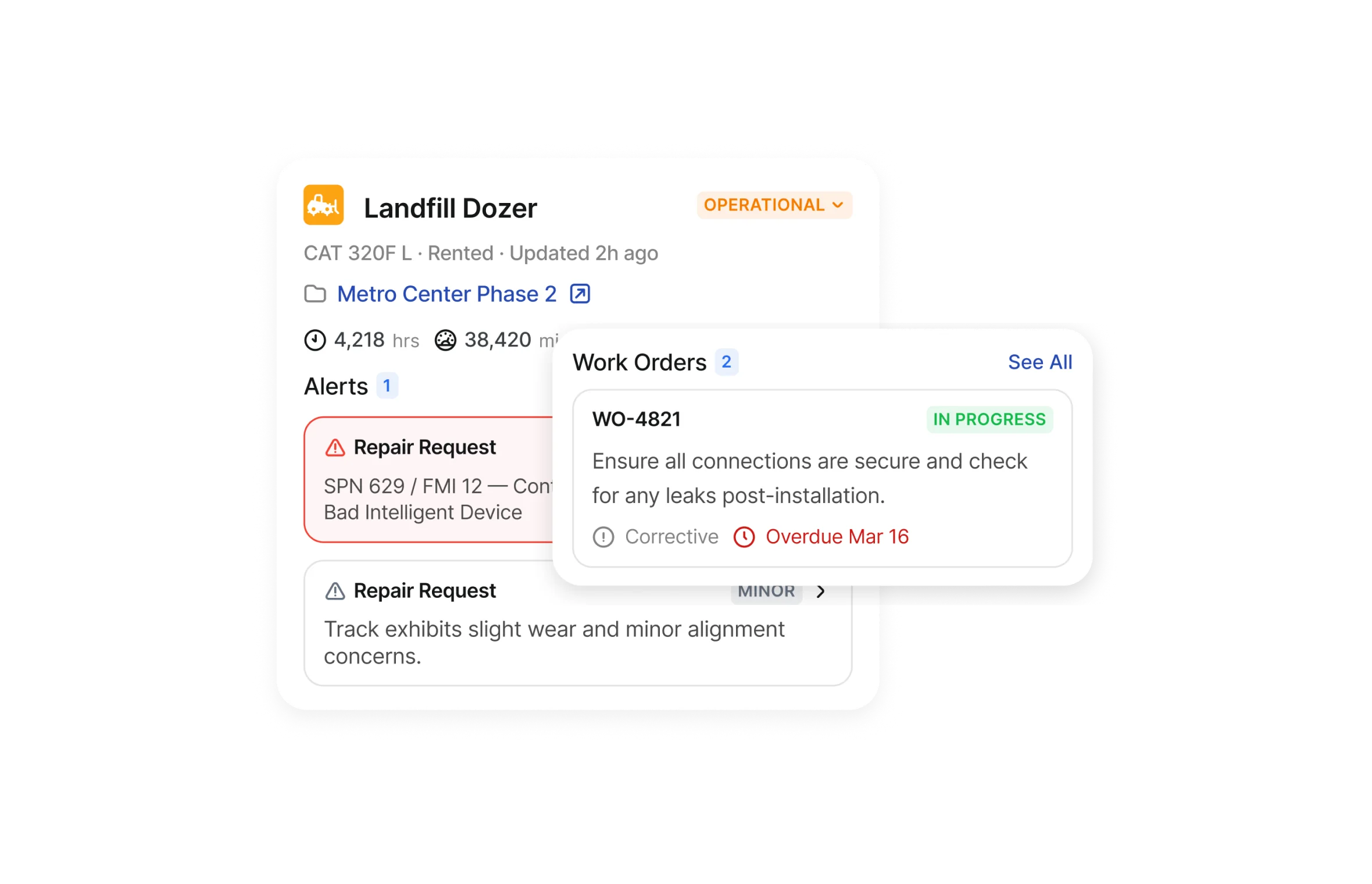
Turn inspection issues, fault codes, PM intervals, and field repair needs into trackable work orders. Clue keeps assignments, parts, labor, photos, status updates, and asset history tied to the repair record from first issue to completed work.




Work order management
One record for every repair. From first issue to closeout.
Turn Inspection Issues Into Repair Work
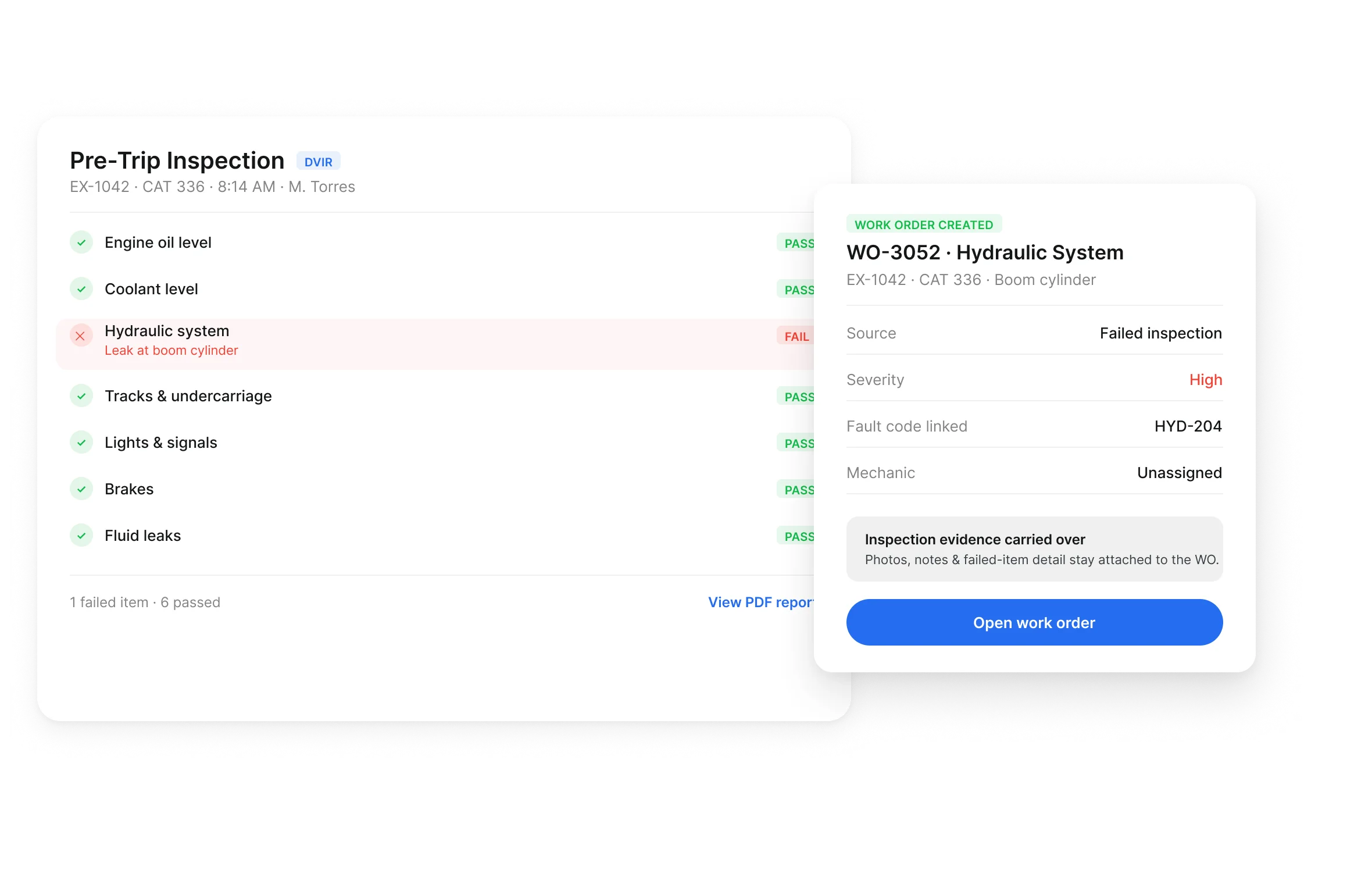
Inspection issues are often the first signal that an asset needs repair, downtime planning, parts, or shop review. The handoff has to preserve that context so the issue stays visible in the queue.
Failed inspection follow-up: Create a work order task when an inspection item is marked failed
Issue details carried over: Keep the asset, issue description, reported severity, and inspection evidence tied to the repair
Fault-code connection: Create repair work from fault codes when diagnostic alerts need maintenance action
Manual work order creation: Open a work order from the asset record or link it to a related issue
Repair history connection: Keep inspection-driven work tied to the asset’s maintenance history
Schedule Work Orders Across the Shop
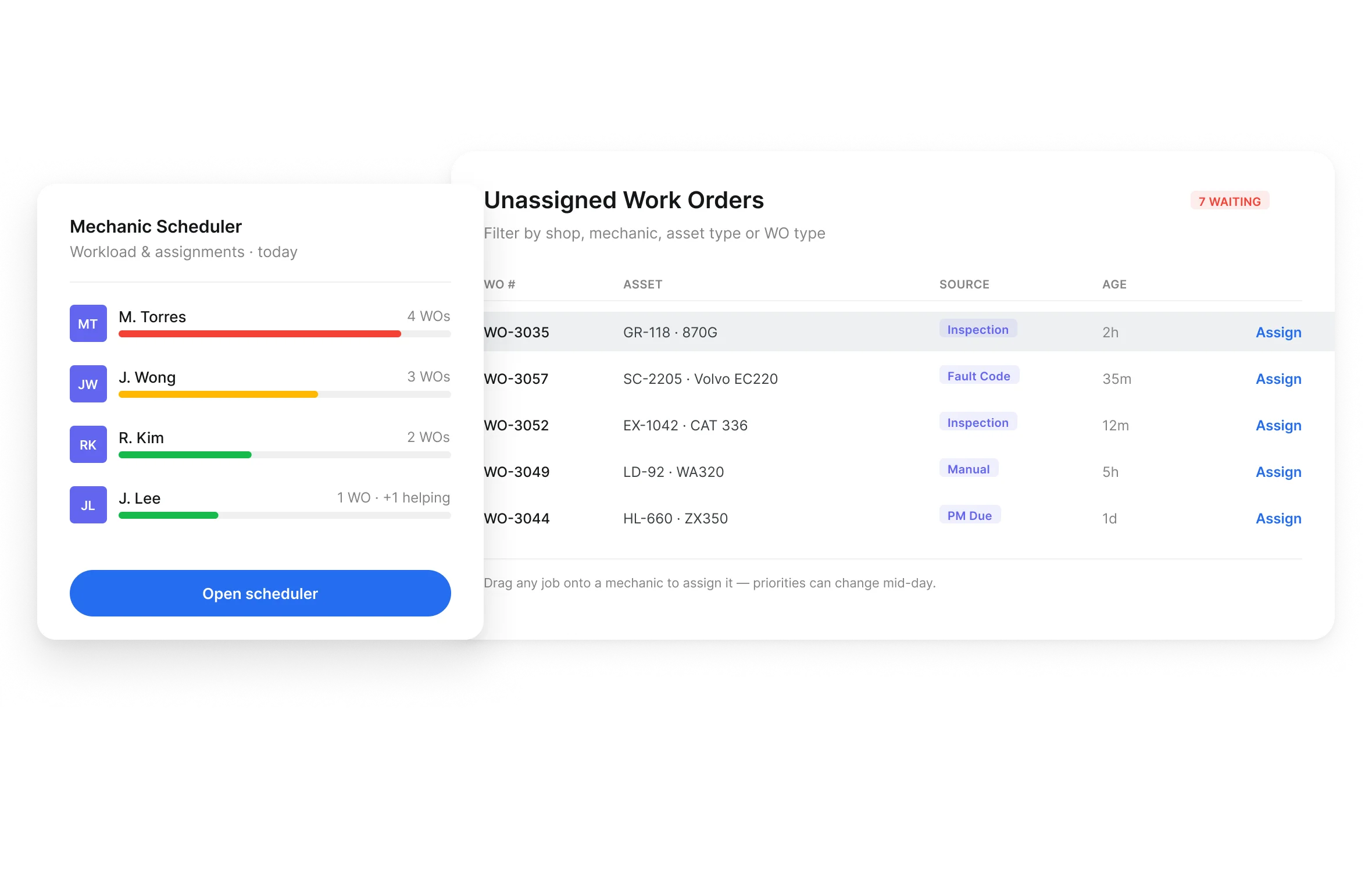
Repairs start sooner once every job has an owner. Shop managers need a clear view of what is waiting, who is assigned, what is scheduled, and where the workload is backing up.
Unassigned WO queue: Surface work orders that still need mechanic ownership
Mechanic scheduler: Review mechanic workload in a day view with color-coded status visibility
Multi-mechanic assignment: Assign more than one mechanic to larger repairs without splitting the record
Drag-and-drop reassignment: Move work orders between mechanics when priorities change
Scheduled work visibility: Review scheduled start and end timing without opening every work order
Calendar filtering: Filter work order schedules by shop, mechanic, asset type, or work order type
Mobile status updates: Let mechanics update work order status from the field or shop floor
Keep Parts Requests Connected to the Repair That Needs Them
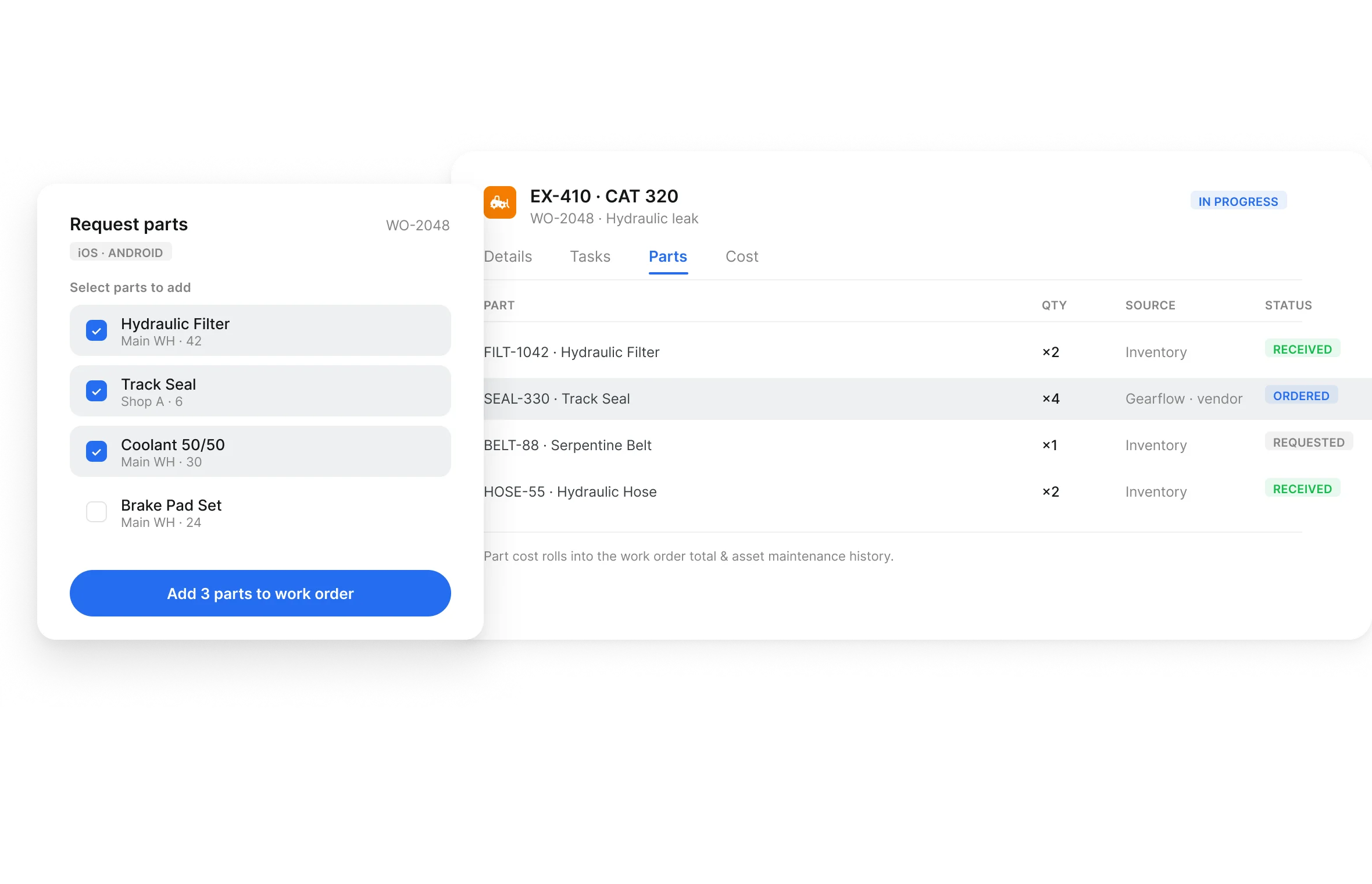
Parts availability determines how fast a work order closes. Clue lets mechanics request parts directly from an open work order so the shop knows what to pull before the repair starts.
Parts request from WO: Request one or multiple parts without leaving the work order
Inventory pull: Add available stock parts to the repair and update inventory counts automatically
Request and order status: Track whether a part is pending, approved, ordered, received, or cancelled
Vendor and delivery visibility: Review quantity, vendor, delivery dates, and order details from the parts workflow
Inventory vs vendor fulfillment: See whether the part came from stock, a vendor, or Gearflow marketplace fulfillment
Parts cost tracking: Roll part costs into the work order total and asset maintenance history
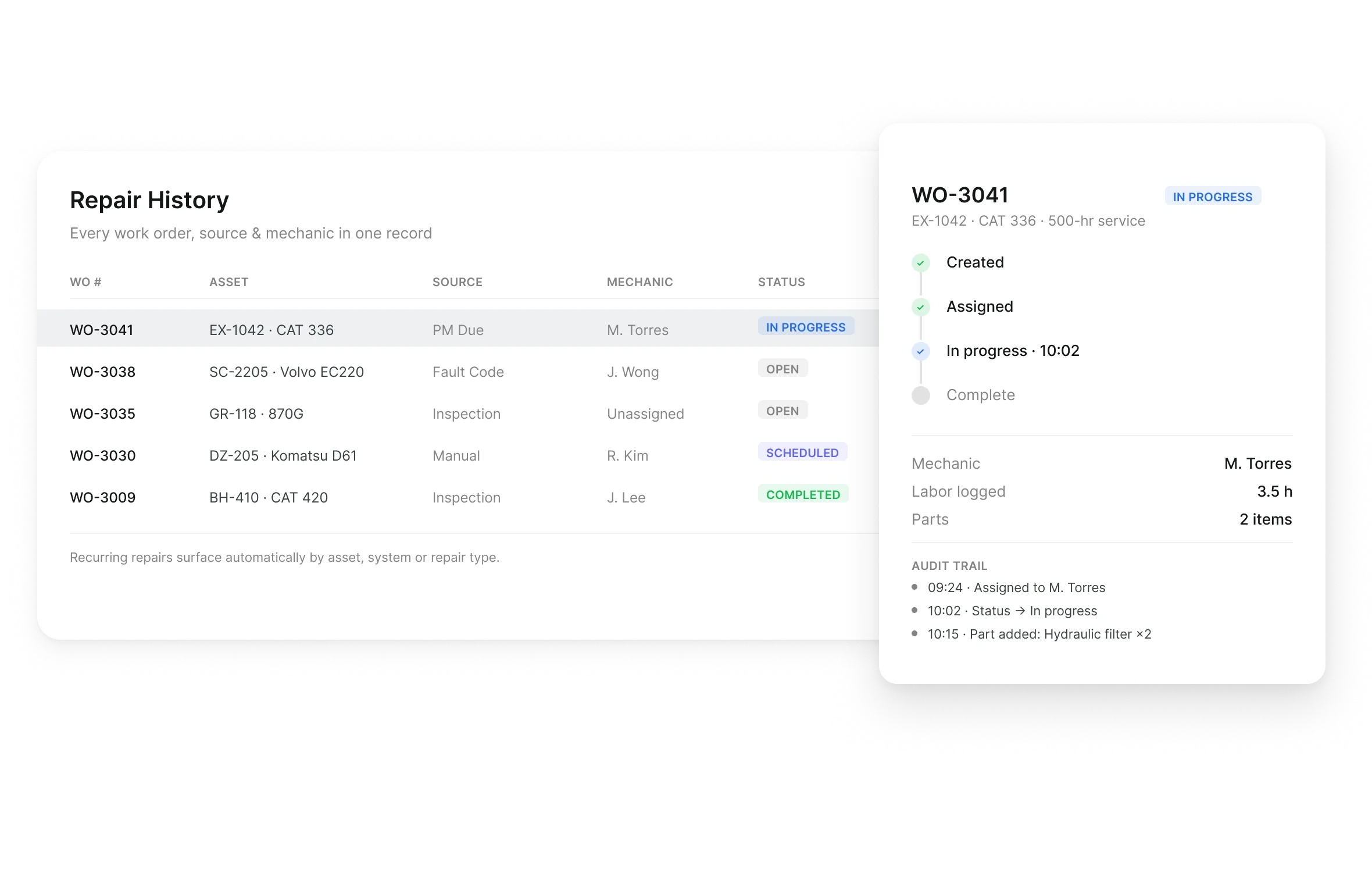
Build an Auditable Repair History for Every Asset
Each work order captures the asset, issue source, mechanic, labor, parts, photos, cost codes, status changes, and repair outcome in one record. Teams can trace what happened, what it cost, and whether the same issue keeps coming back.
Issue source: Track repairs from inspections, fault codes, PM intervals, or manual requests
Mechanic notes and photos: Attach repair notes, field evidence, and completion details
Labor and parts record: Capture mechanic time, parts used, and repair cost
Cost code automation: Auto-fill task cost codes into labor and parts entries for cleaner ERP handoff
Audit trail: Review who changed the work order, what changed, and when
Invoice review: Upload vendor invoices to a work order and flag discrepancies against the repair scope before approval
Recurring repair review: Compare past repairs by asset, system, or repair type
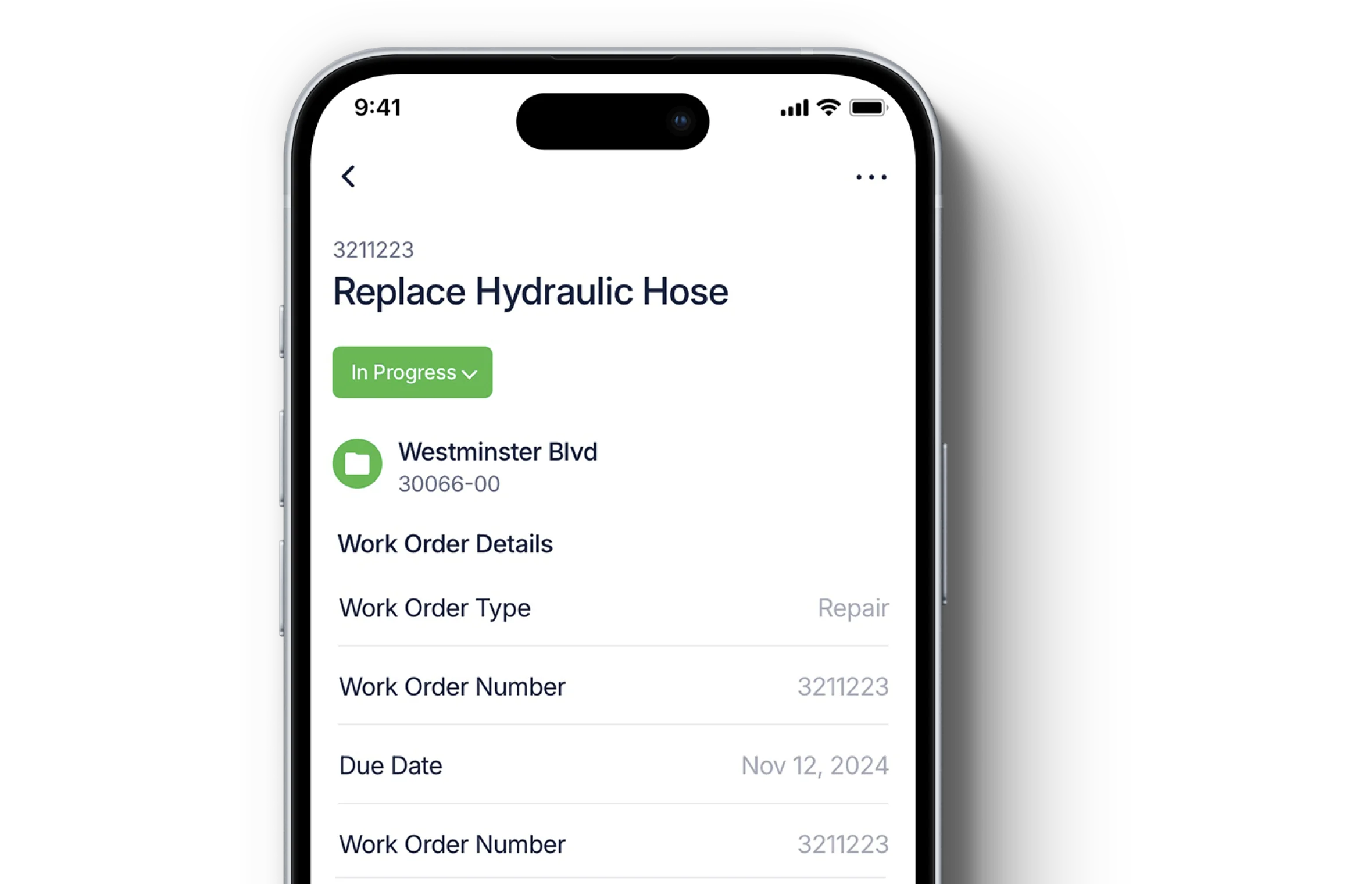
Manage Work Orders From the Mechanic’s Phone
Repair data is most useful when the mechanic captures it at the asset. Mobile work orders keep notes, photos, parts, labor, and status tied to the job as the repair happens, giving the shop a cleaner record and finance a tighter cost trail.
Assigned work: Open assigned jobs from iOS and Android devices
Repair notes: Add findings, comments, and completion details in the field
Photo evidence: Attach issue photos and before-and-after repair images
Parts entry: Request or add parts from the same repair record
Labor capture: Log mechanic time against the job as work is completed
Status alerts: Notify mechanics and managers when assignments or statuses change
PDF records: Download or share the repair record from the work order detail screen
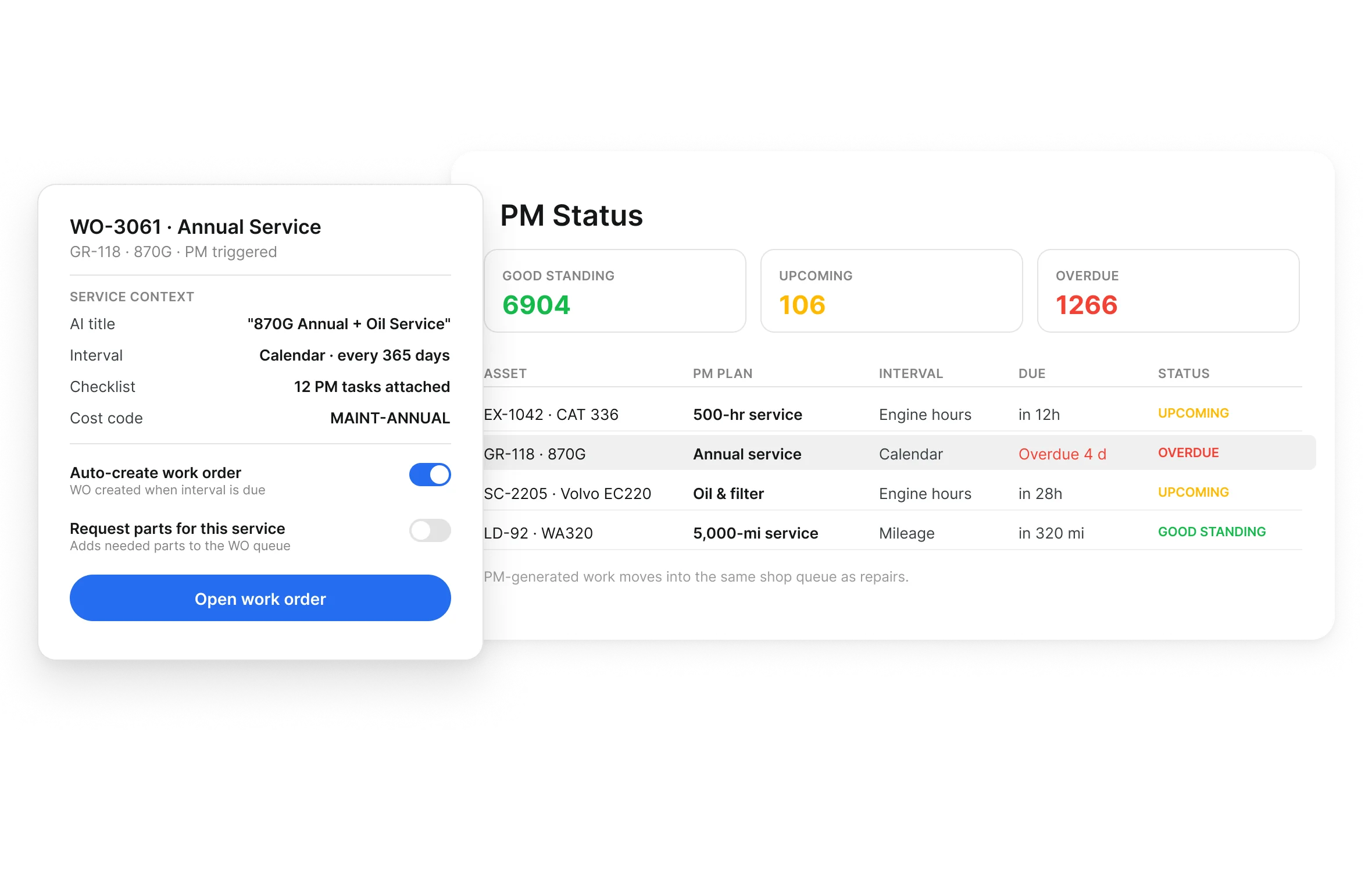
Turn PM Intervals Into Scheduled Work Orders
PM work stays in control when intervals and repairs live in the same place. When a service threshold is reached, Clue creates a scheduled work order with the asset, interval, checklist, tasks, and cost structure already tied to the job.
PM-to-WO automation: Create scheduled work orders from engine hours, mileage, calendar dates, or configured service thresholds
Service task context: Carry PM checklists, service items, and interval details into the work order
Cost code inheritance: Apply default PM item cost codes to labor and parts records
Shop scheduling: Move PM-generated work into the same queue as repair and inspection-driven work
AI work order titles: Generate clear WO titles when PM work is created from multiple service types
Completion tracking: Review whether scheduled PM work orders are open, completed, or overdue
Counter reset: Reset the PM counter from the completion date or current meter reading after service is done
Built for every role
Solutions for every team.
Construction runs on equipment. Clue runs equipment for every team. From mechanics to executives, every role gets the visibility, intelligence, and automation to run modern equipment operations.

Equipment Manager
“It's a single pane of glass where you see everything across your fleet, from the field to the phone to the computer.”
Abe Sharaf
Equipment Manager, Pulice Construction
Read Pulice’s story

Fleet Manager
“Imagine receiving 2,000 spreadsheets that needed to be approved individually in an email. There were entire teams dedicated to that. Now the system is fully automated, completely automated from beginning to end.”
Julio Lopez
Fleet Manager, Fort McKay Group
Read Fort McKay’s story

CFO
“You went from doing two services a day to six services a day. That right there is priceless to me.”
Darrin Sheriff
Director of Maintenance & Purchasing, Palmetto Corp
Read Palmetto’s story

VP of Operations
“The big thing with Clue is that we're able to bridge the gap between our field, our operators in our shop, and other departments. Everybody's bought into Clue now.”
Eric Sellman
COO, Brent Scarbrough & Co
Read Brent Scarbrough’s story

Executive
“We had 20 different logins between all our different softwares and web platforms. Now all that information pulls into one spot and we're able to see it in a single place.”
John Igel
CEO, George Igel Co.
Read Igel’s story

Operations Manager
“The operator's in control of his own destiny. That was a huge reason why not only did I buy into it, but I'm also investing into it for the future.”
Ben Benoit
Operations Manager, Onshore Companies
Read Onshore’s story
Why Clue
Why Construction Maintenance Teams Run Work Orders in Clue
Repair work moves faster when the issue, mechanic, parts, labor, cost codes, and closeout record stay connected.
Every Repair Captured
Failed inspection items and field issues move into the work order flow while the details are still fresh.
Cleaner Shop Priorities
Unassigned work, mechanic workload, scheduled timing, and status changes stay visible so the shop can keep repairs moving.
Parts Tied to the Job
Parts requests stay tied to the repair, giving the shop a clearer view of what is available, ordered, vendor-sourced, or still needed.
Tighter Repair Cost Capture
Labor time, parts used, and cost codes stay connected to the work order, creating a cleaner cost trail per asset.
Planned Work Reaches Execution
PM-triggered work orders enter the same shop queue as repairs, keeping scheduled service from sitting outside the repair workflow.
Better Field-to-Shop Records
Mechanics update notes, photos, labor, parts, and status from the asset, giving managers a cleaner record while the work is still fresh.
Equipment Data Stays With the Repair.
Equipment data and business records can feed the same work order. Clue connects OEM telematics, GPS and aftermarket trackers, and ERP, accounting and CMMS construction systems, so labor, parts and cost codes move without duplicate entry.




























.png)
















From the people who use it every day
What contractors see in the work.
“The big thing with Clue is that we’re able to bridge the gap between our field, our operators in our shop, and other departments.”
Brent Scarbrough & Company
“There were entire teams dedicated to approving spreadsheets one by one.”
Fort McKay First Nation
“The biggest difference has been the user friendliness.”
William A. Hazel
“It exposes dead cost or overhead that maybe we don’t know about because it gets lost in those three different systems.”
Moss Utilities
“Clue’s real-time data capability has completely changed the way we manage our assets.”
Darrin Sheriff, Director of Maintenance and Purchasing
“It was probably taking the better part of a day to combine all the data from the telematics.”
Derek Wolfe, Equipment Manager, George Igel Co.
“Clue allows us to effectively control our operations: financially, effectively and safely.”
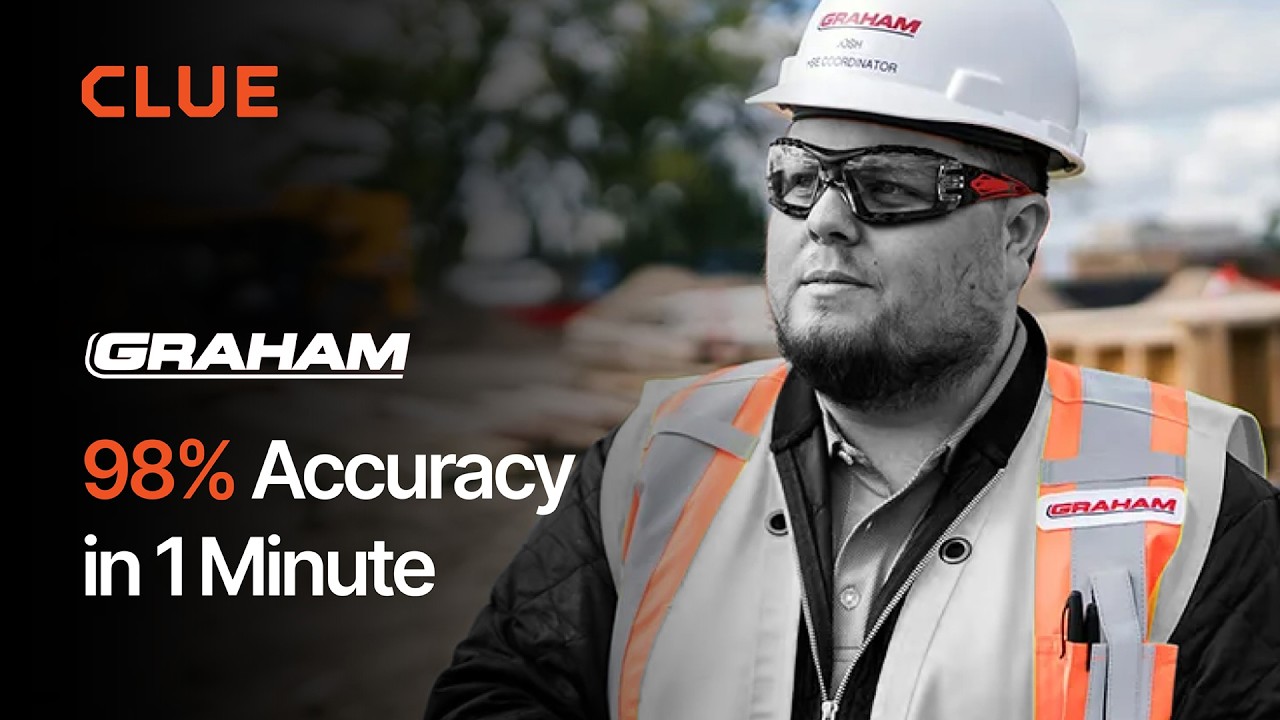
Joseph Yammine, Project Manager, Graham
“QR codes have been a game changer for us with regards to operator inspections.”
Ben Benoit, Operations Manager
“It’s a single pane of glass where you see everything across your fleet, from the field to the phone to the computer.”
Abe Sharaf, Corporate Equipment Engineer
“Our field guys were tired of having a new product, a new something to learn each time.”
Rob Judge, Sr. Procurement & Program Manager
“Our equipment is in far better shape since we started using Clue, for sure.”
Jake Farley, Equipment Manager, Silver Star Construction















Parts Management in Clue: Requests, Delivery Tracking & Inventory
Template Manager in Clue: Inspection Templates, AI Import & Shared Categories
Preventive Maintenance in Clue: Build a PM Plan, Automate Work Orders
Work Orders in Clue: Repair History, Parts, and Labor Costs
Asset Directory in Clue: Saved Views, Bulk Edits & Meters
Common questions
Construction equipment work order management FAQ.
How does Clue create work orders from inspections?
When an inspection item is marked failed, Clue can create a work order task with the asset, issue details, inspection evidence, and maintenance context attached. The issue enters the shop workflow before it gets buried in texts, paper notes, or end-of-day follow-up.
Can mechanics update work orders from mobile?
Yes. Mechanics can use the Clue iOS and Android apps to open assigned work, add notes, attach photos, request or add parts, log labor, update status, and close work orders from the field or shop floor.
How does Clue track parts used in a work order?
Parts can be added from inventory, requested from the work order, or tracked through vendor fulfillment. Clue keeps the part, quantity, vendor, cost, and request status tied to the repair so parts usage stays connected to the work order and asset history.
Can Clue automatically create work orders for preventive maintenance?
Yes. When a PM threshold is reached, Clue can create a scheduled work order with the asset, service interval, checklist context, and service tasks attached. PM-generated work orders stay in the same shop workflow as repairs and inspection-driven work.
Can multiple mechanics work on the same work order?
Yes. Larger repairs can involve more than one mechanic on the same work order. This helps shops assign complex jobs without splitting the repair record across separate tickets.
How does Clue help track labor and cost codes on work orders?
Mechanics can log labor directly inside the work order. Labor time, parts used, and cost codes stay tied to the repair record, giving teams cleaner maintenance cost data for reporting, approvals, and ERP handoff.
Can Clue connect work order data with ERP or CMMS construction workflows?
Yes. Clue can connect work order data with ERP and CMMS construction workflows so labor, parts, cost codes, and completed repair details can move into accounting, job costing, payroll, and reporting systems without duplicate entry.
Can Clue check vendor invoices against work order scope?
Yes. AI Invoice Review lets teams upload a vendor invoice to a work order, then checks it against the work order scope and flags discrepancies before approval.