What is Component-Level Tracking?
What is this?
Most fleet software tracks equipment as a single unit. "D6 Dozer needs an oil change." That works fine for 9 out of 10 contractors. But some organizations need to go deeper. They need to track the engine inside the D6 as its own thing, with its own serial number, maintenance history, hours, and costs. Separate from the dozer it sits in today.
That is what component-level tracking does. It breaks a piece of equipment into its major systems and components, each with its own lifecycle. When you pull an engine out of one machine and drop it into another, the engine's full history moves with it.
A real example
You have a CAT D6 Dozer. At the standard level, Clue tracks the dozer as one asset: work orders, costs, PM schedules, fault codes. All tied to "D6 Dozer #42."
With component-level tracking, the D6 becomes a tree:
- D6 Dozer #42 (the asset)
- Diesel Engine (SN: CAT-3406E-7821) -- 12,400 hours, 3 rebuilds, K lifetime cost
- Transmission (SN: PS-4500-2291) -- original, no rebuilds
- Hydraulic System
- Main Pump (SN: HP-220-4412) -- replaced 2024
- Control Valve
- Undercarriage -- track pads, rollers, idlers
Now when you pull that engine and install it in a different dozer, the engine record moves. Its 12,400 hours, 3 rebuilds, and K cost history follow it. The old dozer gets a new engine record. The data stays clean.
Do you need this?
You probably do NOT need this if:
- Your fleet is mostly trucks, pickups, and light equipment
- You rarely swap major components between machines
- You track maintenance at the asset level and that works fine
- Your team is small and you want to keep things simple
Standard Clue asset tracking handles all of this. Work orders, PM schedules, fault codes, costs -- all at the asset level. No components needed.
You probably DO need this if:
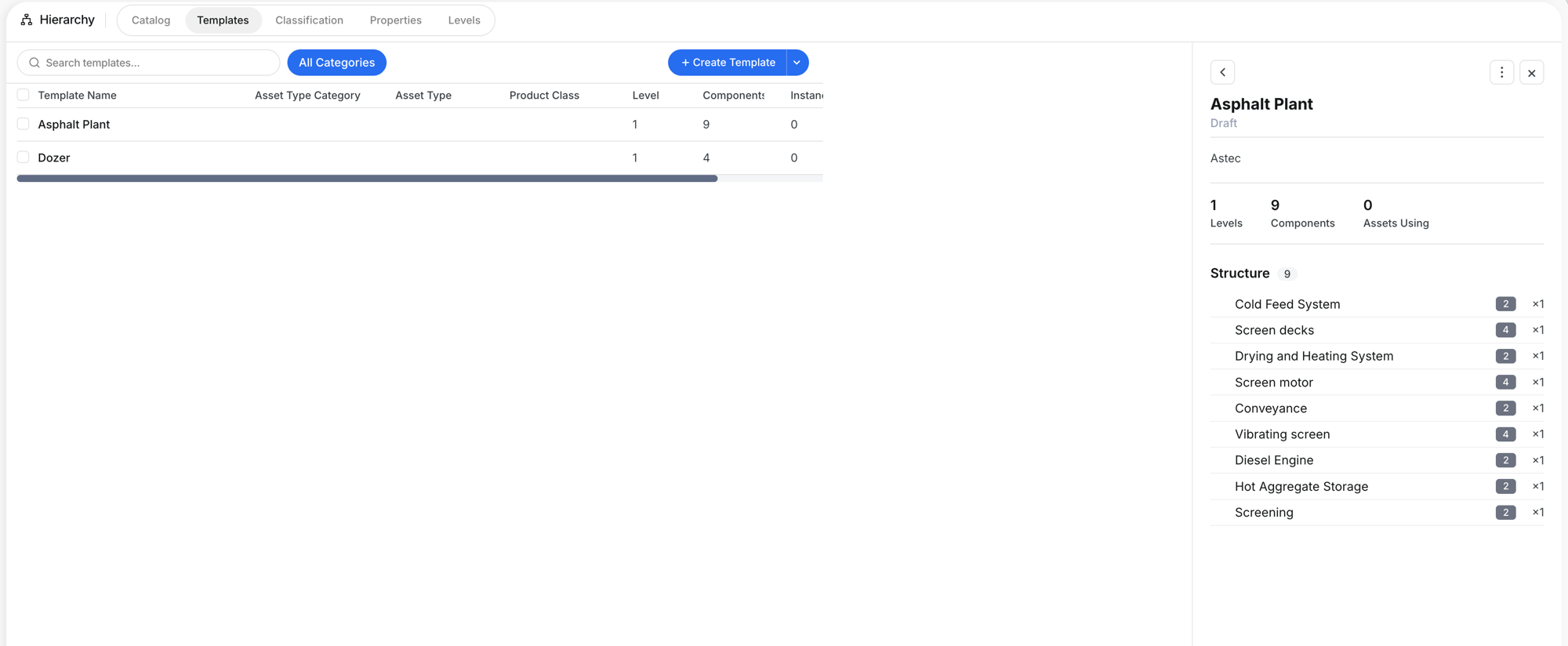
- Asphalt plants and batch plants -- dozens of systems (cold feed, screening, drying, conveyance) that each need their own PM schedules and failure tracking
- Drilling rigs and boring machines -- high-value components that get rebuilt and swapped regularly
- Mining equipment -- engines and transmissions worth K+ that move between machines over their lifetime
- Crane fleets -- booms, winches, and outriggers tracked separately for inspection compliance
- Any equipment where one component costs more than some entire machines in your fleet
What it gives you
- Component-level PM schedules. The engine gets its own PM interval. The hydraulic pump gets its own. They do not have to match the asset's schedule.
- Separate cost tracking. Know exactly how much you have spent on the engine vs. the transmission vs. the undercarriage. Make rebuild-or-replace decisions with real numbers.
- Transfer history. When a component moves to a new machine, its full history goes with it. No lost data.
- Failure analysis by component type. "How often do hydraulic pumps fail across my fleet?" becomes an answerable question.
- ISO-14224 compliance. The hierarchy follows the international standard for equipment reliability data.
How it works
The system has three layers:
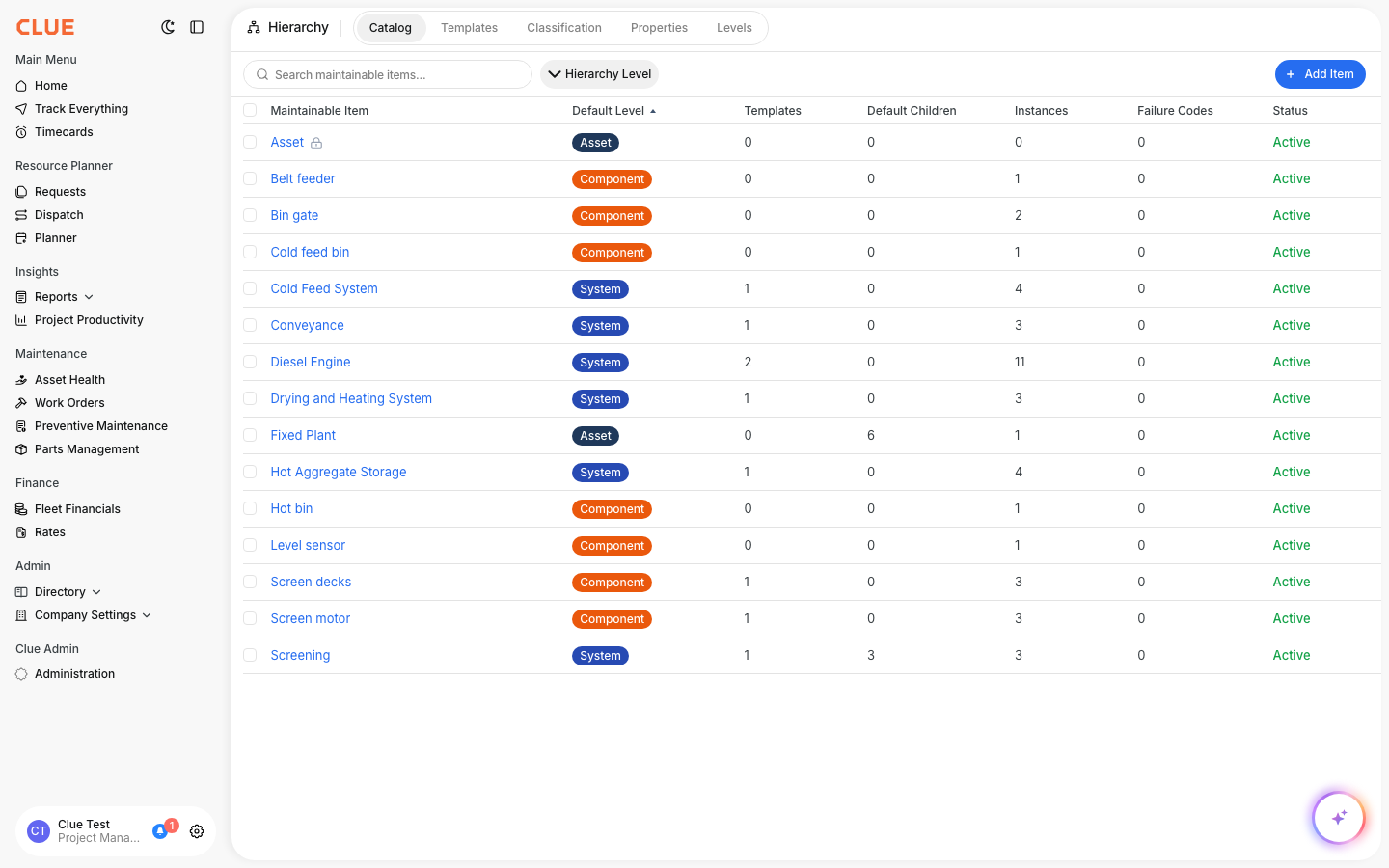
- Catalog -- a library of component types (Diesel Engine, Hydraulic Pump, Screen Motor). Defines what exists.
- Template -- a bill of materials for a specific equipment type. "An Asphalt Plant has these 9 systems." Build once, reuse.
- Instance -- the actual component on a specific machine, with its own serial number and history.

You set up the catalog and templates once. Then create instances on your assets. From there, maintenance, costs, and failures get tracked at the component level automatically.
Getting started
If this sounds right for your operation, here is the path:
- Understanding the Component Hierarchy -- how Catalog, Template, and Instance fit together
- Managing the Component Catalog -- setting up your library of component types
- Creating Equipment Templates -- building the bill of materials for your equipment
Tips
- Start with one equipment type. Pick your most complex or expensive asset class. Build the template, create instances on a few machines, and see if the data is useful before rolling out fleet-wide.
- You do not need to track every bolt. Start at the System level (Engine, Transmission, Hydraulics). Add finer detail later only if you need it.
- Talk to your maintenance manager first. If they already track components in a spreadsheet or their head, this system formalizes what they already do.