What Is Construction Administration (CA) and What Are Its Key Responsibilities?


Hi, I’m Maham Ali. I write about construction equipment management, helping teams use fleet data and maintenance intelligence to improve uptime, control costs, and run smoother jobsites.
Construction projects fail less often because of bad design and more often because of poor execution control. Once drawings are issued and contracts are signed, the project enters a phase where decisions must be enforced, not imagined.
This is where project administration becomes critical.
Nearly 48% of all rework in U.S. construction is caused by poor data and miscommunication, costing billions annually in avoidable work. Rework alone can consume about 5-9% of a project’s total budget on average, primarily driven by poor communication and fragmented information.
In practice, project execution transforms static documents into enforceable controls. It does not manage labor or means and methods. Instead, it validates compliance, records decisions, and preserves accountability throughout construction.
Construction Administration Definition and Meaning

Project administration is the structured oversight of construction execution to verify conformance with approved design documents, contractual obligations, regulatory requirements, and agreed performance criteria.
- Is the work aligned with the approved documents?
- Is the work compliant with applicable codes and standards?
- Is the work eligible for acceptance or payment?
Where Construction Administration Fits in the Project Lifecycle
Construction management operates after design finalization and before final acceptance. However, its influence begins earlier through preparation activities that reduce downstream ambiguity.
Within the project lifecycle, it sits between procurement and closeout, controlling how contractual commitments are interpreted and executed. It becomes increasingly critical during transitions such as:
- Start of physical construction
- Trade handoffs and sequencing overlaps
- Design clarifications during execution
- Scope changes triggered by site conditions
- Final inspections and turnover preparation
This phase is where unmanaged assumptions cause the most damage. Project supervision prevents informal decisions from becoming permanent liabilities.
Why Construction Administration Is a Performance Discipline
Construction administration is not merely an overhead function. It is a vital performance discipline that plays a central role in controlling execution risk throughout the life of a construction project. It is the system that ensures the smooth flow of operations, turning documents into enforceable instructions that can be acted upon.
It converts observations into decisions, ensuring that the various stakeholders (from contractors to clients) can take informed actions at every stage. Furthermore, issues are transformed into resolved actions through proactive management, thus minimizing disruptions to project timelines and quality. It shifts construction activity from being a series of disjointed tasks into accountable progress, where every step is tracked and executed according to the project’s objectives.
The Construction Administration Phase

The construction administration phase involves overseeing the physical work without directing it. Administrators focus on ensuring compliance and managing decision-making processes.
Technically, this phase is governed by:
- Contractual notice requirements
- Defined response timelines
- Approval thresholds tied to authority
- Regulatory inspection sequences
- Payment certification conditions
Missing a required response or failing to document an action during this phase can eliminate contractual protections. For this reason, project supervision is time-sensitive and evidence-driven.
Who Performs Construction Administration
Construction execution responsibilities are assigned through contractual designation. The authority to act must be explicitly stated to avoid disputes over enforceability.
Common parties who perform project supervision include:
- Architects acting as the owner’s representative
- Engineers administering technical compliance
- Construction contract administrators
- Owner-side project managers with delegated authority
- Government-appointed inspectors or agencies
The specific title matters less than the scope of authority. Without clear designation, decisions may lack contractual weight, exposing the project to claims or rework.
Core Objectives of Construction Administration
Administration is driven by five objectives that define how oversight is applied throughout execution. Each objective targets a specific risk exposure and shapes how administrative decisions are made and documented.
- Preserve design intent without redesign: Ensure constructed work aligns with the issued drawings, specifications, and approved clarifications while preventing informal field modifications from evolving into unauthorized design changes. This objective focuses on verifying conformance, managing substitutions, and resolving constructability questions without altering the original design responsibility or scope.
- Enforce contractual scope boundaries: Maintain clear separation between contracted work, approved changes, and excluded activities by controlling RFIs, submittals, and change requests. This prevents scope creep, protects entitlement positions, and ensures that additional work is not performed unless formally authorized.
- Maintain regulatory compliance: Confirm that construction activities meet applicable building codes, permit conditions, inspection requirements, and third-party testing obligations. This includes coordinating inspections, tracking approvals, and documenting compliance to avoid stoppages, penalties, or rework caused by regulatory non-conformance.
- Control financial authorization: Validate that payments, change orders, and cost adjustments align with verified progress, approved scope, and contractual terms. This objective limits unauthorized expenditures, protects cash flow integrity, and ensures financial decisions are supported by documented evidence.
Together, these objectives form the control framework that allows construction execution to manage risk, enforce accountability, and deliver projects that align with contractual and regulatory commitments.
Construction Administration Responsibilities
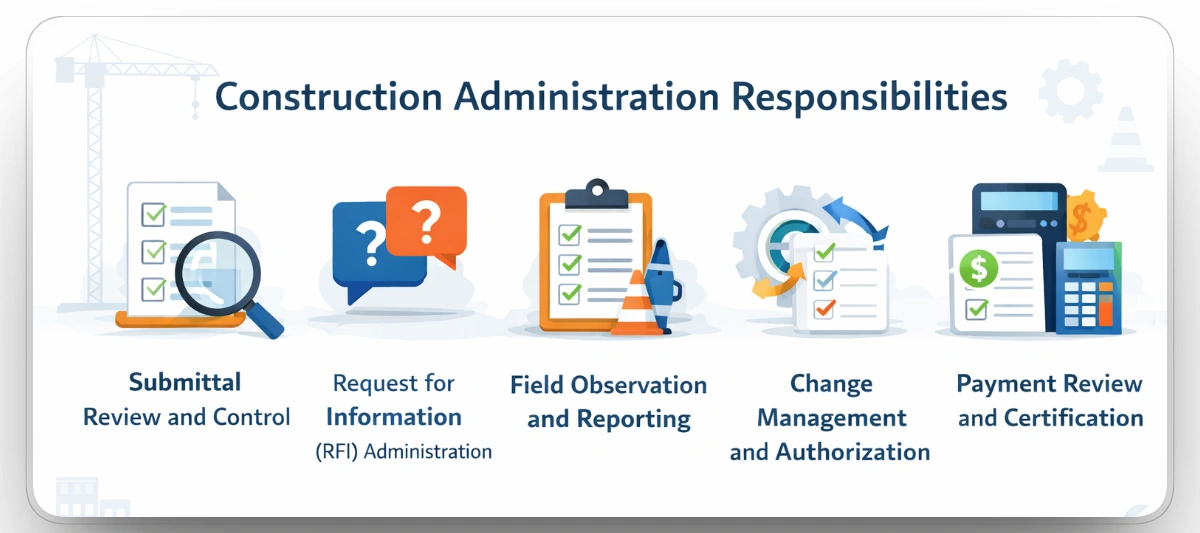
Contract administration duties are not interchangeable with construction management tasks. They focus on governance rather than production.
1. Submittal Review and Control
Submittal review verifies that proposed materials, assemblies, and systems conform to specifications and design intent. Administrators evaluate compatibility, not installation quality.
Technically, this process checks:
- Performance criteria alignment
- Dimensional coordination
- System interfaces
- Code compliance references
- Approved alternates or substitutions
2. Request for Information (RFI) Administration
RFIs are formal clarification tools, not informal questions. Each RFI represents potential risk if mishandled.
Project supervision ensures that RFIs:
- Receive timely responses
- Do not unintentionally alter scope
- Are documented for future reference
- Preserve design intent
- Avoid contradictory instructions
Failure to manage RFIs properly often leads to rework, schedule disruption, or entitlement disputes.
3. Field Observation and Reporting
Field observation verifies general alignment between constructed work and approved documents. It does not guarantee completeness or replace inspections.
Administrators document:
- Observed deviations
- Work progress alignment
- Conditions affecting compliance
- Items requiring follow-up
Language used in reports must remain factual and neutral to avoid implied acceptance or rejection beyond authority.
4. Change Management and Authorization
Change management is one of the most technically sensitive duties.
Administrators control:
- Change request documentation
- Pricing validation
- Schedule logic assessment
- Approval sequencing
- Record preservation
Unauthorized changes represent a significant source of construction disputes.
5. Payment Review and Certification
Payment certification confirms that work completed aligns with contractual milestones and verified progress.
Administrators review:
- Quantities installed
- Retainage application
- Compliance documentation
- Lien waiver conditions
- Approved change integration
Elements of Construction Administration (CA)
.webp)
Construction Administration (CA) plays a vital role in ensuring the successful execution of a construction project. It provides oversight, ensures compliance with design and contractual agreements, and manages risks throughout the construction lifecycle. The following sections detail the key objectives, duties, and risk management aspects of CA.
1. Core Objectives of Construction Administration (CA)
The core objectives of construction administration serve as the foundation for overseeing the construction process.
- Preserve Design Intent: Ensure that the construction work aligns with the approved design documents, specifications, and any design clarifications.
- Enforce Scope Boundaries: Control the project's scope by overseeing and managing RFIs, change orders, and subcontractor work to prevent scope creep.
- Ensure Compliance: Ensure that all construction activities meet the required building codes, regulatory standards, permits, and inspection criteria.
- Control Finances: Monitor and validate all financial decisions, including payments, change orders, and cost adjustments.
2. Key Duties of Construction Administration (CA)
The duties of construction administration define the specific actions taken to ensure that a project runs smoothly. These duties ensure that every decision is documented, all changes are authorized, and the project stays within its scope, schedule, and budget.
- Submittal Review: Review all proposed materials, assemblies, and systems to verify they conform to the project's specifications and design intent. This ensures that only compatible and compliant components are installed, avoiding costly delays or rework.
- RFI Administration: Manage Requests for Information (RFIs) to ensure that all technical queries are addressed promptly and accurately. This prevents miscommunication, delays, or alterations to the scope that could impact project timelines and costs.
- Field Observation: Conduct regular site inspections to verify that the construction work aligns with approved designs. Document any deviations and provide timely guidance to ensure that any issues are addressed quickly and the project stays on track.
- Change Management: Oversee and document all changes to the project scope. Ensure that changes are properly evaluated, priced, and authorized before implementation, with clear communication to all stakeholders to avoid conflicts or unapproved modifications.
- Payment Certification: Review and certify payment requests based on verified work completed. Ensure that payments correspond to the progress and contractual terms, maintaining transparency and financial accountability throughout the project.
3. Risk Management in Construction Administration (CA)
Risk management is a key function of Construction Administration, as it mitigates the potential for disputes, delays, or cost overruns. Effective CA identifies risks early and implements strategies to minimize their impact throughout the project lifecycle.
Punch Lists and Snag Lists in Construction Administration
Punch lists represent the final verification mechanism. They document incomplete or non-conforming items identified during final inspections.
Functional Requirements of a Construction Administration Software

Construction coordination software must enforce consistency rather than add complexity. Effective platforms support administrative control through structured workflows.
Essential Capabilities
- Controlled document distribution
- Version tracking
- Approval routing
- Role-based access
- Time-stamped actions
Without these capabilities, administrative decisions lose enforceability.
Workflow Enforcement Through Software
Software enables:
- Mandatory response fields
- Conditional approvals
- Escalation alerts
- Status tracking
- Centralized records
This reduces reliance on email chains and personal memory.
Enhancing Construction Administration Through Streamlined Operations

In any construction project, visibility, accountability, and control are paramount. Tools that enhance these elements are critical for maintaining smooth operations, particularly during the construction phase.
With Clue, construction administrators can access real-time updates and critical data, ensuring alignment with the project’s goals and timely decision-making.
1. Operational Insight and Task Management
Project management requires constant monitoring of site activities to ensure compliance with design specifications and contractual agreements. By offering a single point of access for work order creation, assignment, and completion tracking, teams are able to stay aligned with objectives. Prioritize tasks and track completion to keep equipment ready and projects on schedule.
2. Digital Inspections and Accurate Documentation
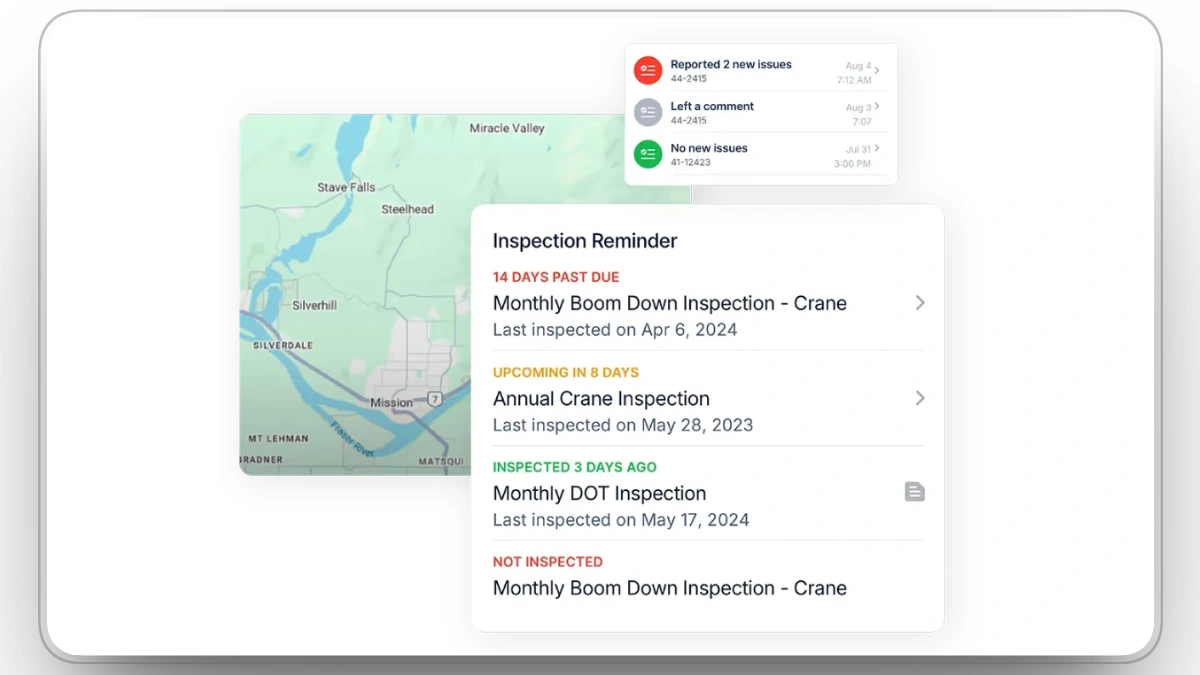
Administrators are responsible for ensuring that all aspects of construction meet both regulatory standards and contractual obligations. Digital tools that allow for on-site inspections, with real-time data entry and photo documentation, reduce the risk of missed observations. Real-time issue tracking ensures timely task closure and enhances accountability, streamlining handoffs for final inspections or project closeout.
3. Asset Tracking and Preventive Maintenance
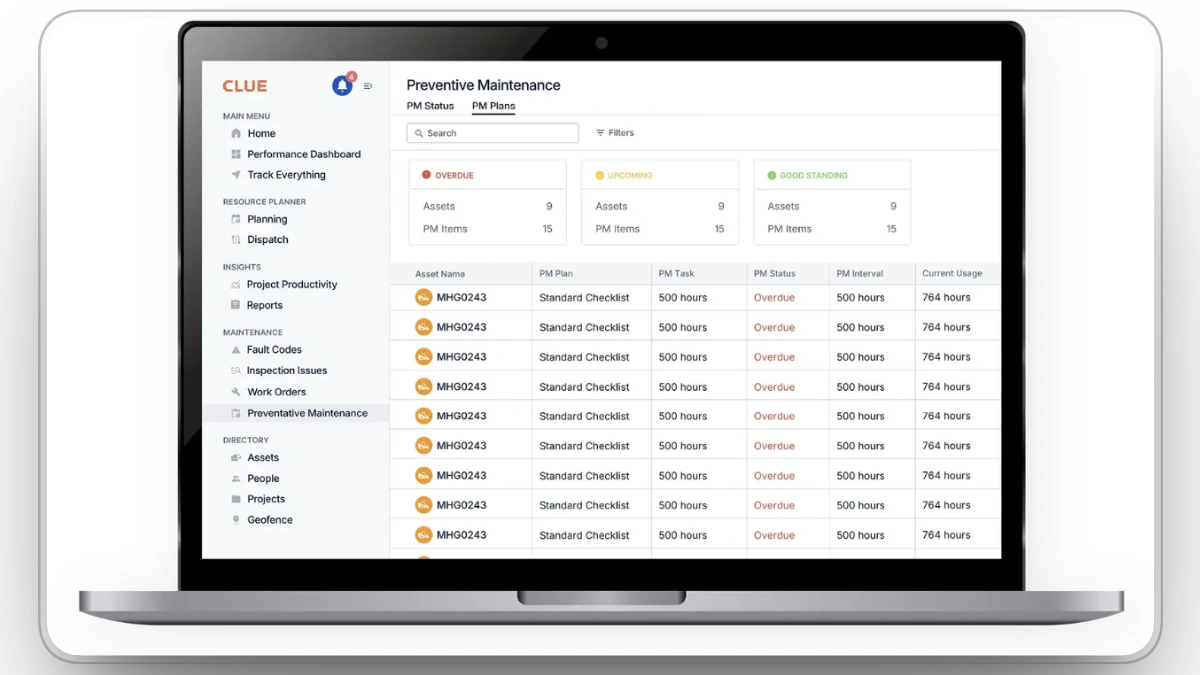
An often-overlooked aspect of administration is construction equipment management softwaresuring all equipment is properly maintained and ready for use. By keeping up-to-date records on equipment condition and preventive maintenance schedules, administrators are better equipped to avoid delays caused by breakdowns or inefficiencies.
4. Improved Communication Between Field and Office

In site coordination, seamless communication between field teams and project managers is essential to mitigate risks and address issues proactively. By having a centralized, mobile-friendly platform, field teams can submit progress updates, inspections, and issues directly into the system.
5. Streamlined Reporting and Decision Making
Data captured on-site can easily be converted into meaningful reports, giving administrators valuable insights into the project’s progress. This helps in decision-making, whether adjusting timelines, allocating resources, or managing change orders. Real-time analytics further enhance the ability to act swiftly and effectively, particularly when dealing with unexpected challenges.

Construction Administration Techniques for High-Risk Projects
High-risk projects demand tighter administrative controls.
Phased Control Techniques
Administrators apply phased controls by:
- Increasing inspection frequency during critical work
- Shortening response timelines
- Elevating approval thresholds
These techniques align administrative rigor with exposure level.
Evidence-Based Decision Making
Every administrative decision should be supported by documented evidence.
This includes:
- Drawings
- Specifications
- Test results
- Field observations
- Contract references
Evidence-based administration limits subjective interpretation.
Common Challenges in Construction Execution

Even structured systems face execution challenges.
1. Information Latency
Delayed responses disrupt sequencing. Administrators must manage response timelines proactively. If approval or decision timelines are not met, project schedules and work sequences can be thrown off track, potentially causing delays across the entire project.
2. Authority Ambiguity
Unclear approval authority leads to unauthorized commitments. When authority lines are not clearly defined, stakeholders may act without the necessary authorization, resulting in scope creep or overspending.
3. Documentation Overload
Volume without structure reduces usability. Too much unorganized documentation can overwhelm project teams, making it difficult to find critical information when needed. Implementing standardized templates, digital document management systems, and categorizing documents based on their relevance can improve the efficiency of data retrieval.
4. Field Resistance
Administrative controls must be practical to gain adoption. When construction workers and contractors feel administrative processes are cumbersome or irrelevant to their daily tasks, they may resist adherence.
5. Rigid Administration
Effective contract administration balances rigor with usability. While it is essential to have a detailed and structured approach to managing a project, overly rigid or cumbersome processes can lead to inefficiencies and frustration among project teams.
Best Practices for Construction Administration Execution

High-performing teams apply consistent execution practices.
- Clear Authority Definition: Roles and limits must be contractually defined. Clear authority definition ensures that all parties understand who is responsible for making decisions and approving various stages of the project.
- Standardized Processes: Templates and workflows reduce variation. Standardized processes are crucial for ensuring consistency across all phases of site management.
- Early Issue Escalation: Small issues addressed early prevent compounding impact. Catching and addressing minor issues before they escalate is critical to maintaining timelines and budgets.
- Continuous Record Maintenance: Records must be updated in real time, not retroactively. Real-time updates to records are essential to be effective. Keeping records accurate and up-to-date throughout the project ensures that there is no lag in information sharing and decision-making.
Long-Term Value of Construction Administration
The value of administration in construction extends beyond project completion.
It contributes to:
- Reduced litigation
- Lower lifecycle maintenance cost
- Higher asset reliability
- Improved stakeholder trust
- Repeat business opportunities
Projects with disciplined administration close faster and perform better post-handover.
Final Conclusion
Administration in construction exists because construction projects are inherently complex, contractual, and risk-laden. It provides the structure needed to translate approved designs and agreements into built reality without erosion of scope, quality, or accountability.
In an industry where mistakes are expensive and permanent, construction administration is the discipline that keeps execution aligned with intent. Leverage Clue’s real-time insights and streamlined task management to stay aligned with your goals and keep your projects on track.
FAQs
What is the primary role of administration in a project?
Project control ensures that the construction phase of a project aligns with the approved design, contractual obligations, and regulatory requirements. It verifies compliance, records decisions, and manages scope changes, all to reduce risks and ensure successful project completion.
How does construction administration differ from construction management?
While both roles focus on overseeing construction projects, construction management specifically handles compliance, documentation, and decision-making to ensure that the project follows the approved design and contractual terms.
Why is timely decision-making crucial in construction administration?
Delayed decisions during construction administration can lead to project disruptions, miscommunications, and increased costs. Quick and documented decisions help ensure that work progresses according to plan, reducing the risk of delays and cost overruns.
How does Clue support administration efforts?
Clue simplifies administration by centralizing task management, tracking progress, and enabling real-time reporting. Its platform allows administrators to monitor compliance, manage RFIs, and ensure timely decision-making, thereby enhancing visibility and control over project execution.
What are the key objectives of construction administration?
The core objectives include preserving design intent, enforcing contractual scope, maintaining regulatory compliance, controlling financial authorization, and documenting decision history. These objectives ensure that the project stays on track, aligns with agreements, and minimizes risks.
What challenges are common in administration in the construction industry?
Common challenges include information latency, authority ambiguity, documentation overload, and field resistance. Contract administration must address these issues by establishing clear authority lines, reducing unnecessary documentation, and implementing practical processes to gain field team adoption.
What tools can enhance construction administration?
Administration in construction can benefit from software like Clue, which provides real-time data, improves communication, tracks compliance, and centralizes documentation. These tools streamline workflows, reduce delays, and ensure that construction projects run efficiently and within the specified guidelines.
Transform Your Equipment Management
%20(1).webp)


